
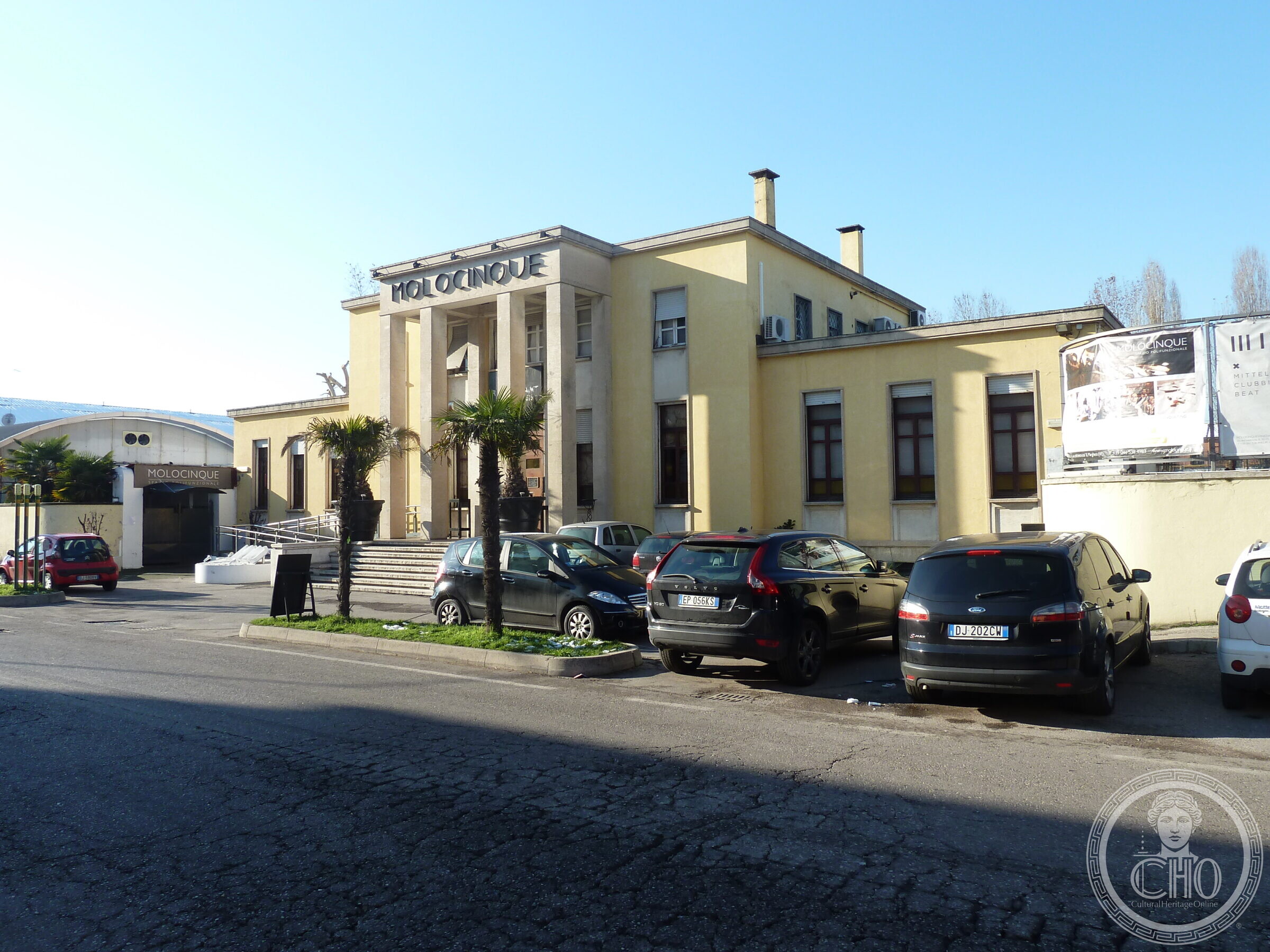
Built in the nineteen-thirties as the after-work club of the Porto Marghera works, with a garden and a small pool behind it. The building is still doing the same job, for a different century.
At a glance
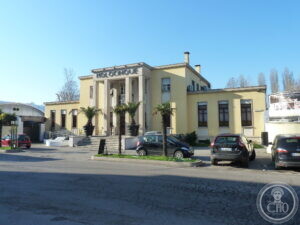
In Via dell’Elettricità, among the works and warehouses of Porto Marghera, stands a symmetrical yellow pavilion with a raised centre and a stepped parapet. It was built in the thirties as a dopolavoro — the after-work club that Italian industry of the period provided for its employees, with a hall, a bar, a garden and a pool. Today it is a nightclub called Molocinque, and the name is up on the parapet where the old one used to be.
Key facts
- Where: Via dell’Elettricità 8–10, 30175 Marghera, Venice
- Built: in the 1930s, as a dopolavoro, the after-work recreation club of the Porto Marghera works
- What you see: a symmetrical front with a raised central block, a stepped parapet, and an entrance framed by flat pilaster strips; yellow render throughout
- Behind it: a large garden with a small swimming pool
- Now: the Molocinque club, in use winter and summer
History
The Opera Nazionale Dopolavoro was set up in 1925 and by the thirties every large Italian works had its club: a hall for meetings and dances, a bar, sports grounds, sometimes a cinema. Porto Marghera, which had been laid out from 1917 as the industrial port of Venice on the mainland, got one too, in the middle of the works and a short walk from the residential quarter.
The building survived the purpose that made it. It has been a music venue for years, and the garden with its pool is still used in the summer. Which works it belonged to, and who designed it, we could not establish from any source we could reach: locally it is remembered as the Dopolavoro of the steelworks.
What you see
A long low block with a taller centre, the whole thing rendered in pale yellow. The centre is framed by flat vertical strips that run up past the eaves into a parapet stepped like a low pediment, and the entrance sits under it behind a short flight of steps. To the sides the walls are plain, with tall rectangular windows set in shallow recesses and a projecting string course at the head. There are no mouldings and no ornament.
It is a building whose character comes entirely from proportion and from the way the centre is lifted — the standard grammar of Italian public building between the wars, applied to a works club.
Do you know more?
On this page we have published what can be seen and what we were able to verify. About which works this Dopolavoro belonged to, and who designed it we could not find a reliable source. If you know something — a name, a date, the architect, the family who lived there, an old photograph, a document, a book that mentions it — write to Sofia, who looks after these pages.
Write to Sofiaor send a message on WhatsApp
Please start your message with the title of this page, so it reaches the right file. Every contribution is checked against independent sources before it goes on the page, and we always say where a piece of information came from.
Practical information
- The building is a working club and is open when the club is open; the outside is seen from the street.
- Check the venue’s own listings before travelling.
Getting there
Via dell’Elettricità runs through the industrial zone of Porto Marghera on the mainland, reached by bus from Venezia Mestre or from Piazzale Roma.
Nearby
- The houses on Via Zambeccari, in the residential quarter.
- The Fondazione Enzo e Silvio Chiari building, in Via Fratelli Bandiera.
Sources
- The photographs — the front, the lettering and the side, photographed on 10 December 2012.
- OpenStreetMap and Nominatim — Molocinque, Via dell’Elettricità 8–10, Marghera, Venice, 30175, and the coordinates.
- Venue listings describing the building as the former Dopolavoro, a typical building of the 1930s, with a large garden and a small pool.
- Stefano Vigolo, who photographed the building and dates it to the 1930s.
Gallery
Photograph by Stefano Vigolo, 2012.
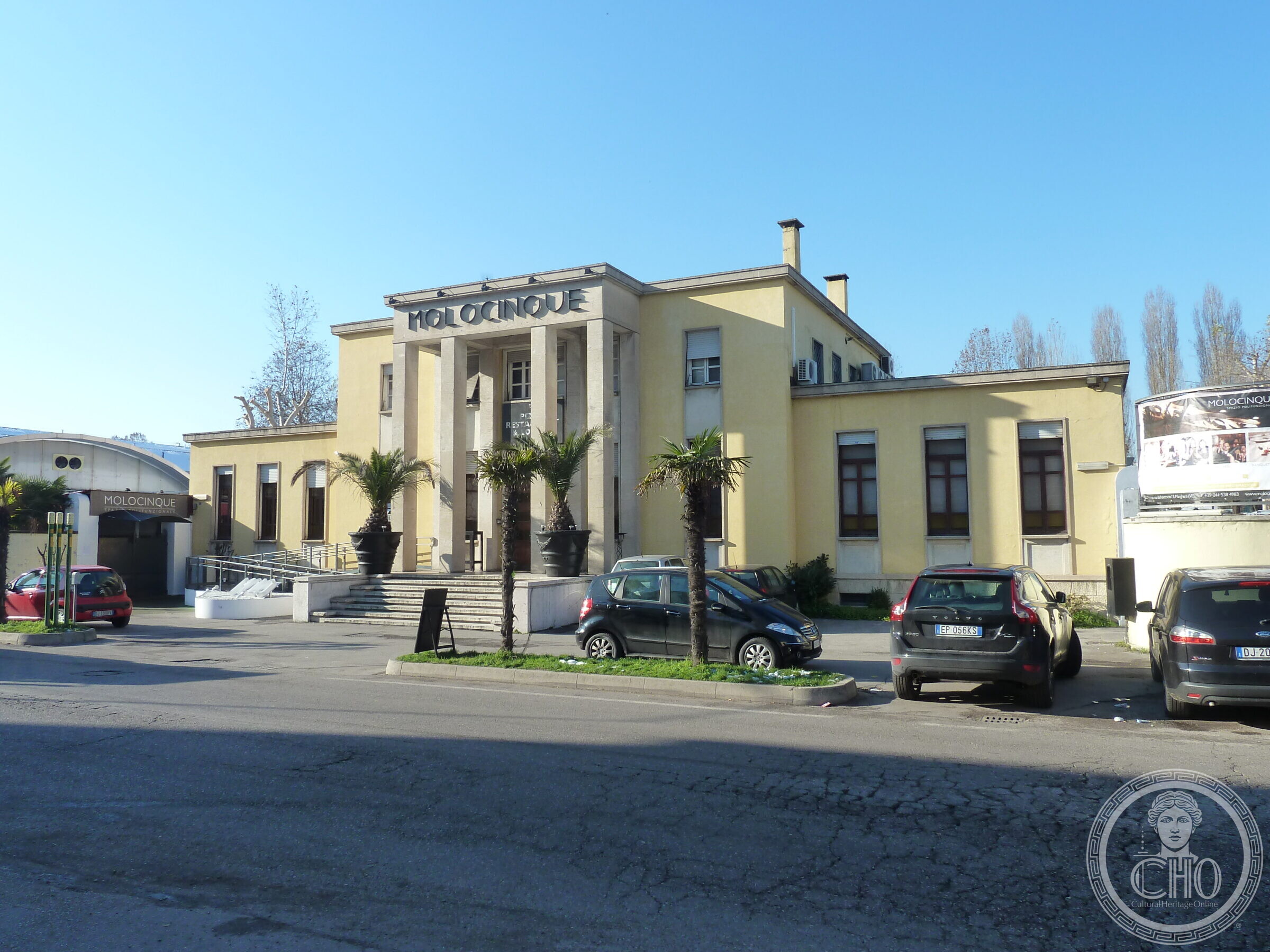
Find it on the map
See this place and what’s around it →Record researched and written by Stefano Vigolo for Cultural Heritage Online, 2026.
📷 Become a Cultural Heritage Online photographer
Share your photos of places: they stay published under your name as the author. The more they're seen, the more you get noticed — and soon a contest will reward the most appreciated photos.
Log in or sign up free to add a photoRequest to use these images
Each photograph is by the person named on it. Cultural Heritage Online is the seller: it runs the payment, handles tax and delivers the file, and the photographer receives 70% of the price net of tax. Buying gives you the right to use the image in your own project — a website, an article, a presentation — with the file and a written licence. Read the Terms of Sale.
What you receive. The file as it is held in our archive: the photographer's own original, without the Cultural Heritage Online watermark, unretouched and not enlarged. This is a working archive built over many years by many people, so the files differ — some were taken recently, others years ago with the equipment of their time. Older pictures are usually smaller: a camera from fifteen or twenty years ago simply recorded fewer pixels than a phone does today, so the resolution is lower and the print comes out smaller. We say so rather than hide it. The size, weight, format and year of each one are printed below it, and the print size is given at 300 dpi. Nothing is upscaled to make a number look better. Where the picture on this page has been cropped for the layout, the file you receive is the full frame, which may be wider or taller than what you see here.
Molocinque
Photo: Stefano Vigolo
€3.00
4000 × 3000 px · JPG · 4.8 MB
prints 34 × 25 cm at 300 dpi · taken 2012
Molocinque
Photo: Stefano Vigolo
€3.00
4000 × 3000 px · JPG · 4.7 MB
prints 34 × 25 cm at 300 dpi · taken 2012
Is this page about you?
This page is read by travellers and heritage enthusiasts who find it on Google. Tell us how you are connected to this place and we will take it from there.