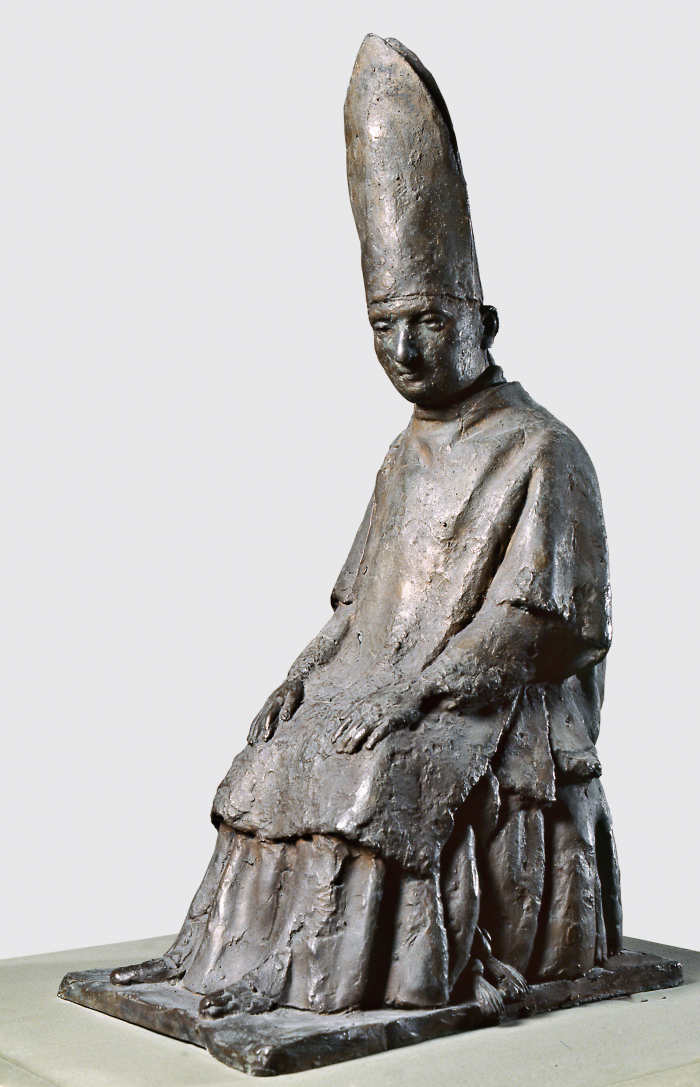
Il cardinale is a sculpture by Giacomo Manzù, created in 1937–38. The work dates to the period when Manzù had recently achieved national recognition following his exhibition of busts at the 1933 Triennale di Milano.
Manzù was born in Bergamo in 1908 and was largely self-taught in sculpture, receiving only occasional evening art classes before developing his craft through independent study and practical work. After military service in Verona in 1928, he moved to Milan, where architect Giovanni Muzio engaged him to execute decorative sculpture for the Università Cattolica del Sacro Cuore chapel (1931–1932). By the mid-1930s, Manzù’s figurative approach had established him as a significant voice in Italian sculpture.
About Giacomo Manzù
Manzù’s career spanned from the interwar years through the postwar period until his death in 1991. The son of a shoemaker and sacristan, he combined formal innovation with religious and humanistic subject matter. His early work in relief and portraiture gave way to increasingly ambitious thematic cycles, notably his bronze bas-reliefs on the Passion of Christ, begun in 1939.
Details
- Creator: Giacomo Manzù (1908–1991)
- Date: 1937–38
- Medium: Sculpture
On video
Frequently asked questions
Who was Giacomo Manzù?
Giacomo Manzù was an Italian sculptor born in Bergamo in 1908. Largely self-taught, he rose to national prominence after exhibiting at the 1933 Triennale di Milano and went on to become a professor and major figure in twentieth-century Italian art, working until his death in 1991.
What period does this work belong to?
Created in 1937–38, Il cardinale dates to the Italian interwar period, when Manzù was consolidating his reputation as a figurative sculptor with a distinctive approach to portraiture and religious subject matter.
What materials did Manzù typically use?
Manzù worked in various materials including wood, which he first used during military service in 1928, and bronze, which became central to his practice in later decades, particularly for his relief cycles.
Sources
- S1 — Panzetta, Alfonso. Nuovo dizionario degli scultori italiani dell'Ottocento e del primo Novecento. AdArte, 2003. ISBN 978-88-422-1158-7.
- S2 — Pontiggia, Elena. Il Novecento Italiano. Abscondita, 2003. ISBN 978-88-8416-048-5.
Spotted an error? Write to editorial@culturalheritageonline.com and we correct it the same day.