
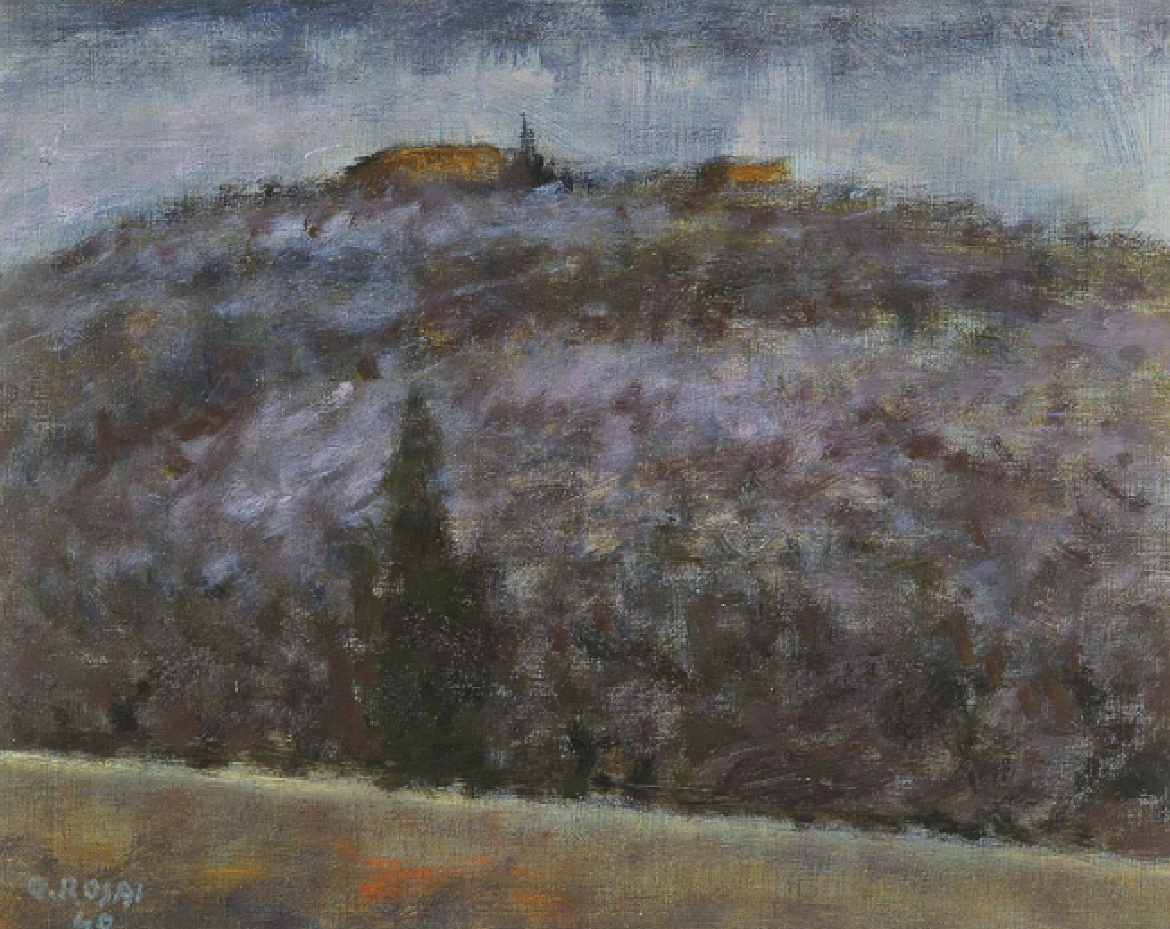
Crepuscolo is a painting created by Ottone Rosai in 1940. Rosai was a Florentine painter (1895–1957) whose career spanned early twentieth-century Italian modernism, from Futurism through the Novecento movement.
Born in Florence, Rosai graduated from the Florence Academy of Fine Arts in 1912 and initially aligned with the city’s Lacerba group of Futurists, exhibiting with critic and painter Ardengo Soffici at the Galleria Sprovieri in Rome in 1914. After service in World War I—during which he earned military decorations—Rosai adopted the aesthetic philosophy of return to order that defined the interwar period. He devoted himself to the study of early Italian masters and became an established presence in Italy’s artistic institutions, participating in the Seconda Mostra del Novecento Italiano in Milan in 1929 and subsequently in the Venice Biennale.
About Ottone Rosai
Rosai’s career reflected the broader trajectory of Italian modernism in the twentieth century. Beyond painting, he contributed to the influential magazine Il Selvaggio from 1926 onward, and his work was championed by important critics and gallery directors of the period, including Edoardo Persico, who organized a solo exhibition at the Galleria del Milione in 1930.
Details
- Artist: Ottone Rosai (1895–1957)
- Year: 1940
- Birthplace and principal city: Florence
- Artistic movements: Futurism, Novecento Italiano
Explore more: 118 heritage places in Firenze
Frequently asked questions
Who was Ottone Rosai?
Ottone Rosai was an Italian painter born in Florence in 1895. He was associated with the Lacerba Futurist group early in his career, then adopted the return-to-order aesthetics of the Novecento Italiano movement, becoming a prominent figure in interwar Italian modernism.
What movements did Rosai work in?
Rosai began as a Futurist in Florence before World War I, then transitioned to the Novecento Italiano movement after the war, a shift that reflected broader European artistic trends toward classical tradition and figuration.
When did Rosai create major works?
Rosai held his first solo exhibition in 1920 at Palazzo Capponi in Florence and gained international recognition through participation in the Venice Biennale and the Seconda Mostra del Novecento Italiano in 1929.
Sources
- S1 — Cavallo, Luigi. Ottone Rosai: L'opera completa. Mondadori, 1973. ISBN 978-88-04-11005-7.
- S2 — Fossati, Paolo. Valori Plastici 1918–1922. Einaudi, 1981. ISBN 978-88-06-05206-5.
Spotted an error? Write to editorial@culturalheritageonline.com and we correct it the same day.


