
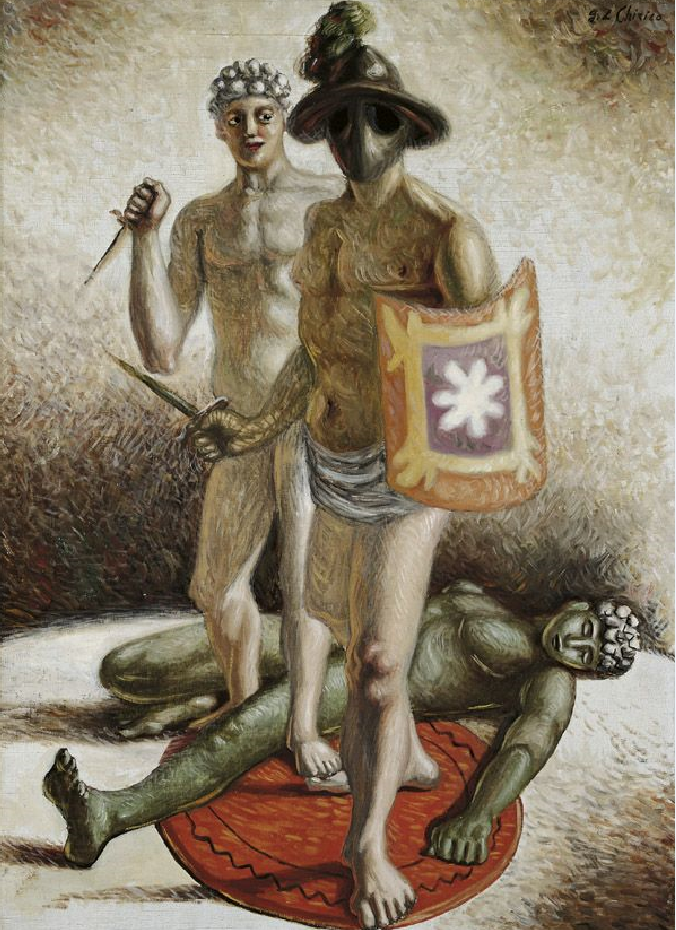
Gladiatori is a painting created by Giorgio de Chirico in 1929. The work belongs to the Metaphysical art movement, which de Chirico founded in the years before World War I and which would profoundly influence the Surrealists.
De Chirico’s visual language—evident in this composition—draws from classical and mythological sources. His paintings characteristically employ Roman arcades, elongated shadows, and perspectives that defy rational spatial logic. These formal strategies reflect de Chirico’s deep engagement with the philosophy of Arthur Schopenhauer and Friedrich Nietzsche, as well as his fascination with the mythology of his native Greece.
About Giorgio de Chirico
De Chirico was a Greek-Italian artist and writer born in Volos, Greece. Through his founding of the Metaphysical school, he created a visual vocabulary that would reshape twentieth-century art, moving away from naturalism toward a dreamlike, philosophical aesthetic rooted in classical antiquity and existential questioning.
Details
- Artist: Giorgio de Chirico
- Year: 1929
- Movement: Metaphysical art (Scuola Metafisica)
- Subject: Classical gladiatorial imagery
On video
Frequently asked questions
Who was Giorgio de Chirico?
Giorgio de Chirico was a Greek-Italian artist and writer born in Volos, Greece, who founded the Metaphysical art movement before World War I. His work profoundly influenced the Surrealists and explored themes of classical mythology, philosophy, and illogical spatial perspective.
What is Metaphysical art?
Metaphysical art (Scuola Metafisica) is an art movement founded by de Chirico that moved beyond naturalism toward a dreamlike, philosophical aesthetic. His works characteristically feature Roman arcades, long shadows, mannequins, trains, and perspectives that defy rational space.
What themes appear in de Chirico’s work?
De Chirico’s imagery reflects his affinity for the philosophy of Schopenhauer and Nietzsche, as well as his deep connection to Greek and Roman mythology. Classical and antiquarian subjects, including gladiatorial imagery, frequently appear in his compositions.
Sources
- S1 — Pontiggia, Elena. Il Novecento Italiano. Abscondita, 2003. ISBN 978-88-8416-048-5.
- S2 — Bossaglia, Rossana. Il Novecento italiano. Electa, 1995. ISBN 978-88-435-6178-0.
Spotted an error? Write to editorial@culturalheritageonline.com and we correct it the same day.


