
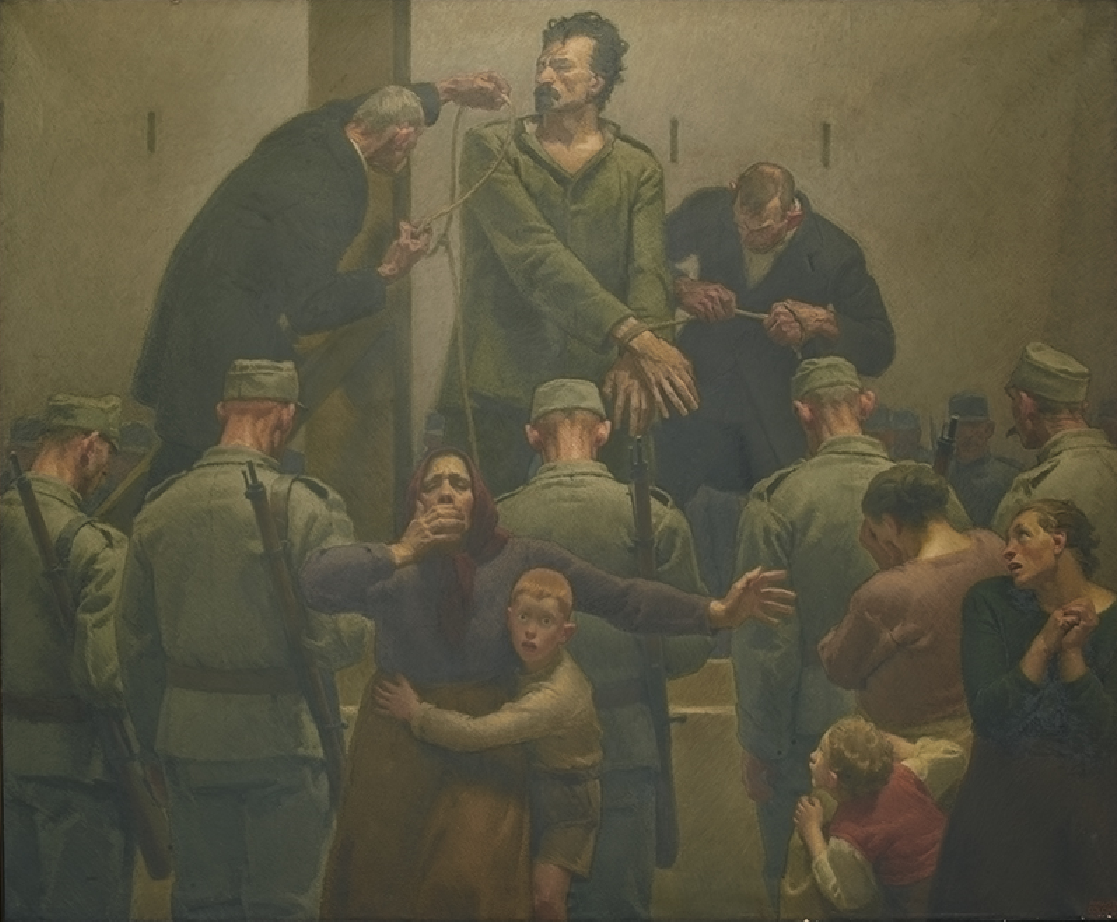
Augusto Colombo’s Martirio di Cesare Battisti is a 1940 painting depicting the martyrdom of Cesare Battisti. Created during the artist’s most politically engaged period, the work represents Colombo’s commitment to large-scale compositions exploring historical and social subjects.
Colombo worked in the tradition of Italian figurative painting, combining narrative clarity with expressive form. During World War II, he produced a series of works documenting the horrors of war, of which this painting forms part. The subject matter—the execution of Battisti, an Italian nationalist—connects to Colombo’s broader antifascist convictions, which defined his artistic and intellectual stance throughout his career.
About Augusto Colombo
Augusto Colombo (1902–1969) was a Milanese painter trained at the Brera Academy under Giuseppe Palanti and Ambrogio Alciati. He received the Cesare Sarfatti Prize in 1924, which supported study in Rome, Florence and Paris. Returning to Milan, he became known for portraits and large-scale compositions addressing social and religious themes. In 1933, he founded an art school that grew to over 800 students during its 36-year existence. A committed antifascist, Colombo played a leading role in postwar Milan’s cultural life, founding the magazine Valori and supporting the Famiglia Meneghina organisation.
Details
- Creator: Augusto Colombo
- Year: 1940
- Subject: Cesare Battisti, Italian nationalist executed during World War I
- Category: Large-scale historical and social composition
Frequently asked questions
Who was Cesare Battisti?
Cesare Battisti was an Italian nationalist whose execution during World War I made him a symbolic figure in Italian history. Colombo’s painting commemorates his martyrdom as a subject of historical significance.
What was Colombo’s artistic approach?
Colombo worked in figurative painting traditions, creating large-scale compositions addressing historical, social and religious subjects. During World War II, he produced works depicting war’s horrors, reflecting his antifascist convictions.
Where did Colombo work and teach?
Based in Milan, Colombo opened an influential art school in his studio in 1933, which operated for 36 years and trained over 800 students. He remained central to Milan’s cultural institutions throughout his career.
Sources
- S1 — Pontiggia, Elena. Il Novecento Italiano. Abscondita, 2003. ISBN 978-88-8416-048-5.
- S2 — Bossaglia, Rossana. Il Novecento italiano. Electa, 1995. ISBN 978-88-435-6178-0.
Spotted an error? Write to editorial@culturalheritageonline.com and we correct it the same day.


