
Curated Itinerary
Ottoman Heritage Trail: Istanbul to the Aegean
The Ottoman Heritage Trail moves from the heart of Istanbul — where Byzantine and Ottoman monuments stand within walking distance of each other — south along…
Take this route into Google Maps
From Rumelihisarı to Selimiye Mosque – Virtual Tour 360°, in the order we curated them.
➤ Turn on the navigator in Google MapsIt opens in the Google Maps app with every stop already loaded, in the order we put them in. From there the route is yours: pick how you travel — on foot, by bike, by public transport or by car — change where you start and where you end, drag the stops into a different order, and add places of your own along the way.
The Ottoman Heritage Trail moves from the heart of Istanbul — where Byzantine and Ottoman monuments stand within walking distance of each other — south along the Aegean coast to the ancient cities and thermal landscapes of western Anatolia. It is a route through one of the world’s longest-occupied urban corridors, where Roman, Byzantine, Seljuk and Ottoman layers accumulate on the same hillsides.
Istanbul alone justifies the journey. The city held the capital of two of history’s most consequential empires — the Byzantine (330–1453 CE) and the Ottoman (1453–1922 CE) — and the monuments of both survive in close proximity around the Sultanahmet district.
Stage 1 — Hagia Sophia (Istanbul)
Hagia Sophia was built in 537 CE as the cathedral of the Byzantine Empire and remained the largest church in the world for nearly a thousand years. Its main dome, 31 metres in diameter and 55 metres above the floor, appears to float on a ring of light — an effect produced by forty windows that make the supporting pendentives invisible from below.
In 1453 Sultan Mehmed II converted it to a mosque. In 1934 Atatürk secularised it as a museum; in 2020 it was reconverted to a functioning mosque. Visitors of all backgrounds are admitted outside prayer times. The interior retains both Byzantine mosaics and Ottoman calligraphic roundels — an unrepeatable architectural palimpsest.
Stage 2 — Blue Mosque (Istanbul)
The Blue Mosque was built between 1609 and 1616 by Sultan Ahmed I, directly across the hippodrome from Hagia Sophia. It takes its popular name from the 20,000 hand-painted Iznik tiles that line the interior, in fifty shades of blue.
It is the only mosque in Istanbul with six minarets. The prayer hall is open to non-Muslim visitors outside prayer times; the courtyard is always accessible.
Stage 3 — Topkapı Palace (Istanbul)
Topkapı Palace was the administrative and residential centre of the Ottoman Empire from the 15th to 19th centuries. Its organisation into four courts reflects a progressive restriction of access: the First Court was public, the Fourth Court essentially private to the sultan.
The Treasury holds the Topkapı Dagger and the Spoonmaker’s Diamond. The Harem section is accessible via separate tour. Views from the palace terrace over the Bosphorus are among the finest urban panoramas in Europe.
Stage 4 — Ephesus (Selçuk, Türkiye)
Ephesus at its height (2nd century CE) had a population of around 200,000 and was the capital of the Roman province of Asia. Its ruins — the Library of Celsus, the Great Theatre (capacity 25,000), the colonnaded Curetes Street — are among the best-preserved in the Mediterranean.
The site carries later layers too: the Basilica of St John (6th century CE), built by Emperor Justinian over what tradition holds to be the apostle’s tomb, and the Isa Bey Mosque (1374), one of the finest examples of Anatolian Seljuk architecture.
Stage 5 — Pamukkale (Türkiye)
Pamukkale — “Cotton Castle” in Turkish — is a thermal site where calcium-rich hot springs have built up over millennia into a cascade of white travertine terraces and natural pools. It has been a place of therapeutic bathing since the Roman period.
Above the travertine lies Hierapolis, a Greco-Roman spa city whose necropolis and well-preserved theatre speak to a long prosperity built on the thermal waters. The two sites are jointly UNESCO-listed and reward a full day.
Satellite Sites Coming Soon
The Basilica Cistern (Istanbul), Süleymaniye Mosque (Istanbul), Selimiye Mosque (Edirne), Safranbolu historic village, and the Green Mosque in Bursa are currently being processed by the CHO curation team and will be added to this itinerary as their place cards are completed.
Practical Notes
- Duration: 7–10 days for Istanbul plus the Aegean sites
- Best season: April–June and September–October; avoid August crowds on the Aegean coast
- Logistics: Istanbul has two international airports; fly to Izmir or take the overnight train for the Aegean section; Pamukkale is 4 hours by bus from Selçuk/Ephesus
- Visa: e-Visa required for most nationalities, available at evisa.gov.tr
- GPS files: Download the GPX or KML for OsmAnd, Garmin, or Google Earth
Get this route — explore at your own pace
The walk and the notes are open to everyone, right here. To take the route with you — the GPX and KML tracks for your phone — you need a CHO account, and a free one is enough. We do not sell these routes: we build them ourselves and give them to the people who read us.
Create a free accountAlready have one? Log in.
This route was built with the tools we give operators.
Guides, associations and cultural operators build their own routes here: pick the stops from the archive, add your notes, and the map, the GPX and the printable version come out on their own. Your programme gets a permanent page, your events go on the city pages people read while planning — and if you sell your route as a road-book or a virtual tour, you receive 80% of the price net of tax.
See how an operator account worksStep by step

Rumelihisarı
A 15th-century Ottoman fortress on Istanbul's Bosphorus shore, built by Sultan Mehmed II to control maritime passage during the siege of Constantinople.

Hagia Sophia
A masterpiece of Byzantine engineering completed in 537, Hagia Sophia's revolutionary pendentive dome created the world's largest interior space…

Blue Mosque, Istanbul
Ottoman imperial mosque in Istanbul famous for its six minarets and interior walls decorated with thousands of blue Iznik tiles. Built 1609–1617 under Ahmed I.

Topkapı Palace – Virtual Tour 360°
The administrative heart and royal residence of the Ottoman Empire from 1459 to 1853, now a museum housing imperial treasures, manuscripts…

Basilica Cistern
The Basilica Cistern is the largest of hundreds of Byzantine underground cisterns beneath Istanbul, built in the 6th century under Emperor Justinian I.

Süleymaniye Mosque
An Ottoman imperial masterpiece atop Istanbul's Third Hill, the Süleymaniye Mosque represents Mimar Sinan's greatest work and dominates the cityscape…

Safranbolu
Ottoman-era bazaar town preserved in a Black Sea ravine with 1,008 registered historical buildings. UNESCO World Heritage site since 1994.
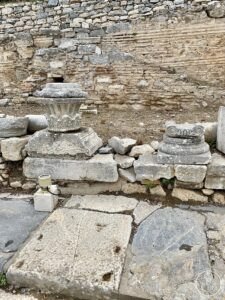
Ephesus – Virtual Tour 360°
Ephesus in Selçuk, Turkey preserves the Library of Celsus, a 24,000-seat theatre and the marble streets of a Roman metropolis, once linked to the Temple of Artemis and the Apostle Paul.

Pamukkale
Pamukkale, or "cotton castle," is a geological and archaeological wonder in south-western Turkey, featuring white travertine terraces and the ruins…
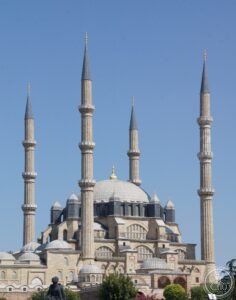
Selimiye Mosque – Virtual Tour 360°
Mimar Sinan's self-declared masterpiece in Edirne, where a dome wider than the Hagia Sophia's rests on eight piers, leaving the prayer hall entirely free of columns.
Download for tour navigation
🔒 The walk and the notes are open to everyone on this page. The files to take with you — the stop list as a PDF, and the GPX and KML tracks for your phone — come with a CHO account, and the free one includes them.
Walk it with the navigator on
It opens in the Google Maps app with every stop already loaded, in the order we put them in. From there the route is yours: pick how you travel — on foot, by bike, by public transport or by car — change where you start and where you end, drag the stops into a different order, and add places of your own along the way.