
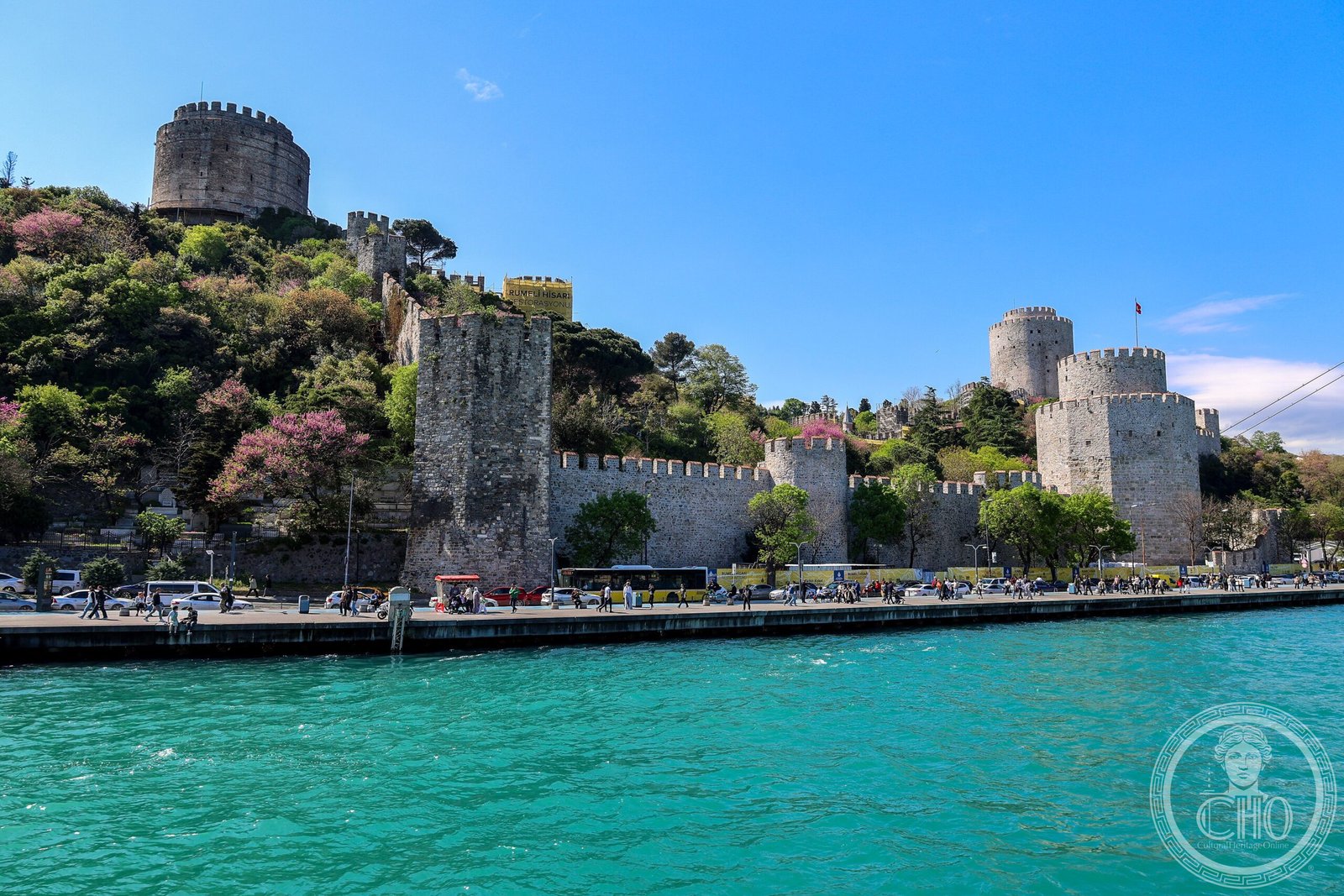
A medieval Ottoman fortress commanding the European shore of the Bosphorus, built to throttle Byzantine Constantinople’s last lifelines before the city’s fall in 1453.
At a glance
Rumelihisarı—also known as the Boğazkesen (Strait-cutter) Fortress—stands on a series of hills overlooking one of the world’s most strategically vital waterways. Constructed in just over a year on the orders of Sultan Mehmed II, it forms part of a two-fortress system that would change the course of history.
History
Built between 1451 and 1452, Rumelihisarı was conceived as an instrument of siege warfare. Mehmed II commissioned the fortress to cut off maritime relief to the Byzantine capital across the Bosphorus. Its counterpart, Anadoluhisarı, sat opposite on the Asian shore; together they formed a noose that would strangle all naval traffic.
The strategy worked. When Constantinople fell to the Ottomans in 1453, Rumelihisarı had already proven its tactical value. After the conquest, the fortress evolved into a customs checkpoint and occasional prison—particularly for enemy embassies during wars. A major earthquake in 1509 caused severe damage, but repairs allowed it to remain in service until the late 19th century.
What you see
The fortress occupies multiple hilltops on the European Bosphorus bank, its stone walls and towers distributed across a dramatic topography. The complex reflects the military engineering priorities of mid-15th-century Ottoman fortress design, adapted to the demanding terrain and strategic requirements of controlling maritime passage.
Cultural significance
Rumelihisarı stands as a monument to a pivotal moment—the final stage of Constantinople’s transformation into Ottoman Istanbul. It embodies both military ingenuity and the geopolitical shift that made the Ottoman Empire master of the Eastern Mediterranean. The fortress’s dual role—as weapon and as administrative center—illustrates how medieval structures served multiple functions within imperial systems.
Key facts
- Country: Turkey
- City: Istanbul
- Constructed: 1451–1452
- Commissioned by: Sultan Mehmed II
- Coordinates: 41.0847, 29.0561
- Alternative names: Boğazkesen Fortress, Rumelian Fortress
Practical information & getting there
Rumelihisarı is now open to the public as a museum. The fortress also functions as an open-air venue for seasonal concerts, art festivals, and special events throughout the year. The neighborhood around it in Sarıyer district is easily reached by public transport or taxi from central Istanbul.
Sources & resources
Find it on the map
See this place and what’s around it →Part of a curated route
This site is one of ten stops on the Ottoman Heritage Trail: Istanbul to the Aegean — a curated CHO itinerary connecting major Ottoman monuments from Istanbul to Edirne. The full route includes downloadable GPX and KML files for navigation.
📷 Become a Cultural Heritage Online photographer
Share your photos of places: they stay published under your name as the author. The more they're seen, the more you get noticed — and soon a contest will reward the most appreciated photos.
Log in or sign up free to add a photoIs this page about you?
This page is read by travellers and heritage enthusiasts who find it on Google. Tell us how you are connected to this place and we will take it from there.