
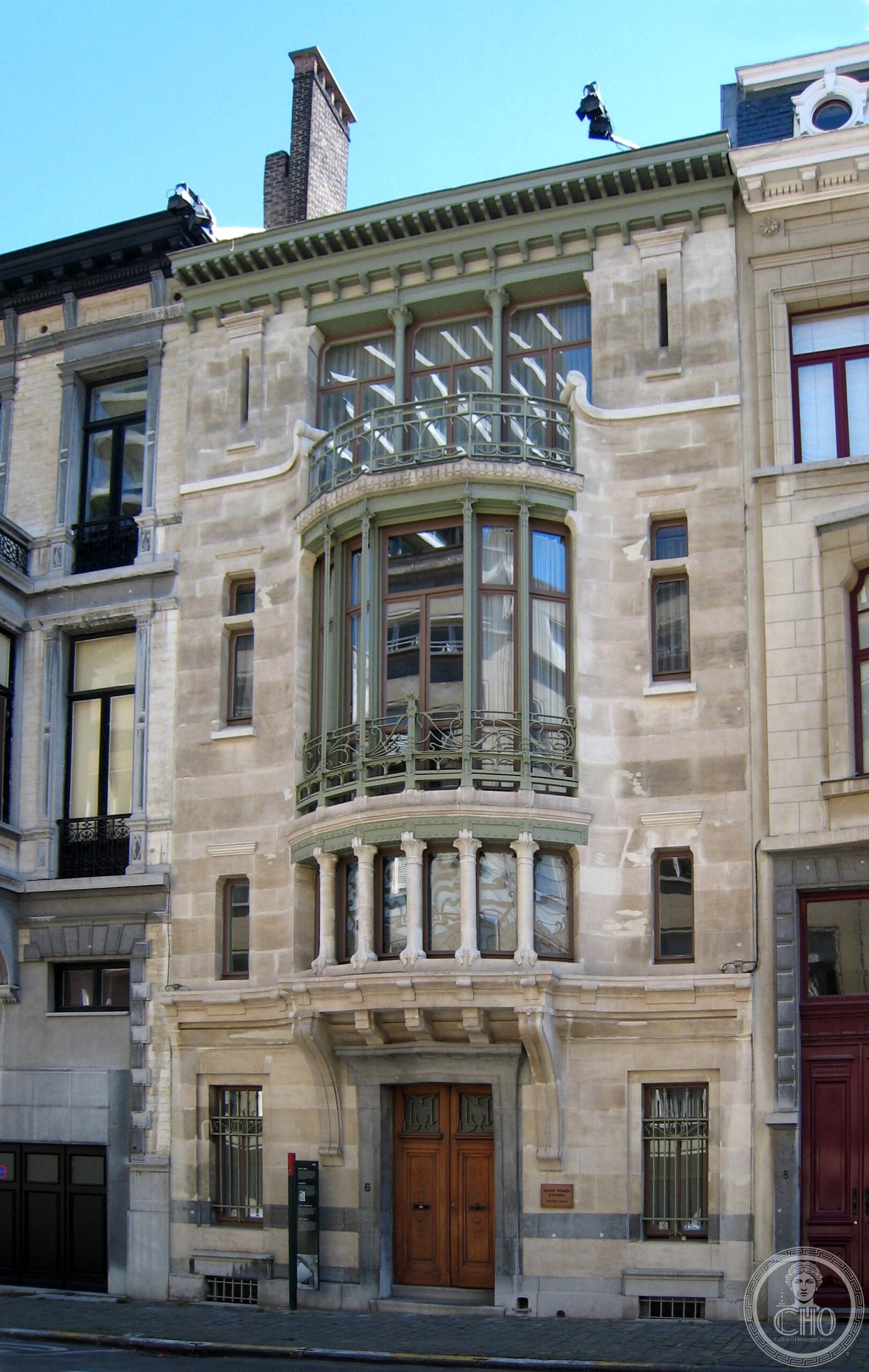
In 1893 Victor Horta completed the Hôtel Tassel on rue Paul-Émile Janson — and with it, invented architectural Art Nouveau. The building’s iron columns, exposed glass ceiling and sinuously tiled floors had no precedent anywhere in Europe.
At a glance
Brussels holds a singular claim in Art Nouveau history: the first building to fully realise the style stands here, on a quiet street in the Ixelles commune. Victor Horta’s Hôtel Tassel (1893) preceded Paris’s Castel Béranger by two years, Olbrich’s Vienna Secession by four. In the decade that followed, Horta designed at least seven more major town houses in Brussels — several of which are now UNESCO-listed — establishing the city as the movement’s architectural laboratory. Today the “Major Town Houses of the Architect Victor Horta” (1898–1906) constitute one of Belgium’s UNESCO World Heritage Sites.
Key facts
- Country: Belgium
- Key period: 1893–1910 (Architectural Art Nouveau)
- Key figure: Victor Horta (1861–1947) — Belgian architect, creator of Art Nouveau’s built vocabulary
- UNESCO heritage: Major Town Houses of Victor Horta (1998) — Hôtel Tassel, Hôtel Solvay, Hôtel van Eetvelde, Maison & Atelier Horta
- Essential sites: Musée Horta (Saint-Gilles), Hôtel Tassel (exterior, Ixelles), Hôtel Solvay (exterior, Avenue Louise), Grand Place (UNESCO)
- Annual anniversaries: Horta nascita 6 gennaio, Horta morte 8 settembre
History
Victor Horta was born in Ghent in 1861 and trained under Alphonse Balat, architect to King Leopold II, before establishing his own practice in Brussels. The commission for the Hôtel Tassel — a private townhouse for the scientist Émile Tassel — gave Horta the freedom to experiment without precedent. He stripped away the historicist facade, exposed the iron structural frame, painted every surface in the plant-stem arabesque he called “the whiplash line,” and opened the interior plan to a flowing spatial sequence that replaced the corridor. European architects who visited were astonished.
Between 1894 and 1900 Horta produced the Hôtel Solvay (Avenue Louise), the Hôtel van Eetvelde (Avenue Palmerston), and his own house and studio in Saint-Gilles — now the Musée Horta. His most ambitious public work, the Maison du Peuple (1899), was a socialist cooperative headquarters of iron and glass that prefigured the functionalism of a decade later. It was controversially demolished in 1965.
Horta survived the First World War in England, returned to Belgium in 1919, and spent the remainder of his career in a more classicising mode — most notably the Palais des Beaux-Arts (1928) and the Central Station (1952, completed posthumously). He died in Brussels in 1947, having bracketed the entire arc of Belgian architectural modernism between the whiplash line of 1893 and the post-war rationalism of his final decade.
What you see
The Musée Horta (25 rue Américaine, Saint-Gilles) preserves the architect’s own house and studio as he left it: the stairwell, with its mirrors, skylight and sinuous iron balustrade, is among the most photographed Art Nouveau interiors in the world. The ground-floor reception rooms retain their original mosaic floors, painted ceilings and fitted furniture — a total artwork in the Jugendstil tradition. The museum is small; book in advance.
The Hôtel Tassel and Hôtel Solvay are private residences and cannot be entered, but their facades are freely visible from the street. A UNESCO-signposted walking route connects all four listed Horta houses within a 2 km circuit of the Ixelles and Saint-Gilles communes. The Grand Place, ten minutes north by tram, rounds out a day with its baroque guild houses and the Hotel de Ville (1402).
Practical information
- Musée Horta: open Tue–Sun 14:00–17:30; admission €10; closed Monday and public holidays
- Grand Place: free, always accessible; best at dawn before the crowds
- Brussels Card: covers public transport and discounts at most museums
- Language: French-speaking commune; most museum staff also speak English and Dutch
- Time needed: half-day for Musée Horta + exterior walking route; full day with Grand Place
Getting there
Brussels Airport (BRU) connects to Brussels-Central and Brussels-Midi by train in 17–22 minutes. Brussels-Midi is also the Eurostar and Thalys hub (London 2h, Paris 1h22, Amsterdam 1h48). From Brussels-Central, tram 92 or 93 runs through Ixelles to Saint-Gilles, stopping within 200 metres of the Musée Horta. The Hôtel Tassel is a 15-minute walk from the Porte de Namur metro station.
Related in CHO
- Anniversario nascita: Victor Horta — 6 gennaio 1861
- Anniversario morte: Victor Horta — 8 settembre 1947
- Paris — Belle Époque, Art Nouveau & Modernism
- Vienna — Capital of the Vienna Secession
Sources
Find it on the map
See this place and what’s around it →Record researched and written by Luigi De Marchi for Cultural Heritage Online, 2026.

Events here — now on & upcoming
- Birth Anniversary: Victor Horta — January 6, 186106 Jan 2027See the event →
- Death Anniversary: Victor Horta — September 8, 194708 Sep 2027See the event →
- Birth Anniversary: Henry van de Velde — April 3, 186303 Apr 2027See the event →
- Death Anniversary: Henry van de Velde — October 25, 195725 Oct 2026See the event →
- Advancing Gender and Diversity Inclusive STEAM Education — Brussels17 Nov 2026See the event →
📷 Become a Cultural Heritage Online photographer
Share your photos of places: they stay published under your name as the author. The more they're seen, the more you get noticed — and soon a contest will reward the most appreciated photos.
Log in or sign up free to add a photo