
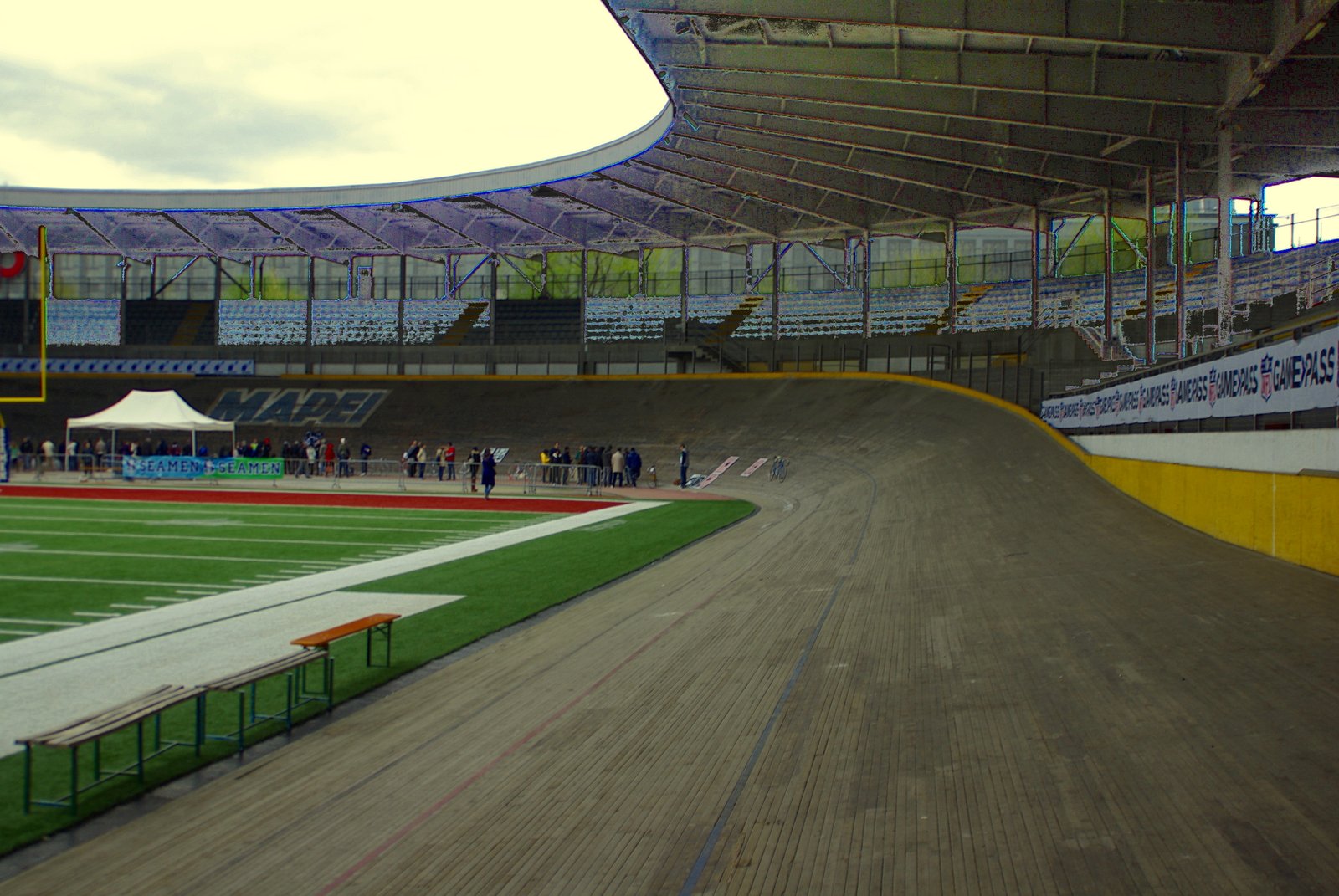
Inaugurated on 28 October 1935 in the Portello district of Milan, the Vigorelli is a 397.27-metre wooden cycling track whose surface absorbed four of the most decisive hour records of twentieth-century road cycling, from Fausto Coppi in 1942 to Roger Riviere in 1957.
At a glance
The Velodromo Vigorelli — officially Velodromo Maspes-Vigorelli since 2001 — is a semi-covered sports arena in north-west Milan, built in 1935 by the bicycle manufacturer Vigorelli and inaugurated on 28 October of that year. Its 397.27-metre wooden track, raked at the curves and laid plank by plank in a long oval, hosted the men’s hour record four times between 1942 and 1957 and the women’s hour record twice in 1958. Today the cycling track sits inside an arena shared with American football: the Seamen Milano and Rhinos Milano play their home matches on the infield, while the planks above them carry the patina of nine decades.
Key facts
- Address: Via Arona 19, 20149 Milano
- Coordinates: 45.4815° N, 9.1581° E
- Inauguration: 28 October 1935
- Track: 397.27 metres, wooden surface, semi-covered
- Current capacity: 7,500 seats
- Heritage status: protected by the Lombardy cultural authority since 2013
- Current use: American football (Seamen Milano, Rhinos Milano) and occasional cycling events
History
The velodrome was commissioned by the Vigorelli bicycle and motorcycle company on a plot in the Portello quarter of north-west Milan. The track was inaugurated on 28 October 1935 with Giuseppe Olmo’s hour record of 45.090 kilometres — the first of a long sequence that would make the plank surface a place of pilgrimage for road riders looking to convert form into history.
On 7 November 1942, in the middle of the Second World War, Fausto Coppi rode 45.798 kilometres in sixty minutes. The mark stood for fourteen years. On 29 June 1956 the French Jacques Anquetil pushed it to 46.159 kilometres; less than three months later, on 19 September, Ercole Baldini reached 46.393. On 18 August 1957 Roger Riviere extended the record to 46.923 kilometres on the same boards. Two women’s records followed in 1958: Millie Robinson on 25 September with 39.718 kilometres, and Elsy Jacobs on 9 November with 41.347.
The track survived the war damaged but not destroyed — incendiary bombing in 1943 wrecked the surface, and the wooden oval was rebuilt in 1946. The roof was less fortunate: heavy snowfall in 1985 brought it down, and the venue has remained semi-covered since. Track cycling competitions effectively ended in 2001, the year the arena was renamed Maspes-Vigorelli in honour of the Milanese sprinter Antonio Maspes. In 2013 the Lombardy regional cultural authority declared the structure a heritage building, blocking demolition projects that had circulated for two decades.
What you see
The velodrome is read from the outside as a long shed: a low perimeter wrapping an oval volume, with the entrance on Via Arona and the bulk of the structure pushing back toward the Monte Stella park. The interior is dominated by the wood. The track surface is built from narrow longitudinal planks fixed to a curved timber sub-structure, the joints running with the direction of travel; on the two long straights the slope is moderate, but at the curves the boards rise into a steep banking that a rider in the saddle reads less as a slope than as a wall.
Around the oval, the grandstands step back in tiers under the partial roof, their concrete bones darkened by eighty years of city air. The infield, originally open earth, is today marked out as an American football pitch, and the chalk lines of the gridiron cross the inner edge of the track in a juxtaposition that says, in one glance, what the building has become — a sports cathedral that outlived its original liturgy and now shelters another.
Practical information
- Open to the public on event days only (American football season, cycling fixtures); no permanent visitor schedule.
- Check the Seamen Milano and Rhinos Milano calendars for game days from spring to early autumn.
- Comfortable shoes recommended; the concrete stands are uncovered in places.
- Allow one to two hours for a match or event; no regular guided tours outside organised heritage open days.
Getting there
The Vigorelli sits in the Portello district of Milan, a short walk from the Lotto metro stop on the M1 red and M5 lilac lines. From Milano Centrale it is roughly fifteen minutes by metro on the M5 to Lotto, then five minutes on foot along Via Arona. By car, the nearest paid parking is at Piazzale Lotto.
Nearby
- Monte Stella — the artificial hill built from Second World War rubble, a short walk west.
- Stadio Giuseppe Meazza (San Siro) — one metro stop or twenty minutes on foot.
- CityLife district — the Hadid, Isozaki and Libeskind towers, around twenty minutes east on foot.
Sources
- Velodromo Vigorelli — Wikipedia (English)
- Velodromo Maspes-Vigorelli — Wikipedia (Italian)
- Velodromo Vigorelli — Wikimedia Commons
- Soprintendenza Archeologia, Belle Arti e Paesaggio per la Citta Metropolitana di Milano — heritage declaration, 2013
Find it on the map
See this place and what’s around it →Record researched and written by Stefano Vigolo for Cultural Heritage Online, 2026.
📷 Become a Cultural Heritage Online photographer
Share your photos of places: they stay published under your name as the author. The more they're seen, the more you get noticed — and soon a contest will reward the most appreciated photos.
Log in or sign up free to add a photoIs this page about you?
This page is read by travellers and heritage enthusiasts who find it on Google. Tell us how you are connected to this place and we will take it from there.