
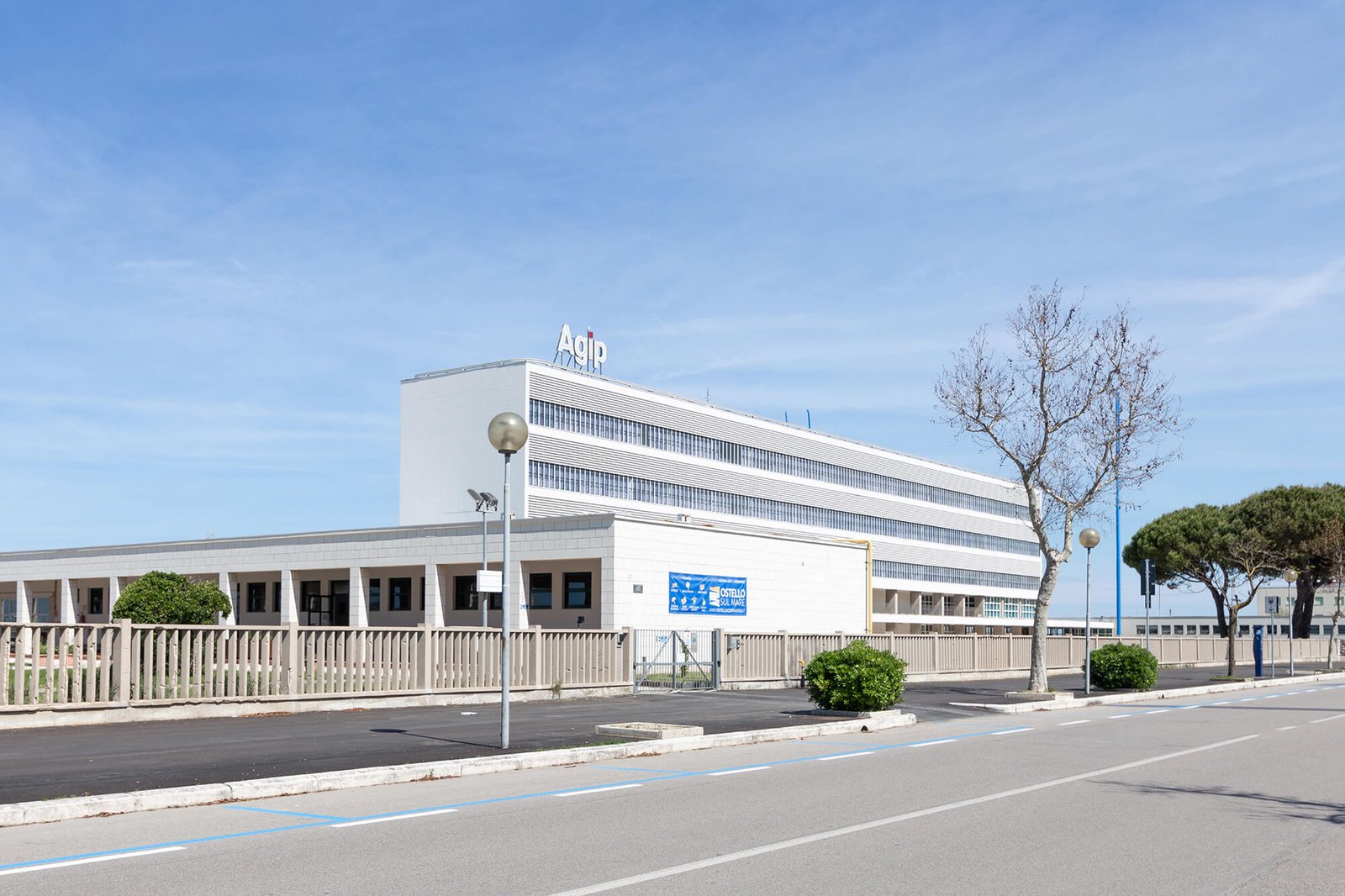
One of the great rationalist summer colonies of the Adriatic, raised on pilotis for the children of an oil company — and, unlike its neighbours, still alive.
At a glance
Stretched along the Cesenatico seafront, the Colonia AGIP is one of the clearest statements of Italian rationalism on the coast. The Bolognese architect Giuseppe Vaccaro built it in 1937–1938 for the summer holidays of the children of AGIP employees, the state oil company. Four building bodies cover an area of 270 by 80 metres; the central block lifts four floors toward the sea. Where most colonies of its generation now stand abandoned, this one survives, still owned by ENI and still in use.
Key facts
- Built: 1937–1938
- Architect: Giuseppe Vaccaro
- Built for: AGIP, as a summer colony for employees’ children
- Capacity: up to 800 children
- Layout: four bodies over a 270 × 80 m site; four-storey central block on pilotis
- Owner today: ENI — still in use as a summer colony
- Recognition: part of the European ATRIUM route; opened on FAI heritage days
History
The colony was commissioned by Umberto Puppini, then president of AGIP, for the children of the company’s workers. It belonged to the wide programme of summer colonies promoted under the Fascist regime, and on completion it was dedicated to Sandro Italico Mussolini, a nephew of the dictator who had died young — a naming that fixes the building firmly in its political moment.
The Second World War turned it, like so many colonies, into a military hospital and a depot for army vehicles. After the war it served as a school and a reception centre for children in difficulty.
Its later life is the exception on this coast. The complex remained with the company and is still owned by ENI, used once more as a summer colony for employees’ children, and opened to the public for cultural events and the annual FAI heritage days.
What you see
The composition is pure rationalist grammar: four bodies arranged on a long site, with the central block — management above, dormitories within — rising four floors to face the sea. The low service wings, holding the refectory, kitchens, infirmary and common rooms, run at right angles to the shoreline. Reinforced concrete made the rest possible: wide glazed bands and terraces open the building to light and sea air, the obsession of the age.
At ground level the block lifts onto pilotis, freeing a shaded portico that shelters from sun and rain alike. The result is the linearity Vaccaro was after — functional, hygienic, almost diagrammatic — and a building that still reads, from the seafront, as a manifesto.
Practical information
- Access: still in use and not generally open — best seen from the Cesenatico seafront.
- Visits: guided visits are organised on the annual FAI heritage days and for some cultural events.
- Best light: early morning, when the sun is off the sea on the main facade.
- Time needed: 15–20 minutes from the street, longer on an open day.
Getting there
The colony stands on the seafront at Cesenatico, in the province of Forlì-Cesena. Cesenatico’s railway station is a short distance inland, and the resort is easily reached from Cesena, Rimini and the A14 motorway. Along the coast it is a simple walk or ride from the historic canal port designed, by tradition, with a hand from Leonardo.
Nearby
- Romagna Colonie Marine Coast Route — the curated driving itinerary with map and GPX
- Colonie Marine, 1912–1939: Nine Seaside Colonies of the Romagna Coast — by Stefano Vigolo
- The marine colonies of the Romagna coast — Cesenatico, Cervia, Riccione, Rimini — a rationalist itinerary in the making.
- The Porto Canale of Cesenatico and its floating maritime museum.
Sources
- Wikipedia (Italian): Colonia Agip — for attribution, dates and history.
- V. Orioli, Cesenatico — turismo e città balneare fra Otto e Novecento, Alinea, 2008.
- E. Mucelli, Colonie di vacanza italiane degli anni ’30, Alinea, 2009.
- Coordinates: 44.1907, 12.4157 (Cesenatico).
Find it on the map
See this place and what’s around it →Record researched and written by Stefano Vigolo for Cultural Heritage Online, 2026.

📷 Become a Cultural Heritage Online photographer
Share your photos of places: they stay published under your name as the author. The more they're seen, the more you get noticed — and soon a contest will reward the most appreciated photos.
Log in or sign up free to add a photoRequest to use these images
Each photograph is offered by the person who took it — the seller is the photographer named on the image; Cultural Heritage Online runs the payment and delivers the file on their behalf. Buying gives you the right to use the image in your own project — a website, an article, a presentation — with the file and a written licence. Read the Terms of Sale.
What you receive. The file as it is held in our archive: the photographer's own original, without the Cultural Heritage Online watermark, unretouched and not enlarged. This is a working archive built over many years by many people, so the files differ — some were taken recently, others years ago with the equipment of their time. Older pictures are usually smaller: a camera from fifteen or twenty years ago simply recorded fewer pixels than a phone does today, so the resolution is lower and the print comes out smaller. We say so rather than hide it. The size, weight, format and year of each one are printed below it, and the print size is given at 300 dpi. Nothing is upscaled to make a number look better. Where the picture on this page has been cropped for the layout, the file you receive is the full frame, which may be wider or taller than what you see here.
colonia-agip-cesenatico-vigolo
Sold by Stefano Vigolo
€3.00
2000 × 1333 px · JPG · 313.6 KB
prints 17 × 11 cm at 300 dpi
Is this page about you?
This page is read by travellers and heritage enthusiasts who find it on Google. Tell us how you are connected to this place and we will take it from there.