
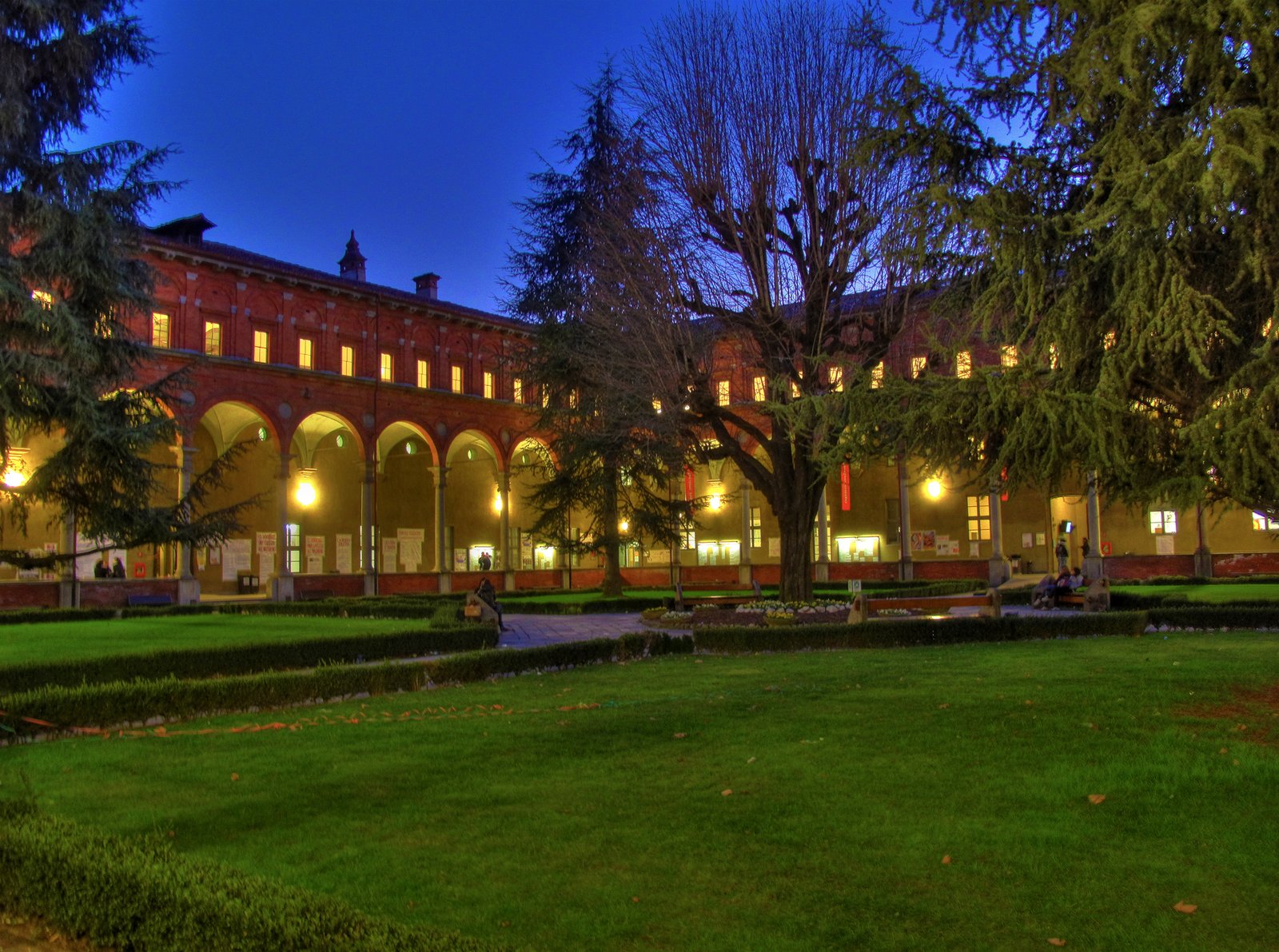
A working university campus wrapped around two Renaissance cloisters traditionally associated with Donato Bramante, where Giovanni Muzio's Novecento Milanese architecture meets the surviving fabric of the former Benedictine monastery of Sant'Ambrogio.
At a glance
The Milan headquarters of the Università Cattolica del Sacro Cuore occupies the ex-Monastero di Sant'Ambrogio, immediately south of the Basilica of Sant'Ambrogio. The complex centres on two Renaissance cloisters traditionally attributed to Donato Bramante. From 1929 onward the architect Giovanni Muzio, working with the engineer Pier Fausto Barelli, adapted the monastery for university use, integrating the cloisters into a new campus designed in the restrained classicising idiom of Milanese Novecento. The university itself had been inaugurated here on 7 December 1921 by Father Agostino Gemelli, who remained its driving figure for decades.
Key facts
- Address: Largo Agostino Gemelli 1, 20123 Milano
- Founder of the university: Father Agostino Gemelli, inaugurated 7 December 1921
- Renaissance fabric: Two cloisters of the former Monastero di Sant'Ambrogio, traditionally attributed to Donato Bramante (late 15th century)
- 20th-century architect: Giovanni Muzio, with engineer Pier Fausto Barelli, from 1929 onward
- Phased works: Collegio Augustinianum 1933–1934; Collegio Marianum 1938; refectory converted to Aula Magna; campus mensa 1949
- War damage: Allied bombing on 15–16 August 1943 destroyed several classrooms and damaged one of the Bramantesque cloisters, later restored
- Style: Novecento Milanese, with classicising references in dialogue with the Renaissance core
History
The site has a Benedictine identity older than the university by nearly a thousand years. The Monastero di Sant'Ambrogio grew alongside the basilica founded by the bishop Ambrose in the late fourth century, and by the end of the fifteenth century the monastic community commissioned a new architectural campaign for its cloisters. Tradition, repeated in the standard literature on Milanese Renaissance architecture, attributes the project to Donato Bramante, who was then working in Milan under the patronage of Ludovico Sforza. The cloisters that visitors cross today belong to that campaign in their plan and proportions, even where later restoration has replaced individual elements.
The conversion to a university campus began on 7 December 1921, when Father Agostino Gemelli, a Franciscan friar, physician and psychologist, inaugurated the Università Cattolica del Sacro Cuore in Milan. The institution moved into the ex-monastery in the late 1920s, and in 1929 Gemelli entrusted the architectural restructuring to Giovanni Muzio, working with the engineer Pier Fausto Barelli. Muzio's intervention extended over roughly twenty years. Among the dated phases are the Collegio Augustinianum (1933–1934), the Collegio Marianum (1938), the conversion of the monastic refectory into the Aula Magna, and the campus mensa completed in 1949.
The Second World War interrupted that programme. On the night of 15–16 August 1943, Allied bombing struck the complex, destroying several classrooms and damaging one of the cloisters traditionally associated with Bramante. The post-war reconstruction reintegrated the Renaissance fabric and completed the Muzio campus on terms that are still visible to anyone walking in from Largo Gemelli today.
What you see
The visitor enters the university from Largo Agostino Gemelli, the small piazza on the southern flank of the basilica. Beyond the entrance vestibule, the first of the two Renaissance cloisters opens as a square arcaded court with slender classical columns carrying a continuous loggia. The proportions are recognisably late-Quattrocento: a square plan, a single order of columns, a rhythm of round arches without the heavier Baroque embellishments that would later become standard in Milanese monastic architecture. The second cloister, photographed by Gabriele Barni in 2009 and shown above, repeats the formula on a slightly different scale.
Around the cloisters, Muzio's Novecento additions read as deliberately quiet. Brick and stone surfaces, symmetrical openings, restrained classicising mouldings and large unadorned wall planes all aim at continuity with the Renaissance core rather than at contrast. The rectorate, the chapel, the auditorium and the collegi on the perimeter belong to that 20th-century programme; the cloisters at the centre still belong, in spirit, to the Benedictines.
Practical information
- Access: The cloisters are inside an active university campus. Visitors are generally admitted during the academic day, with respect for teaching activities.
- Best time: Weekday mornings outside exam periods; pair the visit with the adjacent Basilica of Sant'Ambrogio.
- Time needed: 30–45 minutes for the two cloisters and the main entrance court.
- Dress: Smart casual; this is a working institution, not a tourist site.
- Tickets: Free general access; guided tours organised on specific dates by the university.
Getting there
The campus stands on Largo Agostino Gemelli, immediately south of the Basilica of Sant'Ambrogio. The Milan metro station Sant'Ambrogio (Line M2, green) is a two-minute walk to the north. From Milano Centrale railway station the journey is twelve to fifteen minutes by metro with one interchange at Cadorna or Loreto. Milan Linate and Milan Malpensa are reached by metro and shuttle in roughly forty-five and sixty minutes respectively.
Nearby
- Basilica of Sant'Ambrogio — the late-4th-century Ambrosian foundation, immediately north of the campus
- Museo Nazionale della Scienza e della Tecnologia Leonardo da Vinci — in the adjacent ex-monastic complex of San Vittore al Corpo
- San Maurizio al Monastero Maggiore — the "Sistine Chapel of Milan", ten minutes on foot
- Castello Sforzesco — fifteen minutes on foot to the north-west
Sources
- Wikipedia (English): Catholic University of the Sacred Heart
- Wikipedia (Italian): Università Cattolica del Sacro Cuore
- Wikimedia Commons: Second cloister, photograph by Gabriele Barni, 2009 (CC BY-SA 3.0)
- Università Cattolica del Sacro Cuore, official portal: unicatt.it
Find it on the map
See this place and what’s around it →Record researched and written by Stefano Vigolo for Cultural Heritage Online, 2026.

📷 Become a Cultural Heritage Online photographer
Share your photos of places: they stay published under your name as the author. The more they're seen, the more you get noticed — and soon a contest will reward the most appreciated photos.
Log in or sign up free to add a photoIs this page about you?
This page is read by travellers and heritage enthusiasts who find it on Google. Tell us how you are connected to this place and we will take it from there.