
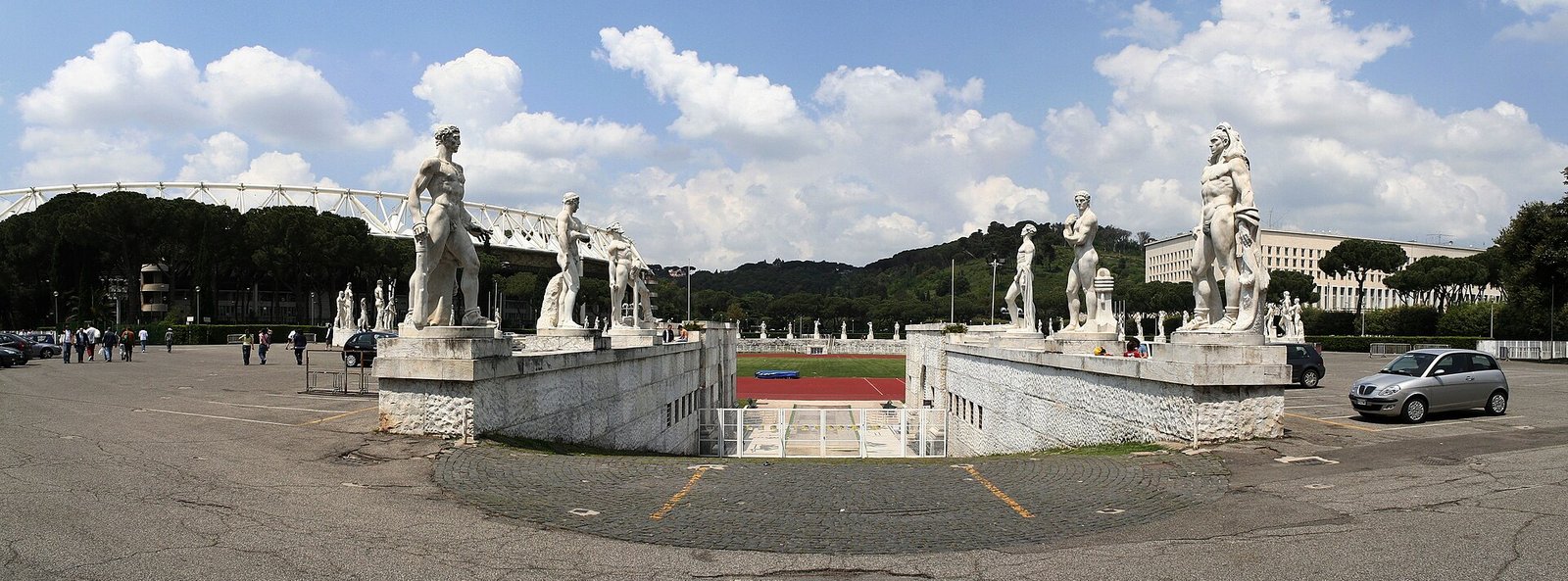
Enrico Del Debbio’s marble arena, ringed by sixty four-metre statues of athletes, where Fascist-era classicism still confronts every visitor crossing the Foro Italico.
At a glance
The Stadio dei Marmi sits at the foot of Monte Mario, inside the Foro Italico sports complex on the right bank of the Tiber. Designed by Enrico Del Debbio (1891–1973) in the late 1920s and inaugurated in 1932, the stadium was built as a training ground for the adjacent Fascist Academy of Physical Education, now the headquarters of CONI, the Italian Olympic Committee. Its defining feature is the ring of sixty Carrara marble athlete statues that lines the upper terrace, each one gifted by an Italian province. The track has hosted field hockey at the 1960 Summer Olympics, the 2009 World Aquatics Championships opening ceremony, and continues to be used for athletics, rugby and ceremonies.
Key facts
- Architect: Enrico Del Debbio (1891–1973)
- Construction: Foro Mussolini complex begun 1928; stadium opened 1932, on the tenth anniversary of the March on Rome
- Statues: sixty figures of athletes, approximately four metres tall, in Carrara marble, one gifted by each Italian province
- Sculptors: twenty-four artists selected by competition, including Nicola D’Antino, Silvio Canevari, Publio Morbiducci, Eugenio Baroni, Francesco Messina and Romano Romanelli
- Complex: one of four stadiums of the Foro Italico, alongside the Stadio Olimpico, the Stadio del Tennis and the Stadio Olimpico del Nuoto
- Status: active sports venue, protected as part of the Foro Italico ensemble
History
Construction of the Foro Mussolini, the sports city that would later be renamed Foro Italico, began in 1928 under Mussolini’s regime. The complex was conceived as the physical and symbolic centre of Fascist athleticism, and the Stadio dei Marmi was its didactic core: a training ground for the Istituto Superiore Fascista di Educazione Fisica, the male physical-education institute opened in 1932 on the same anniversary as the stadium itself. Renato Ricci, head of the Opera Nazionale Balilla, oversaw the sculptural programme to enforce stylistic coherence across the twenty-four chosen artists.
The land underneath the stadium was owned by the Vatican, a detail that proved decisive after 1943: the Foro Italico survived the fall of the regime because Allied forces used it as a refuge centre, and demolition was never seriously pursued. In 1960 the stadium hosted preliminaries of the field hockey tournament at the Rome Summer Olympics, an event that forced Italian officials to confront the surviving Fascist inscriptions of the complex. Two of the most inflammatory texts were removed; most were left in place. A major restoration preceded the 1990 FIFA World Cup, and another wave of works prepared the stadium for the 2009 World Aquatics Championships, whose opening ceremony took place here.
The Stadio dei Marmi remains an unresolved monument. Historians like Valerie Higgins read its continued use as evidence of Italy’s incomplete reckoning with the Fascist period; for others, it is simply the most photogenic athletics track in Rome.
What you see
The plan is a long oval of white travertine and marble, sober and stripped of ornament, that depends almost entirely on its sculptural frame for effect. Del Debbio described the design intent as one of severe monumentality, deliberately referring to the great monuments of ancient Rome. The lower tiers are bare; the upper terrace carries the ring of sixty statues, all in Carrara marble, all roughly four metres tall, standing on plain rectangular pedestals.
Each statue represents a different sport, from boxing and javelin to swimming and ski, and each is inscribed with the name of the Italian province that paid for it. The figures quote directly from classical models, the Doryphoros of Polykleitos and the Discobolus of Myron, but their poses are static rather than mid-action, holding a stone, a discus or a paddle as if for inspection. Up close, the white marble feels cold under the hand and almost unmodelled compared with the deep carving of Imperial Roman work; from the far end of the track the bodies read as a single classical chorus, which is the effect Ricci’s standardisation set out to achieve.
Practical information
- Access: the perimeter and the statue ring are visible from the Viale del Foro Italico promenade without entering the track
- Inside the stadium: accessible during athletics events, rugby matches and official open days
- Best light: late afternoon, when the marble warms and the statues throw long shadows across the track
- Time needed: 30–45 minutes for the stadium itself; allow 1.5–2 hours to walk the wider Foro Italico
- Combine with: the Mussolini Obelisk at the entrance and the mosaics of the Viale
Getting there
The Foro Italico sits on the right bank of the Tiber, north of the historic centre. The easiest approach is Metro line A to Ottaviano or Flaminio, then tram 2 to Mancini and a fifteen-minute walk across the Ponte Duca d’Aosta. Buses 32, 271 and 280 stop along the Lungotevere; from Termini, taxi is around twenty minutes outside peak traffic. The nearest international gateway is Rome Fiumicino, roughly forty-five minutes by Leonardo Express and metro transfer.
Nearby
- Stadio Olimpico, main venue of the 1960 Olympic Games and the 1990 World Cup final, a five-minute walk away
- Ponte Duca d’Aosta and the Mussolini Obelisk, the ceremonial axis of the complex
- Palazzo della Farnesina, seat of the Italian Foreign Ministry, immediately uphill
- Monte Mario and the panoramic terrace of Zodiaco, fifteen minutes by car for the best skyline of Rome
Sources
- Wikipedia, Stadio dei Marmi
- Wikimedia Commons, Category: Stadio dei Marmi
- CONI, Italian Olympic Committee, current custodian of the Foro Italico
- Eden K. McLean, on the Mussolini Forum and Fascist physical education (cited via Wikipedia)
- Valerie Higgins, on the post-war reuse of Fascist heritage in Rome (cited via Wikipedia)
Find it on the map
See this place and what’s around it →Record researched and written by Stefano Vigolo for Cultural Heritage Online, 2026.


📷 Become a Cultural Heritage Online photographer
Share your photos of places: they stay published under your name as the author. The more they're seen, the more you get noticed — and soon a contest will reward the most appreciated photos.
Log in or sign up free to add a photoIs this page about you?
This page is read by travellers and heritage enthusiasts who find it on Google. Tell us how you are connected to this place and we will take it from there.