
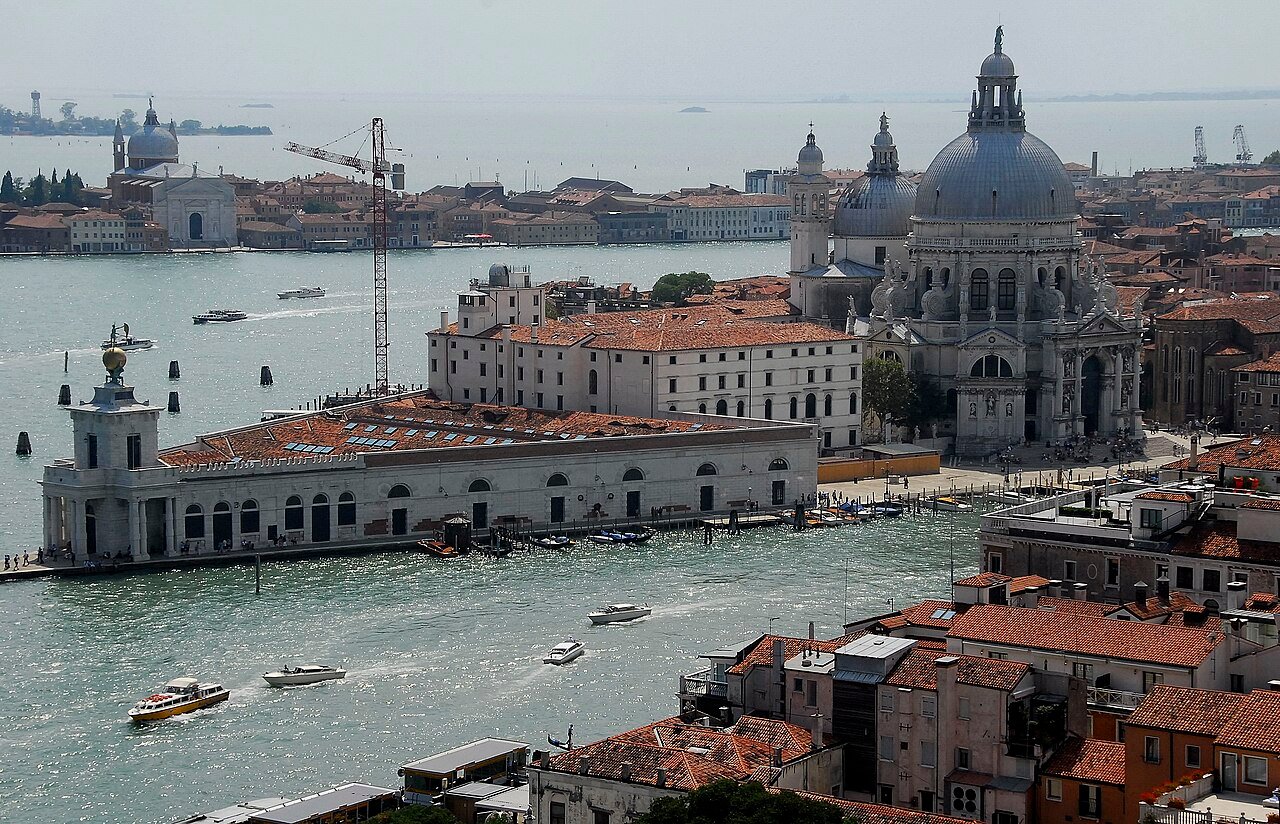
Punta della Dogana stands at the tip of Dorsoduro, where the Grand Canal meets the Giudecca Canal opposite Piazza San Marco. Built between 1677 and 1682 by Giuseppe Benoni as the Dogana da Mar — the Republic of Venice’s seaborne customs house — it is crowned by two bronze Atlas figures supporting a gilded globe surmounted by a rotating bronze Fortuna by Bernardo Falconi (1678), which acts as the building’s weathervane. After standing disused for decades, the structure was restored in 2007–2009 by Japanese architect Tadao Ando for the Pinault Collection and reopened in June 2009 as a contemporary-art museum, adjacent to the basilica of Santa Maria della Salute.
- Address
- Dorsoduro 2, 30123 Venezia VE (Punta della Dogana, between Canal Grande and Canale della Giudecca)
- Period
- Customs building 1677–1682 by Giuseppe Benoni; restored and converted 2007–2009 by Tadao Ando for the Pinault Collection
- Architect (original)
- Giuseppe Benoni (1677–1682)
- Architect (renovation)
- Tadao Ando (2007–2009)
- Function
- Republic of Venice maritime customs house (Dogana da Mar) until the late 20th century; now a contemporary-art museum
- Current use
- Punta della Dogana — Pinault Collection contemporary art museum
- Coordinates
- 45.4307° N, 12.3389° E
- Notes
- Surmounted by two bronze Atlas figures holding a gilded globe and a rotating bronze statue of Fortuna by Bernardo Falconi (1678), which serves as the building's iconic weathervane
Gallery
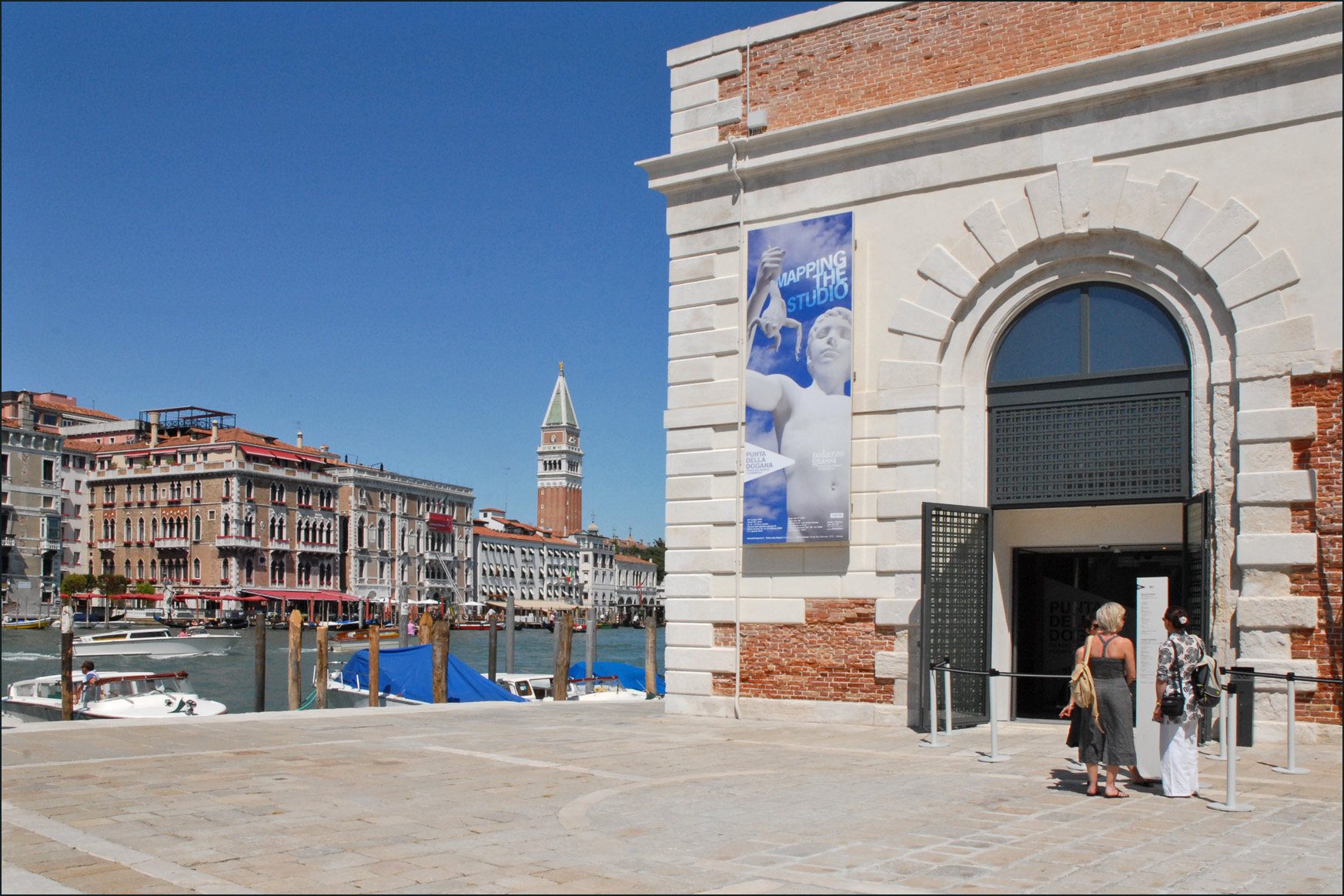
Two views of the building after the 2007–2009 conversion: Ando’s restored interior and the iconic prow facing the Bacino di San Marco.

Visit on the map
Dorsoduro 2 · 45.4307° N, 12.3389° E
Download for your navigator
A single waypoint, ready for GPS apps, navigators, and contacts.
A customs post for goods arriving by sea — the Dogana da Mar — has existed at the eastern tip of Dorsoduro since at least the fifteenth century, controlling cargo entering Venice from the Adriatic alongside the inland Dogana da Terra. The current triangular building, with its long warehouses converging on a low watchtower, was raised between 1677 and 1682 to a design by Giuseppe Benoni after a public competition. Two bronze figures of Atlas, traditionally attributed to the workshop of Bernardo Falconi, support a gilded copper globe on the tower; on top, a bronze statue of Fortuna cast by Falconi in 1678 turns with the wind, serving as the customs house’s weathervane and a landmark visible across the lagoon. The Dogana continued to operate, with various administrative changes through the fall of the Republic in 1797 and the nineteenth-century Austrian and Italian periods, until its commercial function was wound down in the twentieth century.
After the closure of customs activity the building stood largely disused for decades, used intermittently for exhibitions while a long-term destination was debated. In 2007 the City of Venice awarded a thirty-three-year concession to a foundation linked to French collector François Pinault, who already operated Palazzo Grassi as a contemporary-art venue, on condition that the historic structure be restored and reopened to the public as a museum. The architectural commission went to Tadao Ando, the Japanese architect awarded the Pritzker Prize in 1995, who carried out the intervention between 2007 and 2009. Ando’s approach kept the existing brick walls, wooden roof trusses and triangular plan substantially intact, inserting a freestanding inner volume of smooth poured concrete that defines the new exhibition rooms without obscuring the original masonry.
Punta della Dogana opened to the public on 6 June 2009 with the inaugural exhibition Mapping the Studio, drawn from the Pinault Collection and curated by Alison Gingeras and Francesco Bonami. Since then it has functioned as one of the two Venetian venues of the François Pinault Foundation — together with the nearby Palazzo Grassi at San Samuele — hosting large monographic and thematic shows of contemporary art, usually renewed every one to two years, with a combined ticket between the two sites. Its position at the prow of Dorsoduro, framed by Baldassare Longhena’s basilica of Santa Maria della Salute on one side and the open Bacino di San Marco on the other, has made the converted customs house one of the most prominent stages for international contemporary art in Italy since 2009.
Resources & References
Editorial picks across Wikipedia, photo archives, and the official portal.
All photographs Wikimedia Commons (CC-BY / CC-BY-SA / Public Domain) unless otherwise stated. Editorial text Cultural Heritage Online, OASIS Tech LLC USA.
See the place
Find it on the map
See this place and what’s around it →📷 Become a Cultural Heritage Online photographer
Share your photos of places: they stay published under your name as the author. The more they're seen, the more you get noticed — and soon a contest will reward the most appreciated photos.
Log in or sign up free to add a photoIs this page about you?
This page is read by travellers and heritage enthusiasts who find it on Google. Tell us how you are connected to this place and we will take it from there.