
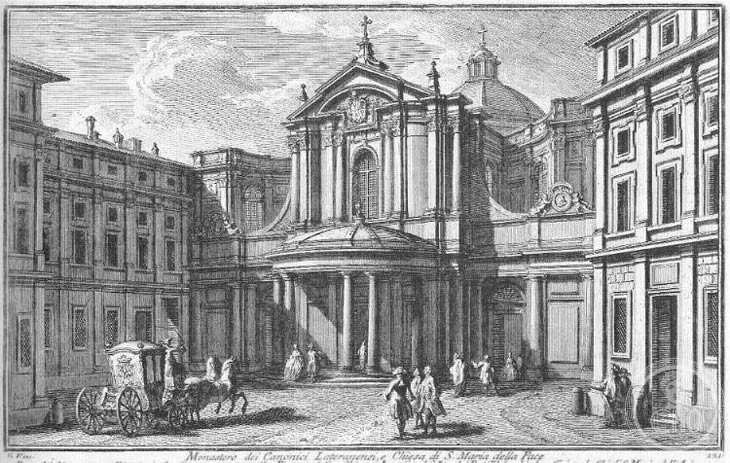
Santa Maria della Pace is a Renaissance Catholic church in the rione Ponte of Rome, a short distance from Piazza Navona. Built by Pope Sixtus IV around 1482 and later remodelled by Pope Alexander VI, the church is celebrated for Raphael’s celebrated Sibyls fresco (c. 1514) painted above the Chigi Chapel — one of the great works of the Roman High Renaissance. The adjoining cloister, designed by Donato Bramante in 1500–04, is considered a masterwork of early Renaissance architecture and now houses the Chiostro del Bramante cultural centre. The church offers a 360° virtual tour experience.
At a glance
- Type
- Catholic church with Renaissance cloister
- Period
- Built c. 1482; cloister 1500–1504; facade 1656–1657
- Style
- Renaissance; Baroque facade by Pietro da Cortona
- Location
- Rione Ponte, Rome, Lazio, Italy
- Coordinates
- 41.8998° N, 12.4716° E
Overview
Santa Maria della Pace stands in the dense historic fabric of central Rome, its semicircular Baroque porch by Pietro da Cortona (1656–57) projecting dramatically into the narrow surrounding streets. The church is a pilgrimage site for lovers of Renaissance art, housing Raphael’s Sibyls — four prophetic figures who seem to receive divine messages from angels — alongside frescoes by Baldassare Peruzzi and Timoteo Viti. The Chiostro del Bramante alongside it is now an internationally recognised venue for major art exhibitions.
History
Pope Sixtus IV commissioned the church following a miracle reported in 1480 involving a damaged image of the Virgin that bled when struck. The early church was completed around 1482 and expanded by Alexander VI. The octagonal interior received its most celebrated decoration when Agostino Chigi, the Sienese banker and patron, commissioned Raphael to paint the Sibyls above the family chapel in 1514. Bramante’s porticoed double-storey cloister — his first work in Rome — was completed between 1500 and 1504, establishing the proportional language of Roman Renaissance architecture. The current Baroque facade was added by Pietro da Cortona under Pope Alexander VII in the 1650s.
What you see
The octagonal nave leads visitors immediately to the Chigi Chapel, where Raphael’s Sibyls occupy the arched lunette above the altar in vivid yellows, reds, and blues. The adjacent chapels contain frescoes by Peruzzi and Viti, and the church preserves an early miraculous image of the Virgin. The Chiostro del Bramante next door — entered separately — offers a pristine two-storey arcade of Doric and Ionic columns that exemplifies Bramante’s serene geometric style. The virtual 360° tour allows full exploration of the interior and cloister from any device.
Cultural significance
Raphael’s Sibyls fresco is one of the defining images of the Roman High Renaissance, commissioned the same year as the Sistine Chapel ceiling was unveiled. Bramante’s cloister is a foundational monument in the history of Renaissance architecture, influencing building design across Italy and Europe for generations.
Practical information
- Address
- Arco della Pace 5, 00186 Roma RM, Italy
- Admission
- Church: free entry (check for Mass schedule). Chiostro del Bramante: ticketed exhibitions
Getting there
The church is a 5-minute walk from Piazza Navona in the Rione Ponte. The nearest bus stops are on Corso del Rinascimento and Via della Scrofa. No Metro station is directly adjacent; the closest is Spagna or Barberini on Line A (20–25 minutes on foot). Taxis and ride-sharing services can drop off on Corso Vittorio Emanuele II, a short walk away.
Sources & resources
See the place
Find it on the map
See this place and what’s around it →Historical events at this place (2)
📷 Become a Cultural Heritage Online photographer
Share your photos of places: they stay published under your name as the author. The more they're seen, the more you get noticed — and soon a contest will reward the most appreciated photos.
Log in or sign up free to add a photoIs this page about you?
This page is read by travellers and heritage enthusiasts who find it on Google. Tell us how you are connected to this place and we will take it from there.