
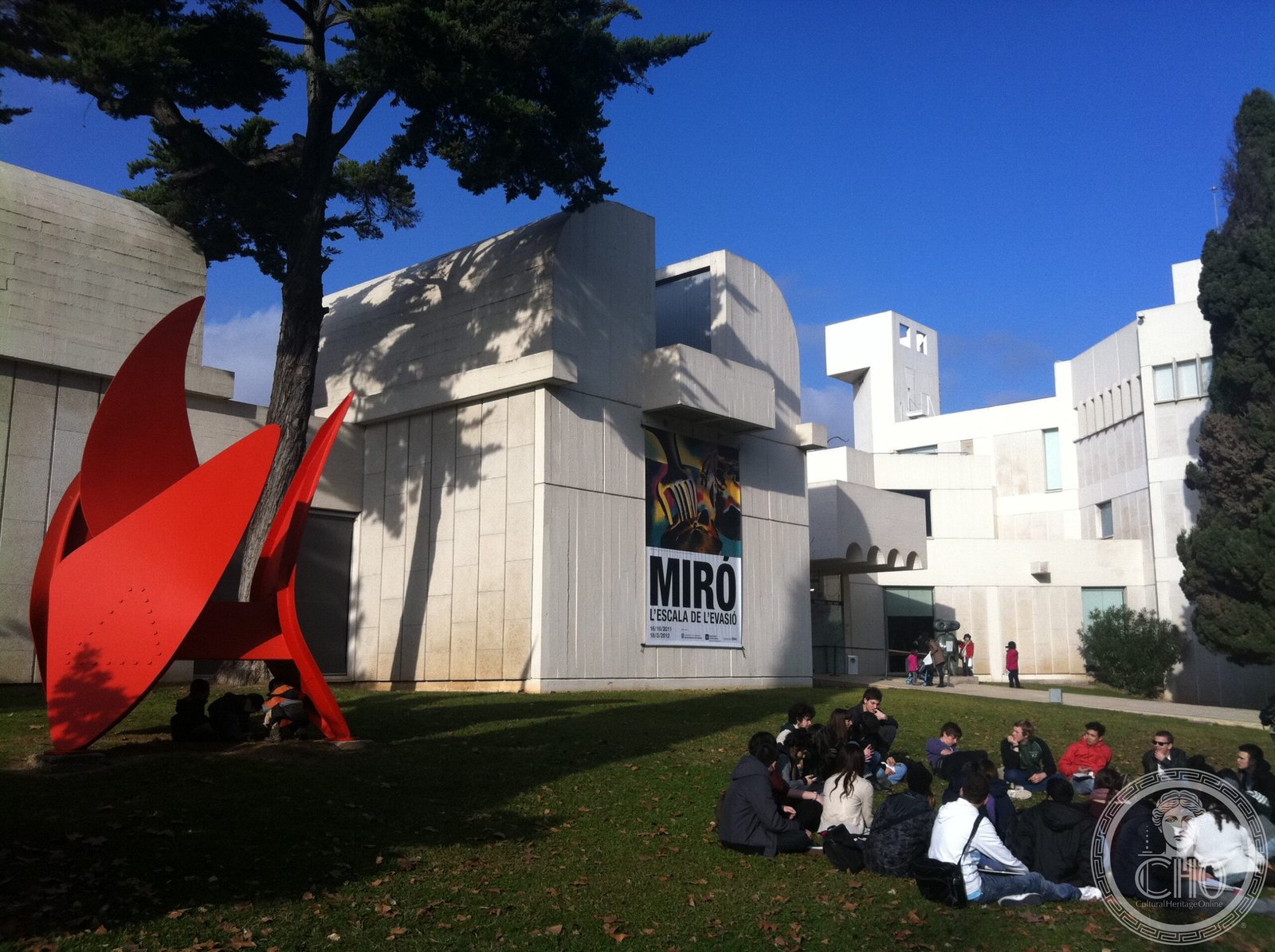
The Fundació Joan Miró in Barcelona is one of the world’s great modern art museums, dedicated to the life and work of Joan Miró (1893–1983), the Catalan surrealist master whose vivid colours, biomorphic forms, and playful symbols made him one of the most recognisable artists of the 20th century. Housed in a luminous rationalist building designed by Josep Lluís Sert on the slopes of Montjuïc, the foundation also champions contemporary art, holding an international collection of works by artists who influenced or were influenced by Miró.
At a glance
- Type
- Modern and contemporary art museum and cultural foundation
- Period
- Opened 1975; Miró’s archive donated to the foundation
- Style
- Mediterranean Rationalism (Josep Lluís Sert, 1975); extension by Jaume Freixa 1988
- Location
- Parc de Montjuïc, 08038 Barcelona
- Coordinates
- 41.3686° N, 2.1577° E
Overview
The Fundació Joan Miró holds the world’s largest and most important collection of Miró’s work, comprising some 14,000 items including paintings, sculptures, textiles, ceramics, and works on paper. Founded by Miró himself in 1975 as a gift to his native city, the foundation was entrusted with preserving his legacy and promoting awareness of contemporary art. In addition to its permanent galleries, it maintains an active programme of temporary exhibitions, educational activities, and international residencies that keep it at the forefront of Barcelona’s cultural life.
History
Joan Miró conceived the foundation in collaboration with his lifelong friend, the architect Josep Lluís Sert, as a space where his art could be shown in ideal conditions and where Catalan and international contemporary art could be celebrated. The building was designed with skylights and open terraces to flood the galleries with Mediterranean light, echoing the luminosity of Miró’s own paintings. The foundation opened on 10 June 1975, just months before the end of the Franco dictatorship, and its establishment marked a watershed moment for cultural freedom in Catalonia. Miró continued to work until shortly before his death in 1983, adding substantially to the foundation’s holdings.
What you see
The permanent collection is organised to trace Miró’s development from early naturalistic and Fauvist works through his Surrealist period and the great series of Constellations, to his late monumental paintings and sculptures. Outdoor terraces display large bronze sculptures against views of Barcelona and the Mediterranean. The Espai 13 gallery presents cutting-edge work by emerging artists in dialogue with Miró’s legacy, while the Sala Joan Prats houses the international collection with works by Calder, Ernst, Léger, Duchamp, and Moore, among others. The rooftop terrace and garden connect the museum experience to the natural landscape of Montjuïc.
Cultural significance
The Fundació Joan Miró is a landmark of both modern architecture and modern art, representing Miró’s conviction that art belongs to the people of his city. As one of the first great artist-founded museums in Europe, it established a model of creative philanthropy that influenced subsequent foundations worldwide. Its building by Sert — drenched in light and responsive to the Mediterranean climate — is itself considered a masterwork of 20th-century architecture.
Practical information
- Address
- Parc de Montjuïc, 08038 Barcelona, Spain
- Hours
- Tuesday–Saturday 10:00–18:00 (until 20:00 on Thursdays); Sunday 10:00–15:00; closed Monday. Check the official website for current schedules.
- Admission
- General admission fee applies; reduced and free categories available. Check official website for pricing.
Getting there
The Joan Miró Foundation is located on Montjuïc hill near MNAC. From Paral·lel metro station (lines 2 and 3) take the Montjuïc cable car or the funicular, then a short walk. Bus 150 from Plaça d’Espanya also stops near the museum. From the MNAC building the foundation is approximately a 10-minute walk east along the hillside path. Cycling access is possible via the Montjuïc cycle route.
Sources & resources
See the place
Find it on the map
See this place and what’s around it →📷 Become a Cultural Heritage Online photographer
Share your photos of places: they stay published under your name as the author. The more they're seen, the more you get noticed — and soon a contest will reward the most appreciated photos.
Log in or sign up free to add a photo