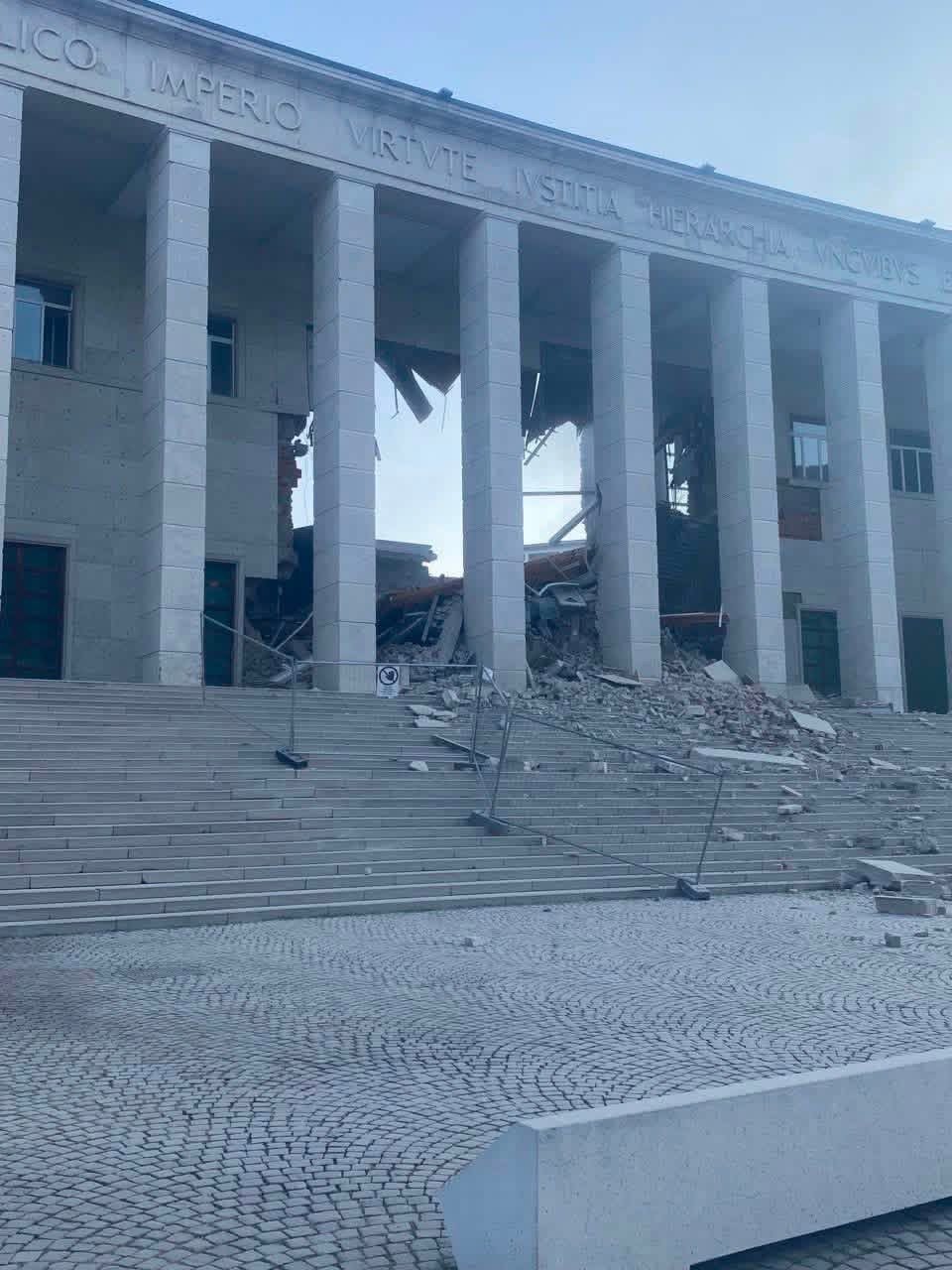
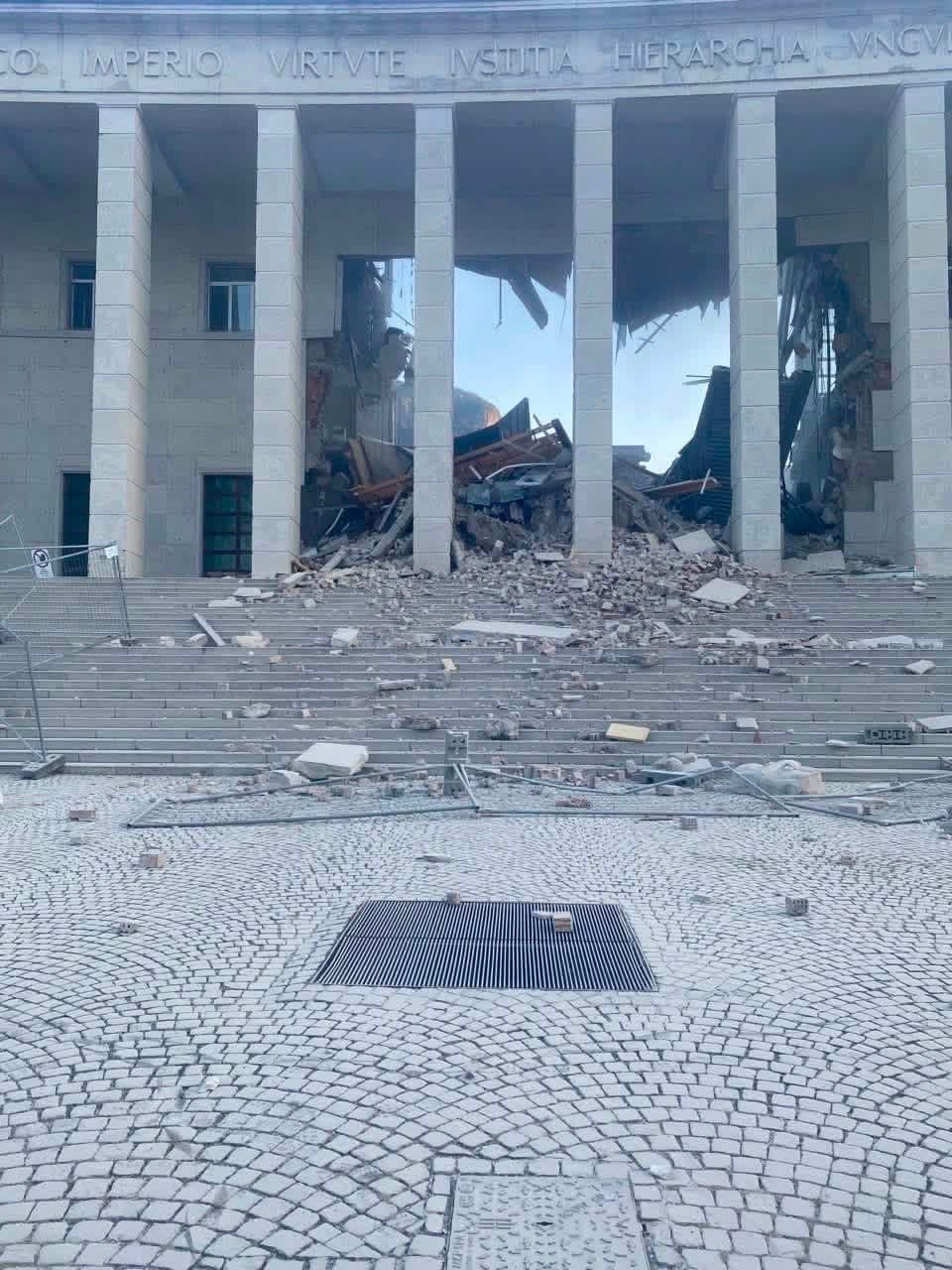
Shortly before six on the morning of Thursday 16 July 2026, a boom woke the centre of Bolzano. A substantial part of the Palazzo di Giustizia — the monumental courthouse on Piazza del Tribunale — had come down. The emergency call reached the city’s fire brigade at 6:24. By daylight, the scale was clear: roughly a quarter of the building, corresponding to its central section, had collapsed onto itself, taking the Corte d’Assise courtroom, the main hall and two third-floor civil courtrooms with it.
What happened
The building was almost empty. Around 150 people work in the courthouse on an ordinary day; at that hour there were only the porter and six cleaning staff. One cleaner was slightly injured — scratches, according to the first reports — and no one else was hurt. Firefighters, carabinieri and medical teams worked through the morning, and structural surveys began immediately, with the public prosecutor’s office opening its own file on the causes.
Renovation and extension works were under way in the building, including the replacement of load-bearing pillars in the first-floor atrium. Investigators’ first hypothesis, reported by the national press, is that the failure is connected to those works: the pillars gave way, and four storeys came down through the centre of the palace. The Italian magistrates’ association reacted within hours, noting that several Italian court buildings operate with serious structural problems that have gone unanswered.
The building that fell
The Palazzo di Giustizia is one of the defining monuments of twentieth-century Bolzano. Designed by the Roman architects Paolo Rossi de Paoli and Michele Busiri Vici, it was begun in 1939 and, with the war in between, completed only in 1956. Its concave colonnaded front — a giant order of pillars carrying a Latin frieze that is still legible above the rubble in these photographs — was conceived as one half of a rhetorical pair: across the square stands the convex front of the former Casa del Littorio (1939–42), and together the two curved facades were meant to form a monumental gateway to the “greater Bolzano” the regime was building for a new Italian population. Piazza del Tribunale itself was laid out between 1939 and 1942 as part of the same plan.
That history makes this square one of the most studied pieces of dissonant heritage in Europe. Bolzano did not demolish its fascist-era monuments; it learned to historicize them. The Victory Monument nearby reopened in 2014 with a permanent exhibition that reads the monument critically instead of celebrating it. In 2017, the huge Piffrader relief of Mussolini on the former Casa del Littorio — directly facing the courthouse — was famously “defused” with an illuminated inscription of Hannah Arendt’s words, Nobody has the right to obey, in the square’s three languages. The courthouse belongs to that same ensemble and to that same, hard-won way of dealing with it: neither veneration nor erasure, but context.
What is at stake now
The immediate questions are practical: the safety of what remains, the cause of the failure, and where a courthouse that serves an entire province will hold its hearings. But for anyone who cares about the built record of the twentieth century, a further question follows close behind. Buildings of this period sit in an uncomfortable place in public affection: architecturally significant, historically compromised, expensive to maintain. When one of them fails, the temptation to simplify the problem with a demolition permit is real, and it has been acted on elsewhere.
It would be the wrong answer here. The Bolzano courthouse is a historical document — of an architecture, of a political project, and of the city’s own decades-long effort to face both honestly. A quarter of it is gone; three quarters, including the colonnade and the frieze, are standing. Heritage does not preserve itself. It survives where maintenance is treated as an obligation rather than an option, and where damage is met with repair and investigation rather than erasure. Bolzano, of all cities, has shown Europe how to live critically with this inheritance. The reconstruction of its courthouse is a chance to show how to care for it, too.
Sources
- ANSA — collapse report, injuries, ANM statement (16 July 2026).
- Il Sole 24 Ore and AGI — event confirmation and ongoing surveys.
- Today.it — timeline (boom before 6:00, call at 6:24), people present, works on the atrium pillars.
- Finestre sull’Arte — extent of the collapse (central section, about one quarter).
- Palazzo di Giustizia (Bolzano), bassorilievomonumentale-bolzano.com and arch.atlas — building history (Rossi de Paoli and Busiri Vici, 1939–1956), the square and its ensemble, the 2017 Arendt inscription.