
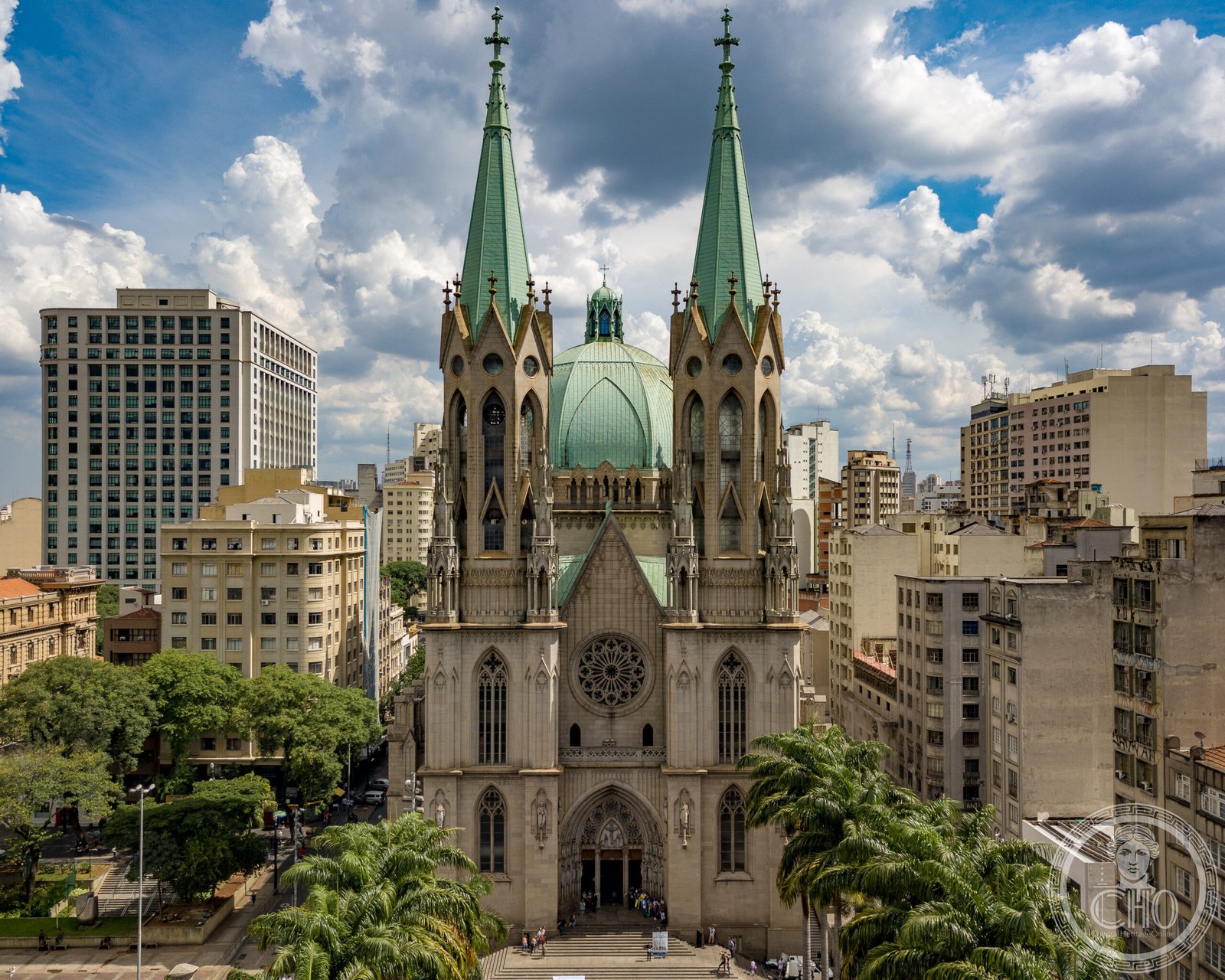
On Praça da Sé, the zero point from which road distances in São Paulo are measured, the metropolitan cathedral stands where a church had existed since 1591. That church was raised to a cathedral in 1745, rebuilt in the Baroque style in 1764 and demolished in 1911. The first stone of the present building was laid on 6 July 1913, to a design by the German architect Maximilian Emil Hehl, a teacher at the Escola Politécnica of São Paulo, who died in 1916, before the works were finished; they were carried on by other architects. The inauguration, with the towers still incomplete, took place on 5 September 1954, on the fourth centenary of the city, while the exact year the towers were finished remains uncertain, the sources divided between 1967 and 1969. The style is neo-Gothic, with a central dome of Renaissance inspiration often compared to that of the Duomo of Florence. The building is often described, though without a verifiable primary source, as the fourth largest neo-Gothic cathedral in the world, one hundred and eleven metres long and ninety-two metres high at the spires, with a capacity of eight thousand people. The archdiocese of São Paulo, erected as a diocese on 6 December 1745 and raised to an archdiocese on 7 June 1908, has been led by Cardinal Odilo Pedro Scherer since 2007. Having turned seventy-five in September 2024, he submitted his resignation as canon law requires, but Pope Francis asked him to stay in office until 2026, and no successor has yet been appointed. On 31 October 1975 an ecumenical act was held in this cathedral in memory of the journalist Vladimir Herzog, killed under torture by the military regime a few days earlier. Led by Cardinal Paulo Evaristo Arns, archbishop of São Paulo, together with Rabbi Henry Sobel and the Presbyterian pastor Jaime Wright, it filled the cathedral despite attempts by the police to block the way in, and is regarded as the first public act of dissent against the dictatorship, the first crack in the regime. In January and April 1984 the nearby Praça da Sé held two of the largest demonstrations in Brazilian history, as part of the «Diretas Já» movement for direct elections, with more than three hundred thousand people on 25 January and a march of one and a half million on 16 April, although these events concern the square and not the cathedral building itself. Pope John Paul II visited São Paulo on 3 July 1980, but the sources do not confirm with certainty whether a mass on that occasion was celebrated in this cathedral or, as one source indicates, in the nearby Pateo do Collégio, the historic site of the founding of the city in 1554.
About the Cathedral
The Sé Cathedral, on Praça da Sé in central São Paulo, is the seat of the Archdiocese of São Paulo. Built 1913–1954 to designs by German architect Maximilian Emil Hehl, its neo-Gothic form with a Renaissance-inspired dome is often described as among the world’s largest neo-Gothic cathedrals.
Key facts
- 6 July 1913: cornerstone laid, replacing an 18th-century baroque cathedral demolished in 1911.
- 5 September 1954: cathedral inaugurated, towers still unfinished, coinciding with the city’s 400th anniversary.
- 7 June 1908: Archdiocese of São Paulo erected.
- 31 October 1975: ecumenical memorial service for tortured journalist Vladimir Herzog held in the cathedral — a landmark act of dissent against military rule.
- 25 January / 16 April 1984: massive “Diretas Já” pro-democracy rallies fill the adjacent Praça da Sé.
- Cardinal Odilo Scherer has led the archdiocese since 2007, remaining in office at Pope Francis’s request past his 2024 retirement age.
History
Completed in 1954 after four decades of construction, the cathedral became, two decades later, the site of one of the defining moments of Brazil’s resistance to military dictatorship: on 31 October 1975, Cardinal Paulo Evaristo Arns joined a rabbi and a Presbyterian pastor to lead an ecumenical memorial for journalist Vladimir Herzog, tortured to death by the regime days earlier — an event historians credit as the first public crack in the dictatorship’s authority. Nearly a decade later, the adjacent Praça da Sé hosted two of the largest pro-democracy demonstrations in Brazilian history during the 1984 “Diretas Já” campaign.
What you see
A neo-Gothic facade rises between twin towers with green (verdigris) spires, fronting a Renaissance-style central dome compared to Florence’s Duomo, with a rose window and a marble-clad interior seating up to 8,000.
Practical information
- Opening hours: generally open daily outside services; check current hours before visiting.
- Address: Praça da Sé, Centro, São Paulo, Brazil.
Getting there
The cathedral fronts Praça da Sé, the historic zero-kilometer point of São Paulo, in the city center. GPS: 23°33′04″S, 46°38′04″W.
Nearby
- Praça da Sé — São Paulo’s historic central square, site of major 1984 pro-democracy rallies.
Sources
- Wikipedia (English and Portuguese) — “São Paulo Cathedral,” “Roman Catholic Archdiocese of São Paulo”
- GCatholic.org and Catholic-Hierarchy.org — Archdiocese of São Paulo records.
- Agência Brasil — 50th-anniversary coverage of the 1975 Vladimir Herzog memorial service.
- IHU Unisinos — coverage of the cathedral’s role in resistance to Brazil’s military dictatorship.
- nvdatabase.swarthmore.edu and osdivergentes.com.br — coverage of the 1984 “Diretas Já” rallies at Praça da Sé.
- Vatican.va — official itinerary of Pope John Paul II’s 1980 visit to São Paulo.
Find it on the map
See this place and what’s around it →📷 Become a Cultural Heritage Online photographer
Share your photos of places: they stay published under your name as the author. The more they're seen, the more you get noticed — and soon a contest will reward the most appreciated photos.
Log in or sign up free to add a photo