
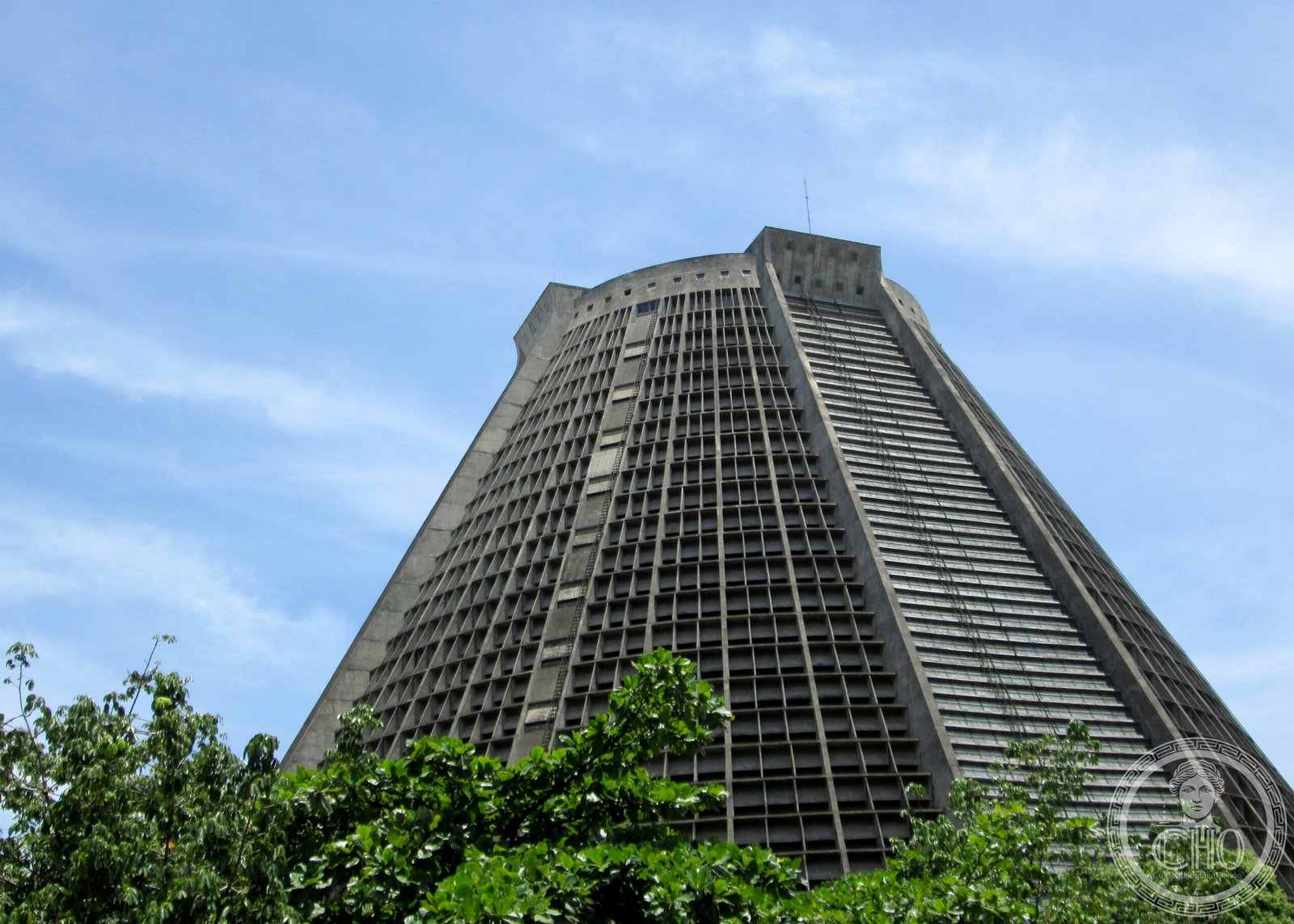
On Avenida República do Chile, in central Rio de Janeiro, the Metropolitan Cathedral of Saint Sebastian is the seat of the Catholic archdiocese of Rio de Janeiro. The foundation stone was blessed on 20 January 1964 by Cardinal Jaime de Barros Câmara, the feast day of Saint Sebastian, to a design by the architect Edgar de Oliveira da Fonseca, with landscaping by Roberto Burle Marx and structural calculations by the technical office named after the engineer Emílio Baumgart; the first mass was celebrated there, in the still unfinished building, at Christmas 1972, the official inauguration took place on 16 November 1976 for the third centenary of the archdiocese, and the solemn dedication as a cathedral followed on 15 August 1979. The building, Modernist Brutalist in style, has the form of a truncated cone inspired by the Maya pyramids, seventy-five metres high outside and sixty-four inside, with a diameter of one hundred and six metres and an interior area of eight thousand square metres, holding twenty thousand people standing; four vertical stained-glass windows, each sixty-four metres high, meet at the ceiling to form a Greek cross above a great crucifix. The cathedral replaced, as archiepiscopal seat, the church of Our Lady of Mount Carmel, facing Praça XV de Novembro, which from 1808, when the Portuguese royal family moved there fleeing Napoleon’s troops, had become the royal and then imperial chapel: here, in 1822 and 1841, the only two emperors in Brazilian history were crowned, the only two Christian coronations ever held in South America; the old seat, still standing as an active parish on the same square, is today known as the “Antiga Sé”. Rio de Janeiro was the capital of colonial Brazil from 1763, the seat of the entire Portuguese empire from 1808 to 1821 — the only time in history that the capital of a European monarchy stood in the Americas — and the national capital until the move to Brasília in 1960. The archdiocese of Rio, erected as a territorial prelature on 19 July 1575, raised to a diocese on 16 November 1676 and to a metropolitan archdiocese on 27 April 1892, has been led by Cardinal Orani João Tempesta since 2009; Pope Leo XIV accepted his resignation in August 2025, but asked him to stay in office for up to two more years, pending a successor. Pope John Paul II celebrated mass in this cathedral on 4 October 1997, before more than five hundred bishops and a thousand priests; Pope Francis came twice in July 2013, during World Youth Day, meeting young Argentinians on 25 July and celebrating mass with bishops, priests and religious on 27 July.
About the Cathedral
The Metropolitan Cathedral of São Sebastião, on Avenida República do Chile in downtown Rio de Janeiro, seat of the Archdiocese of Rio de Janeiro, was built 1964–1979 to designs by architect Edgar de Oliveira da Fonseca, its truncated-cone form inspired by Mayan step-pyramids.
Key facts
- 20 January 1964: cornerstone blessed on the feast of St. Sebastian
- 16 November 1976 / 15 August 1979: official inauguration, then solemn dedication as cathedral
- 75m external / 64m internal height, 106m diameter — capacity up to 20,000 standing
- 4 October 1997: Pope John Paul II celebrates Mass here before 500+ bishops
- 25 and 27 July 2013: Pope Francis visits twice during World Youth Day Rio
- Replaced the Old Cathedral (Nossa Senhora do Carmo), which crowned Brazil’s only two emperors in 1822 and 1841 — the only Christian coronations ever held in South America
History
Built through the 1960s and 70s in a boldly modernist idiom inspired by Mayan pyramids, the cathedral replaced a much older seat of Rio’s Catholic hierarchy: the Nossa Senhora do Carmo church, which became a royal chapel when the Portuguese royal family fled to Rio in 1808, making the city the only European imperial capital ever located in the Americas. That older church hosted the only two Christian coronations in South American history — Pedro I in 1822 and Pedro II in 1841. Its concrete successor has since welcomed two popes, John Paul II in 1997 and Francis twice during the 2013 World Youth Day.
What you see
A truncated concrete cone rises 75 meters, its exposed-concrete Brutalist form evoking Mayan step-pyramids, with four vertical stained-glass strips running the full 64-meter internal height and converging overhead in a Greek cross above a large crucifix.
Practical information
- Opening hours: daily, 7:00 AM–5:00 PM
- Address: Av. República do Chile, 245, Centro, Rio de Janeiro, Brazil
Getting there
The cathedral stands in the Centro district of Rio de Janeiro, near the Carioca and Cinelândia metro stations. GPS: 22°54′39″S, 43°10′51″W.
Nearby
- Old Cathedral (Antiga Sé) — the Nossa Senhora do Carmo church on Praça XV, Rio’s former royal and imperial chapel, about a kilometer away
Sources
- Wikipedia (English and Portuguese) — “Rio de Janeiro Cathedral,” “Old Cathedral of Rio de Janeiro,” “Roman Catholic Archdiocese of São Sebastião do Rio de Janeiro”
- Rio Memórias and riodejaneiroaqui.com — construction and architectural history
- GCatholic.org and Catholic-Hierarchy.org — Archdiocese of Rio de Janeiro records
- Vatican.va — Pope John Paul II’s 1997 homily and Pope Francis’s 2013 World Youth Day itinerary at the cathedral
- Vatican News, Agência Brasil, CNBB — coverage of Cardinal Orani Tempesta’s 2025 resignation and extended tenure
Find it on the map
See this place and what’s around it →📷 Become a Cultural Heritage Online photographer
Share your photos of places: they stay published under your name as the author. The more they're seen, the more you get noticed — and soon a contest will reward the most appreciated photos.
Log in or sign up free to add a photo