
In Nouakchott, the capital of the Islamic Republic of Mauritania, the Cathedral of Saint Joseph was consecrated on 15 December 1968, after about eleven months of work begun on 15 January of the same year, under the diocese’s first bishop, Michel Bernard, of the Fathers of the Holy Spirit. No source documents the name of an architect, and a claim sometimes repeated online that the building was deliberately modelled on a nomadic tent has found no support in any primary source consulted, and should therefore be treated as unverified. The diocese of Nouakchott, the country’s only Catholic jurisdiction, was erected on 18 December 1965 by Pope Paul VI, split off from the apostolic prefecture of Saint-Louis-du-Senegal. The Catholic presence in the region, however, goes back to the French colonial era, with responsibility for the prefecture given in 1955 to the Fathers of the Holy Spirit, in a Nouakchott that was then a small fishing village, chosen as the new national capital only in 1958. A mass expulsion in 1989 of around two hundred thousand non-Mauritanian people, according to the diocese itself, halved the city’s Christian population. Today Mauritania’s Catholic community numbers, according to 2022 data, around four thousand faithful in a national population of over four million, almost entirely foreigners of some forty different nationalities: migrant workers from sub-Saharan Africa, diplomats and expatriates. The Mauritanian constitution reserves Islam for its own citizens, who cannot legally practise other religions, while non-Islamic religious services remain reserved for foreigners and proselytism is forbidden by law. The Mauritanian penal code formally provides for the death penalty for apostasy and blasphemy, reinforced by a 2018 law that made capital punishment automatic for certain blasphemy offences, removing the judicial discretion that existed before. No execution for these offences, however, has been carried out since the eighties, according to reports by the United States State Department. The real risk to Christians in Mauritania has historically come more from jihadist violence than from state action. The American aid worker Christopher Leggett was killed in Nouakchott on 23 June 2009, in an attack claimed by al-Qaeda in the Islamic Maghreb, which accused him of proselytism, a charge he denied. In November-December 2023, some fifteen to eighteen Christians were briefly arrested in Selibaby after a video of a baptism spread online, and were later released without charge. Paradoxically, in that same year 2018, the year the blasphemy law was tightened, the Holy See accredited its first apostolic nuncio to Mauritania, Monsignor Michael Wallace Banach, who would present his credentials on 23 October of that year. Formal diplomatic relations between the Holy See and Mauritania, however, already date back to 9 December 2016. No pope has ever visited Mauritania.
About the Cathedral
In Nouakchott, capital of the Islamic Republic of Mauritania, the Cathedral of Saint Joseph was consecrated on 15 December 1968, after roughly eleven months of construction begun on 15 January that year, under the diocese’s first bishop, Michel Bernard, of the Congregation of the Holy Spirit. No source names an architect, and a sometimes-repeated claim that the building was deliberately designed to evoke a nomadic tent could not be traced to any primary source and should be treated as unverified.
Key facts
- 18 December 1965: the Diocese of Nouakchott erected by Pope Paul VI.
- 15 December 1968: the cathedral consecrated.
- 1989: mass expulsions reportedly halve the city’s Christian population.
- Roughly 4,000 Catholics nationwide, almost entirely foreign migrant workers and diplomats.
- Mauritanian citizens are legally barred from practicing any religion but Islam.
- 9 December 2016: the Holy See and Mauritania establish diplomatic relations.
History
Built into a capital city barely older than itself, this cathedral has always served a congregation of foreigners rather than citizens, in a country whose constitution reserves Islam for Mauritanian nationals. Its real dangers have come less from the state — no one has been executed for apostasy or blasphemy since the 1980s, despite a 2018 law hardening the penalty on paper — than from jihadist violence, most starkly in the 2009 killing of an American aid worker accused of proselytizing, a charge he denied.
What you see
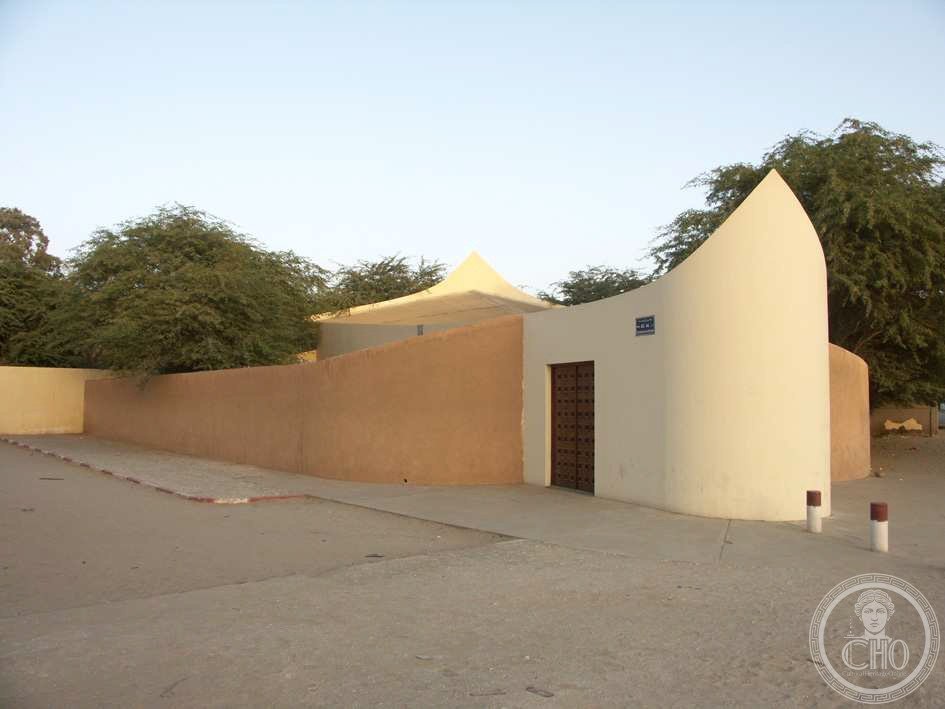
A curved white facade rises from a low, sand-colored perimeter wall, its sail-like silhouette framing a wooden double entrance door, with desert trees standing in the forecourt beyond.
Practical information
- Opening hours: generally open daily outside services; check current hours before visiting.
- Address: Ilot K131, Tévragh-Zeïna, Nouakchott, Mauritania.
Getting there
The cathedral stands in the Tévragh-Zeïna district of Nouakchott, near the city’s embassies. GPS: 18°05′42″N, 15°58′51″W.
Nearby
- Tévragh-Zeïna — Nouakchott’s diplomatic and embassy district, surrounding the cathedral.
Sources
- Wikipedia — “Roman Catholic Diocese of Nouakchott” and “Freedom of religion in Mauritania”
- evechenkc.org — official Diocese of Nouakchott site.
- Catholic-Hierarchy.org and GCatholic.org — Diocese of Nouakchott records.
- US State Department — International Religious Freedom Reports, Mauritania.
- Contemporary news coverage — the 2009 killing of Christopher Leggett and the 2023 Sélibaby baptism arrests.
Find it on the map
See this place and what’s around it →📷 Become a Cultural Heritage Online photographer
Share your photos of places: they stay published under your name as the author. The more they're seen, the more you get noticed — and soon a contest will reward the most appreciated photos.
Log in or sign up free to add a photo