
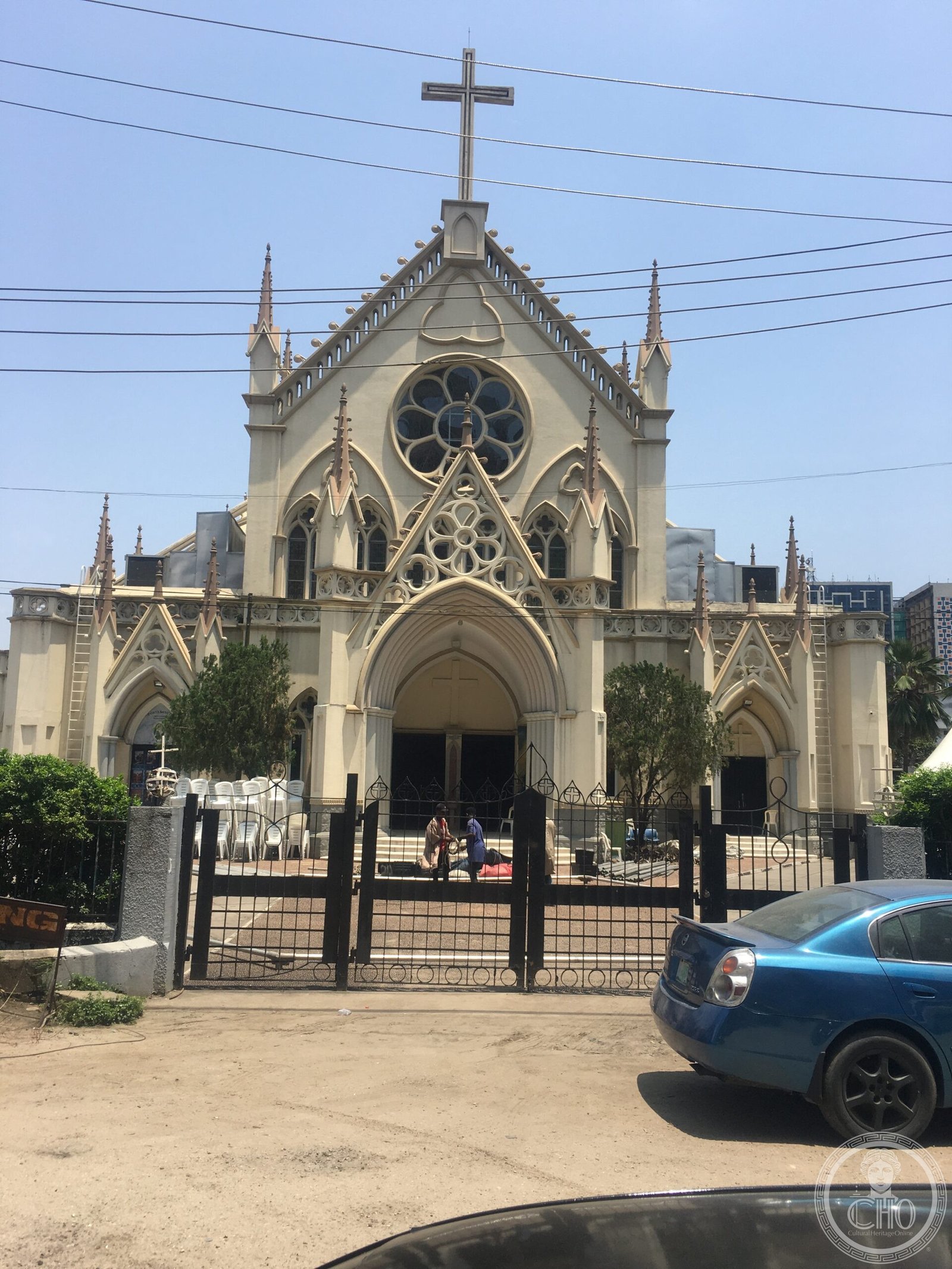
On Lagos Island, in Nigeria, the first documented Catholic mass was celebrated by the Italian missionary Francesco Borghero, of the African Missions of Lyon, in the house of an Italian trader, according to some sources as early as 1862, according to others on 24 September 1863. The community that gathered for that mass was made up largely of Afro-Brazilian returnees, the so-called Aguda, descendants of freed slaves who had come back to Lagos from Brazil. According to the Catholic Encyclopedia of 1913, they had already kept the faith alive for years thanks to a lay catechist known as “Padre Antonio”, even before the missionaries arrived. The permanent mission was founded in 1868 by Father Pierre Bouche and a Spanish lay brother. In 1864 the Aguda community, led according to one source by Isidoro Ezechiel de Souza, is said to have negotiated with the British colonial authorities the land on which to build the church, marked by a wooden cross that gave the building its name. The first pro-cathedral, with its foundation stone of 1878, was completed and opened for worship in 1881, built by the repatriated Afro-Brazilian stonemasons Lazarus Borges da Silva and Francisco Nobre, whose craft skills came from the Americas. It was in that building that, after the death of Bishop Ferdinand Terrien in 1929, the first three Yoruba priests of the diocese were ordained. Having become too small for the growing community, it was demolished in the Thirties to make way for the present cathedral in French Gothic style, whose foundation stone was laid on 6 August 1934 by Bishop Francis O’Rourke. The exact year of completion remains uncertain among the sources, which give 1936, 1938 or 1939, and it has not been possible to identify the architect of the present building, unlike the well-documented builders of the earlier cathedral. The apostolic vicariate of Lagos was raised to a metropolitan archdiocese on 18 April 1950 with the papal bull Laeto accepimus of Pope Pius XII. Among its archbishops, John Kwao Amuzu Aggey, in office from 1965 to 1972, born however in Togo to Togolese parents, was the first Black archbishop of the see. After a period of vacancy he was succeeded by Anthony Olubunmi Okogie, archbishop from 1973 to 2012, made a cardinal by John Paul II in the consistory of 21 October 2003 and an elector in two conclaves, those of 2005 and 2013. The present archbishop, Alfred Adewale Martins, in office since 2012, is not a cardinal, contrary to what is sometimes believed; he was ordained a priest in this very cathedral in 1983. The funeral of Archbishop Aggey, on 22 March 1972, drew about sixty thousand people to this cathedral and was broadcast live by the Nigerian national broadcaster; the archbishop was buried in the building’s chapel of St. Anthony. No pope is fully documented as ever having visited this cathedral: neither John Paul II, who travelled to Nigeria twice, in 1982 and 1998, without touching Lagos on the second visit, nor Benedict XVI nor Francis, who never visited the country. On 22 April 2025 Archbishop Martins presided here over a requiem mass in memory of Pope Francis, who had just died.
About Holy Cross Cathedral
On Lagos Island, Nigeria, the first documented Catholic Mass was celebrated by Italian missionary Francesco Borghero of the Society of African Missions of Lyon, in the home of an Italian trader, according to some sources as early as 1862, according to others on 24 September 1863. The community that gathered for it was largely Afro-Brazilian returnees, the Aguda, descendants of freed slaves who had come back to Lagos from Brazil, said by the 1913 Catholic Encyclopedia to have already kept the faith alive for years through a lay catechist known as “Padre Antonio,” before any missionary arrived.
Key facts
- 1868: permanent Catholic mission founded by Fr. Pierre Bouche.
- 1878-1881: the first pro-cathedral built by Afro-Brazilian craftsmen Lazarus Borges da Silva and Francisco Nobre.
- 6 August 1934: foundation stone of the current cathedral laid by Bishop Francis O’Rourke.
- 18 April 1950: elevated to the Metropolitan Archdiocese of Lagos by Pope Pius XII.
- 21 October 2003: Archbishop Anthony Olubunmi Okogie created cardinal.
- 22 March 1972: Archbishop Aggey’s funeral draws roughly 60,000 mourners, televised nationally.
- No pope has ever visited this cathedral on fully confirmed record.
History
This cathedral stands on ground first claimed for the Church in 1864 by Afro-Brazilian returnees who had survived the transatlantic slave trade and come home to Lagos, and first built on by their own stonemasons in 1878-1881 — a building where the diocese’s first three Yoruba priests were later ordained. Outgrown by the 1930s, that structure gave way to the current French Gothic cathedral, whose exact completion date is still disputed among sources, but which became the seat of Nigeria’s most prominent Catholic archdiocese in 1950. It has since drawn roughly 60,000 mourners to Archbishop Aggey’s 1972 funeral and hosted Cardinal Anthony Okogie, an elector in two papal conclaves, though no pope has ever visited the building itself on confirmed record.
What you see
A cream-colored French Gothic facade rises with twin pinnacle spires flanking a large rose window, pointed-arch tracery and, per an academic study, ribbed vaults and flying buttresses within — a European architectural vocabulary carried out on ground first built upon by 19th-century Afro-Brazilian craftsmen using techniques learned across the Atlantic.
Practical information
- Opening hours: generally open daily outside services; check current hours before visiting.
- Address: Catholic Mission Street, Lagos Island, Lagos, Nigeria (exact house number disputed across sources).
Getting there
The cathedral stands on Catholic Mission Street, Lagos Island, in the historic heart of the city. GPS: 6°27′00″N, 3°23′48″E.
Nearby
- Cathedral Church of Christ, Marina — Lagos’s Anglican cathedral, a short distance away on Lagos Island.
Sources
- Wikipedia — “Holy Cross Cathedral, Lagos” and “Roman Catholic Archdiocese of Lagos”
- Catholic-Hierarchy.org and GCatholic.org — Archdiocese of Lagos records.
- Catholic Encyclopedia (1913) — on early Catholic mission history in the Bight of Benin.
- Society of African Missions (sma.ie) — on Fr. Francesco Borghero’s mission to Lagos.
- historicalnigeria.com — “Popo Aguda: The Roman Catholic Mission Quarter of Lagos”
Find it on the map
See this place and what’s around it →📷 Become a Cultural Heritage Online photographer
Share your photos of places: they stay published under your name as the author. The more they're seen, the more you get noticed — and soon a contest will reward the most appreciated photos.
Log in or sign up free to add a photo