
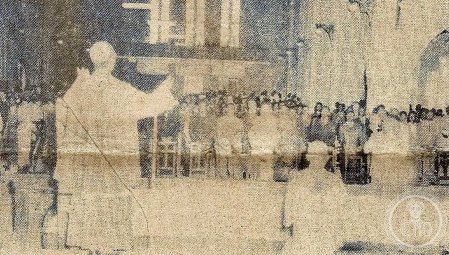
In Kinshasa, then Léopoldville, capital of the Belgian Congo, this cathedral was built from 1947 and inaugurated towards the end of 1949. It is in red brick, in a style inspired by the modernist architectural models of the Thirties. An interior fresco depicts Christ with the Lingala inscription “Yesu asekwi Aleluya”, “Jesus is risen, Alleluia”. An architect’s name, Roger Erell, is sometimes associated with this building. It most probably belongs instead to his best-known and well-documented work, the basilica of Sainte-Anne-du-Congo in Brazzaville, on the other bank of the river, in a different country, the Republic of the Congo: an attribution to be treated as unverified for this cathedral. The apostolic vicariate of the Belgian Congo, erected in 1888, was raised to the metropolitan archdiocese of Léopoldville on 10 November 1959, on the eve of independence. It was renamed the archdiocese of Kinshasa in 1966, when the city itself changed its name as part of President Mobutu’s “authenticity” campaign. Cardinal Joseph-Albert Malula, archbishop from 1964 until his death in 1989 and made a cardinal in 1969, was among the leading promoters of African liturgical inculturation, developing the so-called Zairean rite of the mass, approved by the Holy See in 1988. In 1972, when Mobutu ordered all Congolese, including the clergy, to abandon their Christian baptismal names for “authentic” African ones, Malula opposed him publicly and urged his bishops to ignore the order. In retaliation he was stripped of his official residence and spent some months in exile in Rome. He is buried in this cathedral. His successor at the head of the archdiocese, since November 2018, is Cardinal Fridolin Ambongo Besungu, made a cardinal in 2019. His Christmas homily in this cathedral has repeatedly taken on tones of open political criticism. In December 2023 he called the presidential elections a “gigantic, organised mess”. In April 2024 he became the subject of a judicial investigation for alleged seditious statements, publicly contested by clergy and faithful as harassment. In December 2025 he again called for peace in the conflict in eastern Congo from the pulpit of this very cathedral. Pope John Paul II visited Kinshasa in 1980 and in 1985, though it is not fully confirmed whether the events took place specifically in this building. Pope Francis, by contrast, certainly met Congolese priests, religious and seminarians here on 2 February 2023, according to a primary Vatican document, during his apostolic journey; that meeting was distinct from the mass at Ndolo airport, which gathered over a million people on the same trip.
About Notre-Dame du Congo Cathedral
In Kinshasa, then Léopoldville, capital of the Belgian Congo, this cathedral was built from 1947 and inaugurated toward the end of 1949, in red brick, in a style drawing on 1930s modernist architectural models; an interior fresco depicts Christ with the Lingala inscription “Yesu asekwi Aleluya” — “Jesus is risen, Alleluia.” An architect’s name, Roger Erell, sometimes attached to this building, most likely belongs instead to his better-documented work, the Basilica of Sainte-Anne-du-Congo in Brazzaville, across the river in the separate Republic of the Congo — an attribution that should be treated as unverified for this cathedral.
Key facts
- 1947-1949: the cathedral built and inaugurated under Belgian colonial rule.
- 10 November 1959: Léopoldville elevated to a metropolitan archdiocese, on the eve of independence.
- 1972: Cardinal Malula exiled to Rome for defying Mobutu’s ban on Christian names.
- Cardinal Malula is buried in this cathedral.
- 2 February 2023: Pope Francis meets Congolese clergy and religious here.
- Cardinal Ambongo’s Christmas homilies here have repeatedly addressed disputed elections and the eastern Congo war.
History
Built in the last years of Belgian colonial rule, this cathedral became the seat of Cardinal Joseph-Albert Malula, whose 1972 exile to Rome for refusing to strip Christian names from Congolese Catholics established the Church as one of the few institutions in Mobutu’s Zaire capable of open dissent — a role his successor Cardinal Fridolin Ambongo Besungu has continued, using Christmas homilies from this same pulpit to criticize disputed elections and call for peace amid the ongoing war in eastern Congo. Malula himself is buried here, and Pope Francis met Congolese clergy inside the cathedral during his 2023 visit.
What you see
A red-brick cathedral in a 1930s-inspired modernist style, its interior brick left exposed around a simple choir, with a fresco of the risen Christ bearing a Lingala inscription — a building whose visual record survives today mainly through archival photographs of the ceremonies held within it, rather than modern exterior photography.
Practical information
- Opening hours: generally open daily outside services; check current hours before visiting.
- Address: Avenue de la Libération, Kinshasa, Democratic Republic of the Congo (exact commune disputed across sources).
Getting there
The cathedral stands near Boulevard du 30 Juin in central Kinshasa. GPS: 4°19′26″S, 15°17′40″E.
Nearby
- Boulevard du 30 Juin — Kinshasa’s central avenue, named for the date of Congolese independence in 1960.
Sources
- Wikipedia (English and French) — “Our Lady of the Congo Cathedral” and “Cathédrale Notre-Dame du Congo”
- Catholic-Hierarchy.org and GCatholic.org — Archdiocese of Kinshasa records.
- Wikipedia — “Joseph Malula” and “Authenticité (Zaire)”
- Vatican.va — official text, Pope Francis’s meeting with clergy at Notre Dame du Congo Cathedral, 2 February 2023.
- Crux and Vatican News — coverage of Cardinal Fridolin Ambongo Besungu’s public statements, 2023-2025.
Find it on the map
See this place and what’s around it →📷 Become a Cultural Heritage Online photographer
Share your photos of places: they stay published under your name as the author. The more they're seen, the more you get noticed — and soon a contest will reward the most appreciated photos.
Log in or sign up free to add a photo