
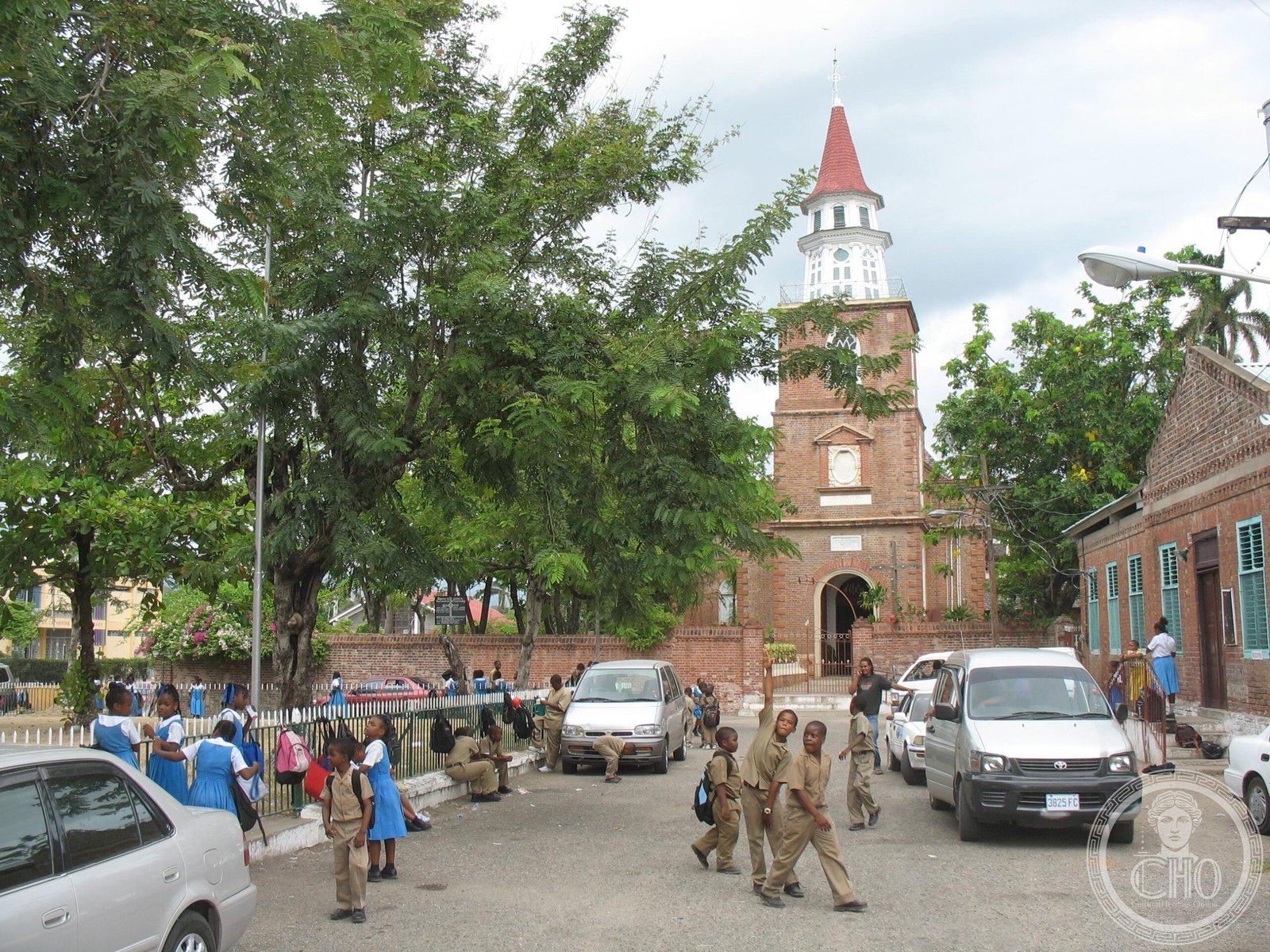
A Spanish Town, allora capitale della Giamaica, una chiesa cattolica spagnola, nota come cappella o chiesa della “Croce Rossa”, sorgeva sul sito almeno dagli anni Venti o Trenta del Cinquecento, secondo fonti che divergono tra il 1525 e il 1538. Dopo la conquista inglese della Giamaica nel 1655, l’edificio spagnolo fu distrutto e una chiesa anglicana fu costruita sulle sue rovine tra il 1661 e il 1664, secondo la diocesi anglicana della Giamaica; alcune fonti riportano invece una distruzione nel 1665, probabile errore di trascrizione per il 1655. Quella prima chiesa inglese fu a sua volta distrutta da un uragano nel 1712, e l’edificio oggi in piedi — navata e transetto in stile romanico, con archi a tutto sesto — fu ricostruito e dedicato nel 1714, sotto il regno della regina Anna; una singola fonte governativa parla erroneamente di un terremoto nel 1714, in contrasto con le altre fonti che concordano sull’uragano del 1712. Una torre campanaria fu aggiunta nel 1817, tra i pochi campanili a guglia dei Caraibi, mentre il coro fu ricostruito in stile gotico, con archi a sesto acuto, nel 1848, creando il contrasto stilistico oggi visibile tra le due campagne edilizie. La cattedrale è spesso descritta, anche dalla stessa diocesi anglicana, come la più antica cattedrale anglicana fuori dalle Isole Britanniche, sebbene la diocesi stessa usi il termine “forse” per l’affermazione correlata di ospitare il sito di culto cristiano continuo più antico dell’emisfero; l’edificio divenne cattedrale solo nel 1843, sotto il vescovo Aubrey Spencer, mentre la diocesi anglicana della Giamaica era stata istituita il 24 luglio 1824 con lettere patenti di re Giorgio IV, comprendendo allora anche Bahamas e Honduras Britannico. Spanish Town, fondata come Villa de la Vega attorno al 1534, restò capitale della Giamaica spagnola fino al 1655 e poi di quella inglese fino al 1872, quando la capitale fu trasferita a Kingston. All’interno, numerosi monumenti commemorano governatori e figure coloniali, tra cui, secondo fonti che meriterebbero ulteriore verifica incrociata, il governatore Thomas Howard, conte di Effingham, con un monumento del celebre scultore inglese John Bacon, autore di tre opere nella cattedrale. Non risulta documentato alcun evento specifico di restauro o danno recente all’edificio nelle fonti consultate, né risulta possibile confermare con certezza il nome dell’attuale vescovo della diocesi, data la disponibilità di fonti contrastanti su questo punto.
About St. Jago de la Vega Cathedral
In Spanish Town, then the capital of Jamaica, a Spanish Catholic church known as the Chapel or Church of the Red Cross stood on this site at least since the 1520s or 1530s, sources disagreeing on the exact year. After the English conquest of Jamaica in 1655, the Spanish building was destroyed and an Anglican church was built on its ruins between 1661 and 1664, per the Anglican Diocese of Jamaica; some sources instead cite a destruction in 1665, likely a transcription error for 1655.
Key facts
- 1655: the Spanish Catholic church destroyed following the English conquest of Jamaica
- 1714: the current building constructed after a 1712 hurricane destroyed its predecessor
- 1817: a bell tower added, one of the few steeples found in the Caribbean
- 1848: the chancel rebuilt in Gothic style, contrasting with the 1714 Romanesque nave
- 1843: designated a cathedral under Bishop Aubrey Spencer
- Widely described, including by the diocese itself, as the oldest Anglican cathedral outside the British Isles
History
Built on the ruins of a Spanish Catholic church destroyed by the English themselves after their 1655 conquest of Jamaica, this cathedral’s current form dates only to 1714, after a hurricane destroyed the first Anglican-era building. Only designated a cathedral in 1843, it nonetheless carries a claim, repeated even by its own diocese, to being the oldest Anglican cathedral outside the British Isles — a claim about its institutional seniority as a cathedral, distinct from separate claims about the world’s oldest surviving Anglican church buildings elsewhere in the Caribbean and Atlantic.
What you see
A Romanesque nave and transept from 1714, with rounded arches and classical quoins, meets a Gothic chancel rebuilt in 1848 with pointed arches — a visible seam between two building campaigns more than a century apart. A 1817 steeple tower, rare in the Caribbean, rises above an interior filled with marble memorials to colonial governors and notables, including work by the English sculptor John Bacon.
Practical information
- Opening hours: generally open daily outside services; check current hours before visiting
- Address: Barrett Street, Spanish Town, Saint Catherine Parish, Jamaica
Getting there
The cathedral stands on Barrett Street in Spanish Town, Jamaica’s former colonial capital. GPS: 17°59′40″N, 76°57′07″W.
Nearby
- Spanish Town’s main square — home to a separate statue of Admiral George Rodney by sculptor John Bacon, whose other work appears inside the cathedral
Sources
- Anglican Diocese of Jamaica and the Cayman Islands — official history page (anglicandioceseja.org)
- Jamaica National Heritage Trust — heritage listing for St. Jago de la Vega Cathedral
- Wikipedia — “Spanish Town” (en.wikipedia.org)
- jamaica55.gov.jm — Jamaican government commemorative heritage page
Find it on the map
See this place and what’s around it →📷 Become a Cultural Heritage Online photographer
Share your photos of places: they stay published under your name as the author. The more they're seen, the more you get noticed — and soon a contest will reward the most appreciated photos.
Log in or sign up free to add a photo