
In Windhoek, the capital of Namibia, the first Catholic services were held in a wooden chapel with a canvas roof. The cornerstone of a permanent church, with a single tower, was laid in March 1903.
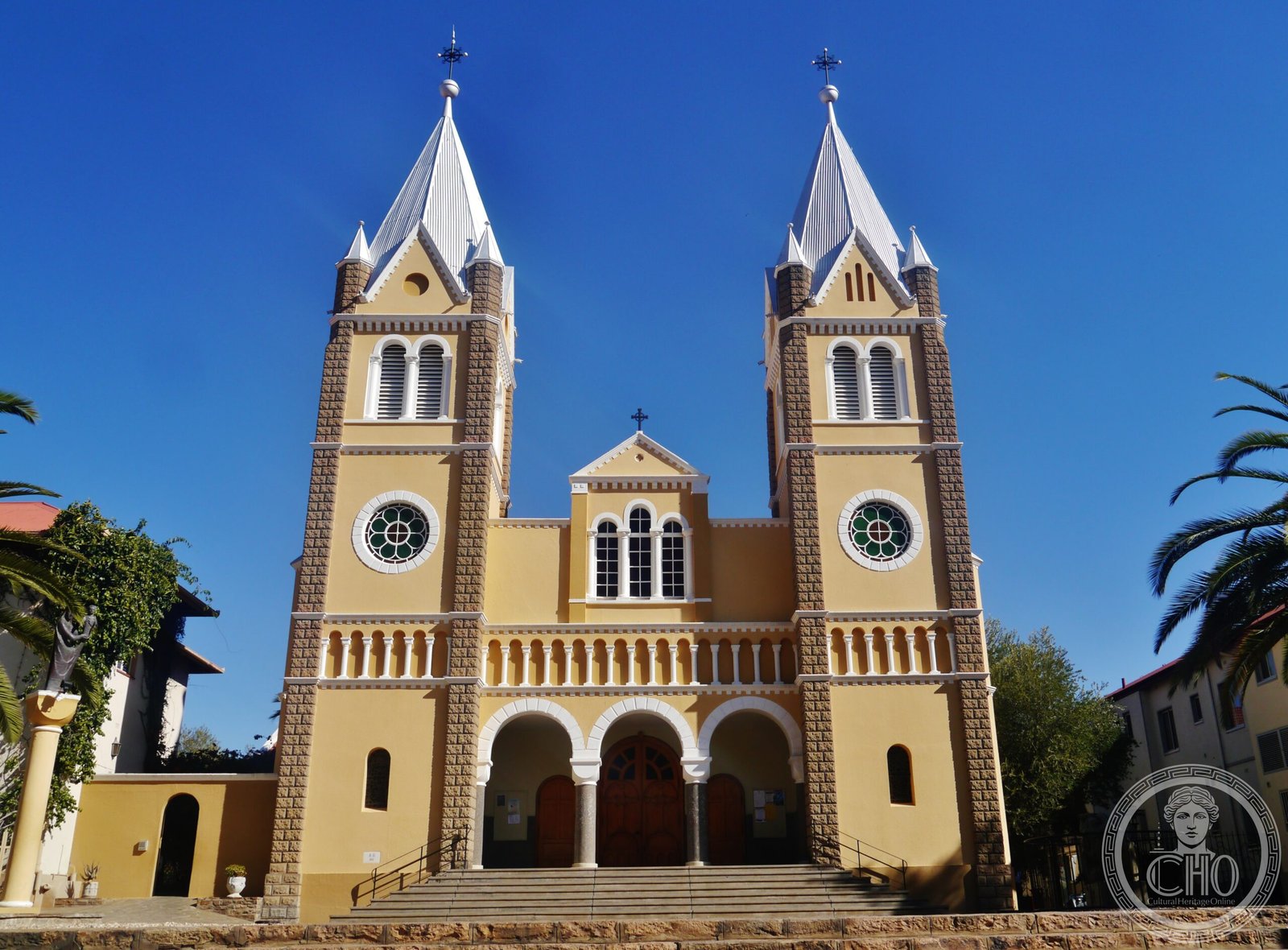
The building itself was constructed between 1906 and 1908, using local materials with brick elements, in the Romanesque Revival style. It had two quadrangular towers over four levels, crowned by white spires, and a facade preceded by a triple round-arched porch. The land was granted by the German colonial government in 1896 to the Oblati di Maria Immacolata, who had held the territory’s Catholic prefecture since 1892. They also built a rectory, hospital, convent, and secondary school on the same hill, later known as “Roman Hill.”
As the community grew, the church was expanded in 1931 and consecrated as the Cattedrale di Santa Maria on 24 April 1932. No architect’s name is documented.
The construction of the cathedral, between 1906 and 1908, coincided with the years of the Herero and Nama genocide (1904-1908) in the German colony of Africa Sud-occidentale. However, the historically documented role of missionaries in gathering Herero and Nama survivors for detention in concentration camps is associated mainly with the Rhenish mission, of Lutheran Protestant tradition. This mission was linked to the Christ Church of the same city, not to the Catholic mission of the Oblati di Maria Immacolata.
As for the latter, sources instead document a disruption caused by the conflict: a Catholic mission station founded in 1904 at Epukiro was destroyed in 1905 during the Herero-Nama uprising. No documented link exists between the cathedral building itself and the concentration-camp system of the period.
The apostolic prefecture of (Lower) Cimbebasia was erected on 1 August 1892, entrusted to the Oblati di Maria Immacolata. It was renamed the apostolic prefecture of Cimbebasia on 10 January 1921. It was elevated to the apostolic vicariate of Windhoek on 11 May 1926, and finally to the metropolitan archdiocese of Windhoek on 14 March 1994, shortly after Namibian independence. A previous claim that the building was elevated to a cathedral in 1952, with the establishment of a “diocese of Windhoek,” conflicts with this better-documented chronology and should be considered unreliable.
Among the mission’s leaders, Monsignor Bonifatius Haushiku was, from 1980, the first head of Namibian origin. The current archbishop is Monsignor Liborius Ndumbukuti Nashenda, oblata di Maria Immacolata, appointed in 2004.
No specific event tied to the building is documented during the South African occupation of Windhoek, which took place without clashes on 15 May 1915. The same is true for Namibian independence on 21 March 1990. Sources document only, at a general level, “very cordial” relations between the Chiesa (the Church) and the new Namibian Stato (the State) after that date.
No pope is documented to have ever visited Namibia or this cathedral. The building was declared a national monument on 15 June 1983, for its aesthetic and architectural value.
About St. Mary’s Cathedral
In Windhoek, Namibia, the first Catholic services were held in a wooden chapel with a canvas roof. The cornerstone of a permanent, single-tower church was laid in March 1903.
The building proper was constructed between 1906 and 1908 in local materials with brick elements, in the Romanesque Revival style. It had twin four-level towers crowned by white spires and a facade preceded by a triple-arched porch. The land was granted by the German colonial government in 1896 to the Oblates of Mary Immaculate, who had held the territory’s Catholic prefecture since 1892. They built a rectory, hospital, convent, and secondary school on the same hill, later known as “Roman Hill.”
Key facts
- 1906-1908: the cathedral built by Oblate missionaries on “Roman Hill”
- 24 April 1932: consecrated as St. Mary’s Cathedral after a 1931 expansion
- 11 May 1926 – 14 March 1994: the mission rises from apostolic vicariate to metropolitan archdiocese
- 15 June 1983: declared a national monument
- No documented connection between this cathedral and the German colonial concentration-camp system, which is historically tied to the Lutheran Rhenish mission
- No papal visit to Namibia or this cathedral has ever taken place
History
Built between 1906 and 1908 by Oblate missionaries on a hilltop granted by the German colonial government, this cathedral rose during the same years as the Herero and Nama genocide in German South West Africa. However, the documented missionary role in the colonial camp system belongs to Windhoek’s separate Lutheran Rhenish mission, not this Catholic one. This Catholic mission’s own outlying mission station at Epukiro was instead destroyed in the same conflict.
Declared a national monument in 1983 and elevated to a metropolitan archdiocese in 1994, shortly after Namibian independence, it has never received a papal visit.
What you see
Twin Romanesque Revival towers rise in four levels to white-painted spires above a mustard-colored stucco facade with brown stone quoining. Its entrance is preceded by a triple-arched porch — a design distinct from the single Gothic spire of Windhoek’s better-known Lutheran Christ Church nearby.
Practical information
- Opening hours: generally open daily outside services; check current hours before visiting
- Address: near Werner List Street, central Windhoek, Namibia (street-name spelling varies across sources)
Getting there
The cathedral stands on “Roman Hill” in central Windhoek. GPS: 22°33′53″S, 17°04′56″E.
Nearby
- Christ Church, Windhoek — the city’s landmark Lutheran church, a separate building with its own colonial history
Sources
- Wikipedia — “St. Mary’s Cathedral, Windhoek” and “Roman Catholic Archdiocese of Windhoek”
- windhoekcc.org.na — “Roman Catholic Cathedral,” Windhoek city heritage page
- rcchurch.na — “Brief History,” Roman Catholic Church in Namibia
- Catholic-Hierarchy.org — Archdiocese of Windhoek listing
Find it on the map
See this place and what’s around it →📷 Become a Cultural Heritage Online photographer
Share your photos of places: they stay published under your name as the author. The more they're seen, the more you get noticed — and soon a contest will reward the most appreciated photos.
Log in or sign up free to add a photo