
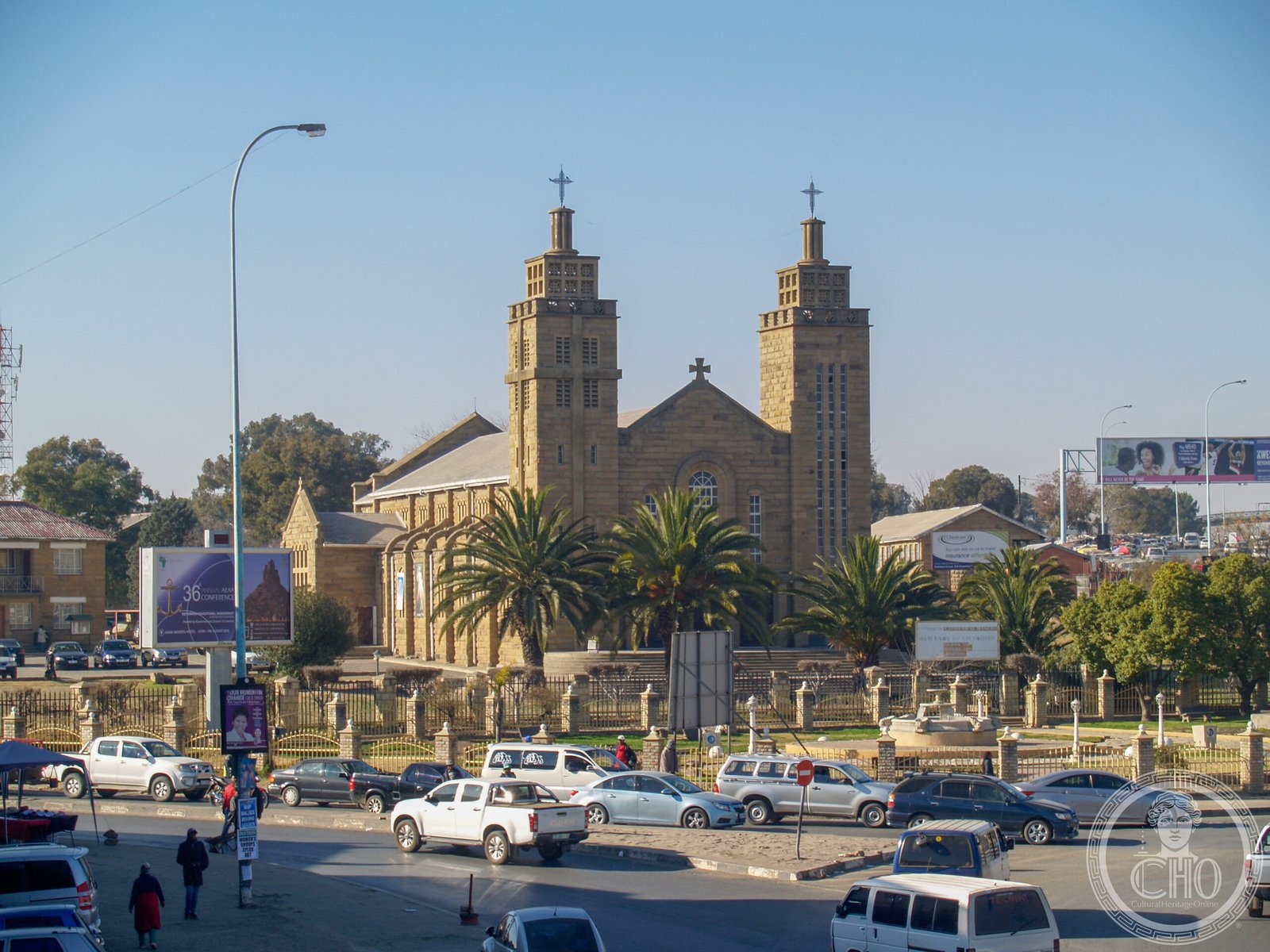
In Maseru, the capital of Lesotho, the cathedral of Our Lady of Victories was completed in 1955 as a simple parish church, designed by the South African architect Eduard Hebertus Antonio Payens. It was built in local sandstone for reasons of cost and of context, with a tower that reflects the influence of post-war Dutch architecture, and precast geometric concrete elements used for graphic effect and to reduce costs. The body that commissioned it is not documented with certainty, although a link with the mission of the Oblates of Mary Immaculate active in the region is reasonable to assume. The Catholic mission in Basutoland arrived late compared with the Protestant mission of the Paris Evangelical Missionary Society, present since 1833 at the invitation of King Moshoeshoe I. Two Oblates were sent from the apostolic vicariate of Natal and settled at Roma, a place some 30 kilometres from Maseru, in 1862. Moshoeshoe I himself chose the site of the mission and is said to have attended the consecration of the first Catholic church, urging his chiefs to protect it; the sources differ slightly on the exact composition of the founding missionary group. The king never formally converted, fearing that he would divide a people already partly attached to the evangelical church. Shortly before his death in 1870 he is said to have declared that he had been «a believer for three months», with a baptism arranged for the night before he died, which never took place. The ecclesiastical district was erected as the apostolic prefecture of Basutoland on 8 May 1894, raised to an apostolic vicariate on 18 February 1909, to the diocese of Maseru on 11 January 1951 and finally to a metropolitan archdiocese on 3 January 1961, with the bull «Etsi priora»; on that occasion the church was raised to a cathedral. The first archbishop, Emmanuel ‘Mabathoana, a great-grandson of King Moshoeshoe I himself, was the first African Catholic bishop of southern Africa. He died on 19 September 1966, during a flight from Maseru to Pretoria, just two weeks before the independence of Lesotho on 4 October 1966, a documented coincidence, although no specific ceremony connected with independence is recorded in the cathedral itself. Nor is there any documented link between the building and the political crisis of 1998, when the military intervention of the SADC followed disorder that caused heavy damage to the centre of Maseru. From 14 to 16 September 1988 Pope John Paul II visited Lesotho, celebrating mass and meeting the local bishops’ conference. He beatified Father Joseph Gerard, an Oblate of Mary Immaculate, at the Maseru racecourse, although a dispatch of the time wrongly called him a Jesuit, and he met priests, religious and seminarians specifically in the cathedral of Maseru. The present archbishop is Monsignor Gerard Tlali Lerotholi, in office since 2009.
About Our Lady of Victories Cathedral
In Maseru, the capital of Lesotho, Our Lady of Victories Cathedral was completed in 1955 as a simple parish church, designed by South African architect Eduard Hebertus Antonio Payens and built in local sandstone for economic and contextual reasons, its tower reflecting post-war Dutch architectural influence and precast geometric concrete elements used for graphic effect and cost reduction. The Catholic mission in Basutoland arrived late compared to the Paris Evangelical Missionary Society’s Protestant mission, present since 1833 at King Moshoeshoe I’s invitation: two Oblates of Mary Immaculate, sent from the Vicariate of Natal, settled at Roma, some 30 kilometers from Maseru, in 1862, with Moshoeshoe I himself choosing the mission site and reportedly attending the first Catholic church’s consecration there.
Key facts
- 1955: the church built in local sandstone by architect Eduard Payens.
- 3 January 1961: elevated to cathedral and seat of the new Metropolitan Archdiocese of Maseru.
- 1961-1966: Archbishop Emmanuel ‘Mabathoana, great-grandson of King Moshoeshoe I, becomes Southern Africa’s first African Catholic bishop.
- 19 September 1966: ‘Mabathoana dies mid-flight, two weeks before Lesotho’s independence.
- 15 September 1988: Pope John Paul II meets priests, religious, and seminarians here during his Lesotho visit.
- 2009: Archbishop Gerard Tlali Lerotholi takes office.
History
Built as an ordinary parish church in 1955 and elevated to cathedral status only in 1961, this building became the seat of an archdiocese led by Emmanuel ‘Mabathoana — Southern Africa’s first African Catholic bishop and a great-grandson of King Moshoeshoe I, the very monarch who had welcomed the first Oblate missionaries to Basutoland a century earlier. ‘Mabathoana’s death mid-flight just two weeks before Lesotho’s 1966 independence closes a symbolic century-long arc between a king’s cautious embrace of a new faith and his descendant’s death on the threshold of a new nation.
What you see
A sandstone facade and tower reflect post-war Dutch architectural influence, with precast geometric concrete elements chosen for both visual effect and economy, in a building designed more for a modest parish than for the archdiocesan seat it soon became.
Practical information
- Opening hours: generally open daily outside services; check current hours before visiting.
- Address: central Maseru, Lesotho (no formally documented street address; see GPS).
Getting there
The cathedral stands in central Maseru. GPS: 29°19′01″S, 27°29′42″E.
Nearby
- Central Maseru — Lesotho’s capital and commercial center surrounding the cathedral.
Sources
- Wikipedia — “Our Lady of Victories Cathedral, Maseru” and “Roman Catholic Archdiocese of Maseru”
- artefacts.co.za — South African built-environment database, entry on architect Eduard Payens.
- Vatican.va — official itinerary, Apostolic Journey of Pope John Paul II to Africa, September 1988.
- Encyclopedia.com — “Lesotho, The Catholic Church in”
Find it on the map
See this place and what’s around it →📷 Become a Cultural Heritage Online photographer
Share your photos of places: they stay published under your name as the author. The more they're seen, the more you get noticed — and soon a contest will reward the most appreciated photos.
Log in or sign up free to add a photo