
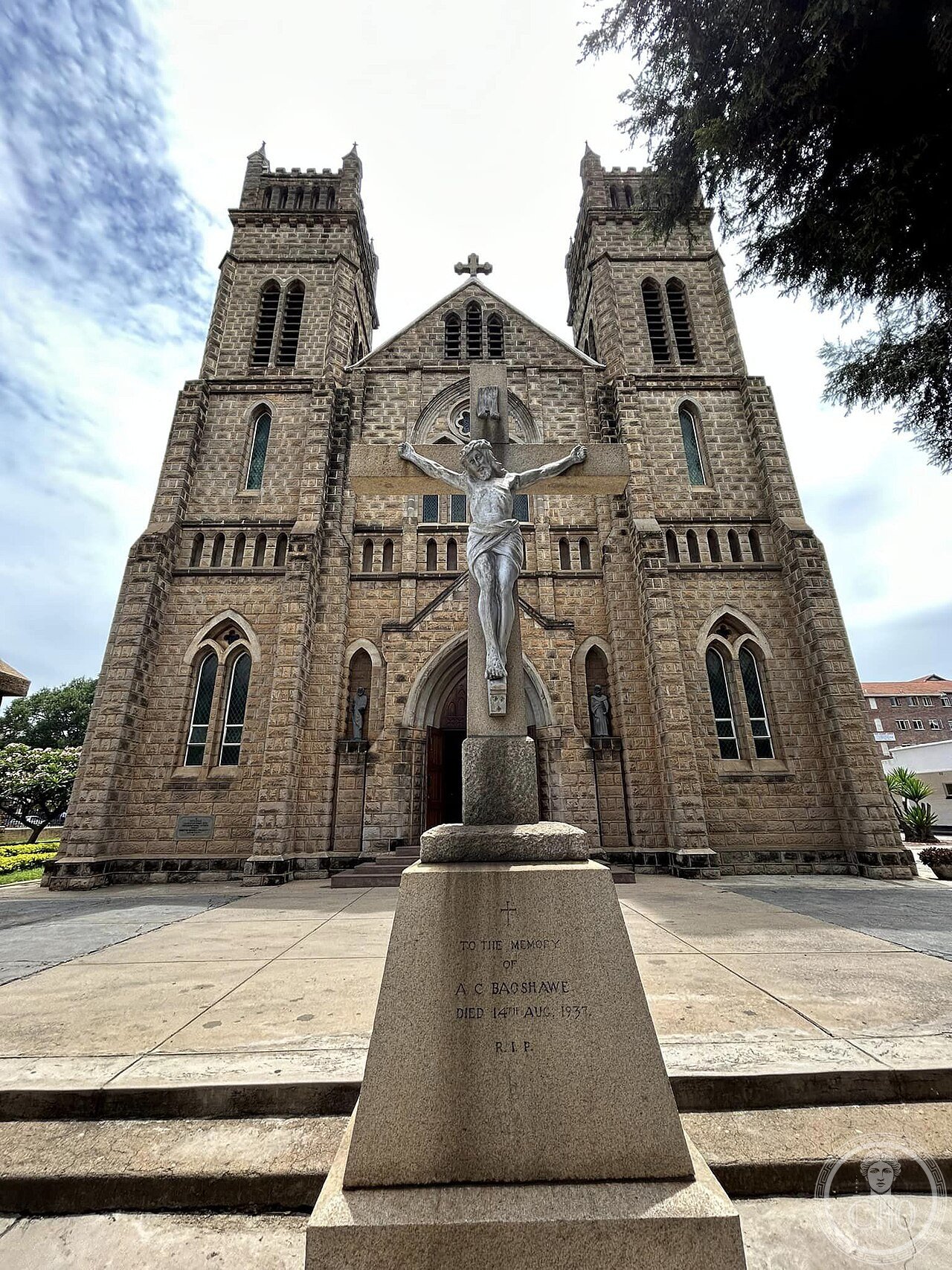
Ad Harare, capitale dello Zimbabwe (allora Salisbury, nella Rhodesia coloniale), i missionari gesuiti aprirono una piccola cappella per 40 persone nel 1893, presso il convento domenicano della città; una chiesa più grande, progettata da padre Aloysius Leboeuf, aprì nel giorno dell’Annunciazione del 1900. La prima pietra dell’attuale cattedrale fu posata dal monsignor Brown, secondo Wikipedia il 28 giugno 1924, sebbene un’altra fonte indichi una data internamente incoerente (“il giorno di San Patrizio, nel maggio 1924” — San Patrizio cade però il 17 marzo); l’edificio fu completato e inaugurato domenica 2 agosto 1925. Il progetto è attribuito allo stesso padre Leboeuf, senza un architetto professionista distinto documentato dalle fonti; la costruzione fu realizzata da fratelli missionari gesuiti e marianhill francesi e tedeschi, con l’assistenza di costruttori africani — una circostanza insolita, dato che i mestieri edili qualificati nella Rhodesia coloniale rimasero dominati da manodopera europea fino agli anni Cinquanta. In stile gotico revival, la cattedrale è lunga 40 metri e larga 19,5, con due torri che affiancano l’ingresso occidentale e una cantoria sopra di esso; le pareti sono in mattoni rivestiti di pietra artificiale, mentre le finestre e gli archi gotici a sesto acuto furono realizzati in cemento, una scelta innovativa per l’epoca e il luogo, con legni pregiati importati da Beira, in Mozambico, e legno saligna dalla missione di Driefontein. Le rifiniture artigianali comprendono i ferri battuti di fratel Schönbrod, gli intagli in pietra ollare di fratel Krechel, gli elementi in legno intagliato di fratel Göll e le vetrate importate dall’Austria; nel 1970 furono aggiunte estensioni sui lati sud ed est. La diocesi, con origini che risalgono alla “missione sui iuris” dello Zambesi istituita il 2 luglio 1879, divenne prefettura apostolica dello Zambesi nel 1915, fu rinominata prefettura apostolica di Salisbury nel 1927, elevata a vicariato apostolico nel 1931 e infine ad arcidiocesi metropolitana di Salisbury il 1° gennaio 1955, ridenominata arcidiocesi di Harare il 25 giugno 1982 dopo l’indipendenza del paese. I gesuiti amministrarono la parrocchia cattedrale fino al 31 dicembre 2008, quando fu affidata al clero diocesano. Papa Giovanni Paolo II visitò la cattedrale l’11 settembre 1988, nel corso di un viaggio apostolico che toccò anche Botswana, Lesotho, Eswatini e Mozambico, elogiando in quell’occasione il secolo di contributo dei gesuiti alla Chiesa nello Zimbabwe; il 2025 ha segnato il centenario dell’apertura dell’edificio. L’attuale arcivescovo di Harare è monsignor Robert Christopher Ndlovu, insediato nel 2004 (le fonti divergono sulla data esatta, indicando variamente il 10 giugno o il 21 agosto). Non risulta, nelle fonti consultate, un’iscrizione della cattedrale nel registro dei monumenti nazionali dello Zimbabwe.
About Cathedral of the Sacred Heart
In Harare, the capital of Zimbabwe (then Salisbury, in colonial Rhodesia), Jesuit missionaries opened a small chapel for 40 people in 1893 on the grounds of the city’s Dominican Convent; a larger church, designed by Father Aloysius Leboeuf, opened on the Feast of the Annunciation in 1900. The foundation stone of the present cathedral was laid by Monsignor Brown, per Wikipedia on 28 June 1924, though another source gives an internally inconsistent date (“St Patrick’s Day, in May 1924” — St Patrick’s Day actually falls on 17 March); the building was completed and opened on Sunday, 2 August 1925.
Key facts
- 1893: the first small Jesuit mission chapel opens in Salisbury
- 1924-1925: the present cathedral built, designed by Father Aloysius Leboeuf
- 1 January 1955: the see elevated to the Metropolitan Archdiocese of Salisbury, later Harare
- 11 September 1988: visited by Pope John Paul II
- 31 December 2008: parish administration transferred from Jesuits to diocesan clergy
- 2025: the cathedral’s centenary
History
Built by Jesuit and Marianhill missionary brothers working alongside African builders, at a time when skilled construction trades in colonial Rhodesia remained largely closed to Black tradesmen, the Cathedral of the Sacred Heart’s own construction history quietly complicates the segregated society it rose within. Its subsequent century — from Jesuit administration through a 1988 papal visit to its 2008 handover to diocesan clergy and 2025 centenary — traces the transition from a colonial mission church to the seat of an independent Zimbabwe’s Catholic archdiocese.
What you see
Twin Gothic Revival towers flank the west entrance of a cast-stone-clad brick building whose pointed arches and windows were built in concrete, an innovative material choice for 1920s Rhodesia. Inside, ironwork by Brother Schönbrod, soapstone carving by Brother Krechel, carved timber by Brother Göll and stained glass imported from Austria reflect the missionary brothers who built and furnished the cathedral by hand.
Practical information
- Opening hours: generally open daily outside services; check current hours before visiting
- Address: Fourth Street at Herbert Chitepo Avenue, Harare, Zimbabwe
Getting there
The cathedral stands in central Harare at the corner of Fourth Street and Herbert Chitepo Avenue, easily reached on foot from the city center. GPS: 17°49′16″S, 31°03′12″E.
Nearby
- Central Harare — the city’s main commercial and administrative district
Sources
- Wikipedia — “Sacred Heart Cathedral, Harare” and “Roman Catholic Archdiocese of Harare” (en.wikipedia.org)
- Open Council — “Historic Buildings: Cathedral of the Sacred Heart” (opencouncil.co.zw)
- Vatican.va — Pope John Paul II, Harare farewell ceremony, 13 September 1988
Find it on the map
See this place and what’s around it →📷 Become a Cultural Heritage Online photographer
Share your photos of places: they stay published under your name as the author. The more they're seen, the more you get noticed — and soon a contest will reward the most appreciated photos.
Log in or sign up free to add a photo