
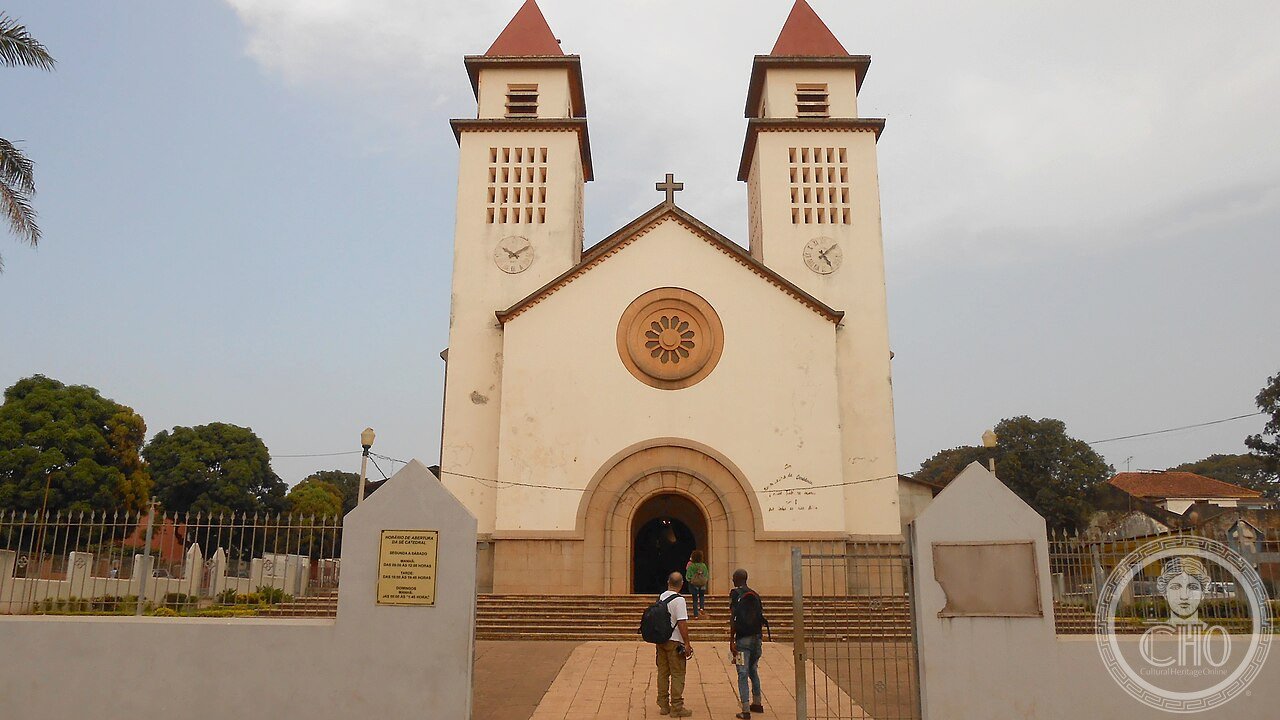
In Bissau, the capital of Guinea-Bissau, work on the present cathedral, dedicated to Nossa Senhora da Candelária, began on 28 May 1935, replacing an earlier building described as of «medievalist expression». One source credits the initiative to the missionary priest José Pinheiro, under the colonial governor General Carvalho Viegas, a detail not confirmed by other independent sources. The design passed through several architects: Vasco Regaleira in 1942, Paulo Cunha in the revisions of 1945, and finally João Simões and Galhardo Zilhão, authors of the definitive design of 1946-1947. The consecration took place on 7-8 December 1950, although one source mistakenly gives 1954, a year that in fact corresponds to the installation of an electric organ. In a modernised Romanesque Revival style with Portuguese tropical features, the cathedral has three naves over five bays, a wooden roof structure, buttresses, elongated windows and a central rose window, with stained glass added in 1953. Its most unusual feature is that the north tower, about 36 metres high, works as an active lighthouse: a flashing green light with a period of about nine seconds guides ships along the estuary of the Geba river to the port of Bissau, maintained according to one source by the Capitania dos Portos. Catholic missionary presence in the region goes back to the Portuguese arrival, traditionally dated to 1446, with the Franciscans charged with evangelisation from 1462, but for centuries it remained extremely thin: by 1929 there was a single priest in the whole territory. A revival came with the re-establishment of the French Franciscan mission in 1933 and the arrival of the priests of the Pontifical Institute for Foreign Missions of Milan in 1947. No direct role of the cathedral is documented during the war of independence of Guinea-Bissau, from 1963 to 1974. The ecclesiastical circumscription was erected as a mission «sui iuris» on 4 September 1940, separated from the diocese of Santiago de Cabo Verde. It was raised to an apostolic prefecture on 29 April 1955, renamed apostolic prefecture of Guinea-Bissau on 1 January 1975 after independence, and finally raised to the diocese of Bissau on 21 March 1977, when the cathedral formally became its seat. Pope John Paul II came here on 27 January 1990, in the first papal visit ever to the country, meeting priests, religious, seminarians, catechists and lay people. Bishop Settimio Ferrazzetta gave an address in the cathedral on 9 August 1998 denouncing the violence during the civil war of Guinea-Bissau, from June 1998 to May 1999. He died on 26-27 January 1999 and is buried inside the building. No source consulted either confirms or rules out direct physical damage to the cathedral during the conflicts in the country. The present bishop of Bissau is Monsignor José Lampra Cá, appointed on 10 December 2021. The building is recorded in the Portuguese heritage inventory SIPA (ref. 30430), without any formal legal protection under the law of Guinea-Bissau being confirmed.
About Sé Catedral de Nossa Senhora da Candelária
In Bissau, the capital of Guinea-Bissau, construction of the present cathedral, dedicated to Our Lady of Candelária, began on 28 May 1935, replacing an earlier building described as of “medievalist expression,” reportedly on the initiative of missionary priest José Pinheiro under colonial governor General Carvalho Viegas — a detail not independently confirmed by other sources. The design passed through several architects: Vasco Regaleira in 1942, Paulo Cunha in 1945 revisions, and finally João Simões and Galhardo Zilhão, credited with the final 1946-1947 design; the building was consecrated on 7-8 December 1950, though one source mistakenly gives 1954, a year that actually corresponds to the installation of an electric organ.
Key facts
- 1935-1950: the current cathedral built and consecrated.
- The 36-metre north tower doubles as an active lighthouse guiding ships up the Geba River.
- 21 March 1977: elevated to the seat of the newly created Diocese of Bissau.
- 27 January 1990: visited by Pope John Paul II, the first-ever papal visit to Guinea-Bissau.
- 9 August 1998: Bishop Settimio Ferrazzetta denounces civil-war violence in a cathedral address.
- 1999: Bishop Ferrazzetta buried inside the cathedral after his death.
History
Built over 15 years under Portuguese colonial rule and consecrated in 1950, Sé Catedral de Nossa Senhora da Candelária became the cathedral of an independent Guinea-Bissau’s own diocese in 1977, three years after the country’s independence. Its role during the country’s independence war and later civil war remains only partly documented, but Bishop Settimio Ferrazzetta’s 1998 public denunciation of civil-war violence, delivered from the cathedral itself, stands as its clearest recorded moment of engagement with the nation’s turmoil.
What you see
A modernized Neo-Romanesque building with tropical Portuguese characteristics, its three naves span five bays beneath a wooden roof structure, lit by elongated windows and a central rose window with stained glass added in 1953. Its most unusual feature is functional rather than decorative: the roughly 36-metre north tower carries an operating navigation light, a flashing green beacon guiding ships along the Geba River estuary into the Port of Bissau.
Practical information
- Opening hours: generally open daily outside services; check current hours before visiting.
- Address: Avenida Amílcar Cabral, Bissau, Guinea-Bissau.
Getting there
The cathedral stands on Avenida Amílcar Cabral, one of central Bissau’s main thoroughfares, easily reached on foot from the city center. GPS: 11°51′36″N, 15°34′52″W.
Nearby
- Avenida Amílcar Cabral — Bissau’s central avenue, lined with government and commercial buildings.
Sources
- Wikipedia — “Bissau Cathedral” (en.wikipedia.org).
- Portuguese Wikipedia — “Catedral de Bissau”
- Vatican.va — Pope John Paul II, address at Bissau Cathedral, 27 January 1990.
- Wikipedia — “Settimio Ferrazzetta” (en.wikipedia.org).
Find it on the map
See this place and what’s around it →📷 Become a Cultural Heritage Online photographer
Share your photos of places: they stay published under your name as the author. The more they're seen, the more you get noticed — and soon a contest will reward the most appreciated photos.
Log in or sign up free to add a photo