
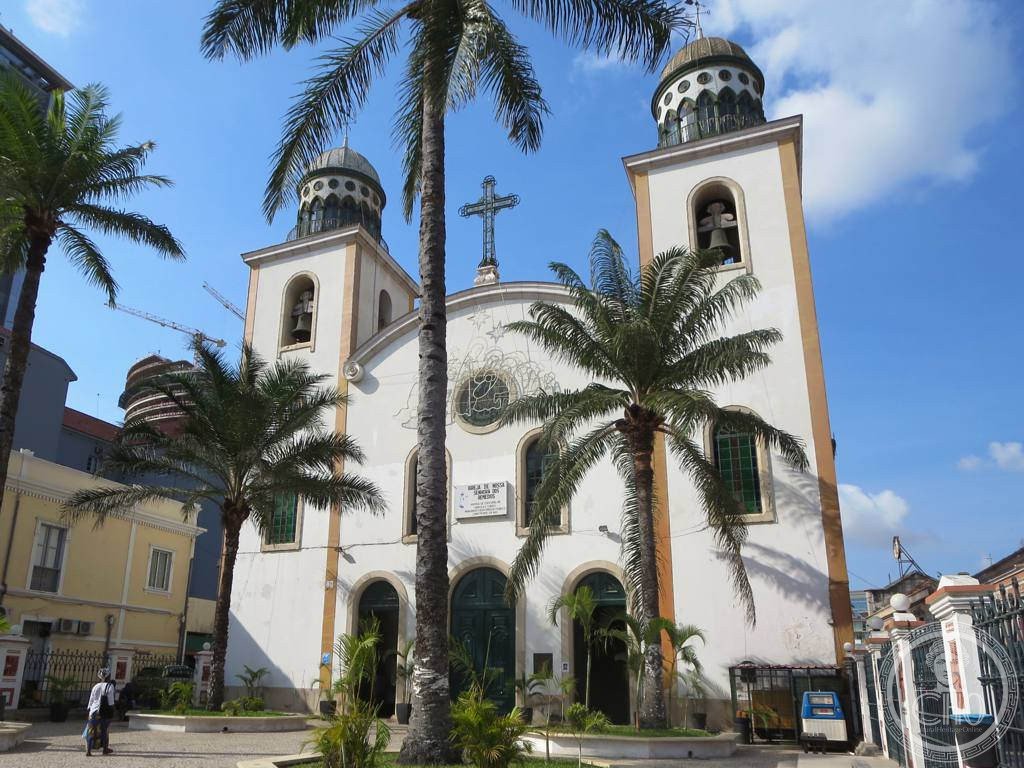
In Luanda, the capital of Angola, the present Sé Catedral, formally the Igreja de Nossa Senhora dos Remédios, the church of Our Lady of Remedies, replaced two small earlier chapels on the same site, dedicated to the Holy Spirit and to Corpus Christi. The building, begun according to the sources in 1651 or in 1655 and completed in 1679, when it was solemnly inaugurated by Bishop Manuel da Natividade, was promoted by the merchants and the inhabitants of the «baixa», the lower city of Luanda, as a collective civic and religious undertaking to rival the churches of the upper city. No source names a particular patron or architect. One entry in the English edition of Wikipedia gives 1628 instead as the year of construction, against three independent sources that agree on the period 1650-1679, and the discrepancy remains unresolved. The building has a Baroque façade with two twin bell towers crowned by domes of wrought iron, a rectangular plan with a single nave, three doorways with small pediments and a broad triangular pediment with volutes and an oculus. The interior keeps two pulpits, a wooden ceiling, wrought-iron elements, the Portuguese royal arms and a Cross of Christ, the emblem of Portuguese colonial expansion. By 1877 the building was in a state of almost complete ruin. A major restoration, carried out between 1880 and 1900, and completed according to some sources in 1897, gave it its present look, with a curved pediment and decorative elements of neo-Baroque and Gothic Revival taste. Catholicism reached the region through the Kingdom of Kongo, which converted after the first Portuguese contacts of 1483. The diocese of Angola and Congo was erected in 1596 by Pope Clement VIII, with its seat at first in São Salvador do Congo, Mbanza Kongo, the capital of the kingdom, before moving to Luanda in 1716. No source documents a direct role of this particular building in the Atlantic slave trade, unlike the church of Nossa Senhora da Muxima, about 110 kilometres from Luanda, historically tied to that trade and visited for that reason by Pope Leo XIV in April 2026, a distinction that should not be blurred. According to a source in Portuguese, the building already served as a cathedral between 1828 and 1850, and returned to that role later, though the sources do not fully clarify the continuity of this status over time. On 4 September 1940 the diocese was raised to the metropolitan archdiocese of Luanda, with Moisés Alves de Pinho as its first archbishop. No specific damage to the building is documented during the Angolan civil war, from 1975 to 2002, nor any papal visit confirmed specifically to the cathedral, despite the visits to Angola of John Paul II in 1992, Benedict XVI in 2009 and Leo XIV in 2026. The present archbishop of Luanda is Monsignor Filomeno do Nascimento Vieira Dias, in office since 8 December 2014. The building was declared an «Imóvel de Interesse Público» in 1949, under the Portuguese colonial administration.
About Sé Catedral de Luanda
In Luanda, the capital of Angola, the current Sé Catedral — formally the Igreja de Nossa Senhora dos Remédios (Church of Our Lady of Remedies) — replaced two earlier small chapels on the same site, dedicated to the Holy Spirit and to Corpus Christi. Construction, begun according to sources in either 1651 or 1655 and completed in 1679, when it was solemnly inaugurated by Bishop Manuel da Natividade, was promoted by merchants and residents of Luanda’s “baixa” (lower city) as a collective civic and religious initiative to rival the churches of the upper city — no source identifies a specific patron or architect. One English Wikipedia entry instead cites 1628 as the construction year, contradicting three independent sources that agree on the 1650-1679 range; this discrepancy remains unresolved.
Key facts
- 1651/1655-1679: the cathedral built by merchants of Luanda’s lower city.
- 1596: the Diocese of Angola and Congo established, originally seated in the Kongo capital.
- 1716: the episcopal seat moved to Luanda.
- 1880-1900: a major restoration after near-total ruin by 1877, giving the current façade.
- 4 September 1940: elevated to the Metropolitan Archdiocese of Luanda.
- 1949: declared a Property of Public Interest under Portuguese colonial administration.
History
Built not by a colonial governor or bishop but by the merchants of Luanda’s own lower city, seeking to match the churches of the wealthier upper town, the Sé Catedral’s origins reflect the commercial character of Portuguese colonial Luanda as much as its religious life. Its lineage traces back to the Kingdom of Kongo’s early Christian conversion in the 1480s, through a diocese first seated in the Kongo capital before relocating to Luanda in 1716 — a history distinct from, and sometimes confused with, the region’s separately documented role in the transatlantic slave trade.
What you see
Twin Baroque bell towers, each topped with a wrought-iron dome, flank a triangular pediment with volutes and a central oculus above three arched entrance doors. Inside, a wooden ceiling, wrought-iron fittings, two pulpits, the Portuguese royal coat of arms and a Cross of Christ recall the church’s colonial-era origins, while the current curved pediment and decorative details date to an 1880-1900 restoration that rescued the building from near-total ruin.
Practical information
- Opening hours: generally open daily outside services; check current hours before visiting.
- Address: Largo do Palácio, 9, Luanda, Angola.
Getting there
The cathedral stands on Largo do Palácio in Luanda’s historic Baixa district, near Rua dos Mercadores, easily reached on foot from the old town center. GPS: 8°48′49″S, 13°13′47″E.
Nearby
- Baixa de Luanda — the historic lower-city district surrounding the cathedral.
Sources
- Portuguese Wikipedia — “Sé Catedral de Luanda” (pt.wikipedia.org).
- Wikipedia — “Church of Our Lady of Remedies” and “Archdiocese of Luanda” (en.wikipedia.org).
- Rede Angola — “Sé Catedral de Luanda”
Find it on the map
See this place and what’s around it →📷 Become a Cultural Heritage Online photographer
Share your photos of places: they stay published under your name as the author. The more they're seen, the more you get noticed — and soon a contest will reward the most appreciated photos.
Log in or sign up free to add a photo