
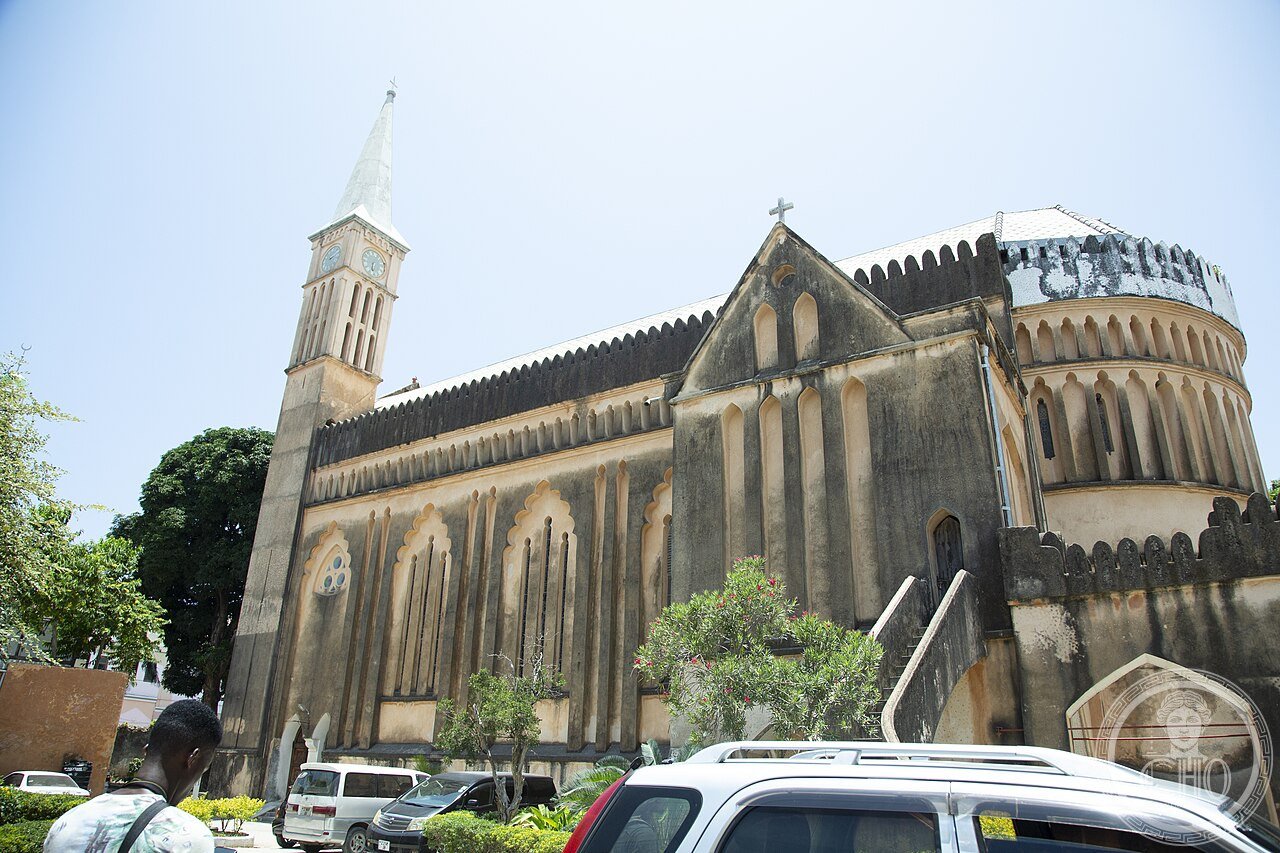
A Stone Town, capitale storica di Zanzibar, in Tanzania, la Christ Church Cathedral sorge sul sito del più grande mercato degli schiavi dell’Africa orientale, chiuso come mercato aperto nel 1873 in seguito al decreto del sultano Barghash che vietava la tratta, legato al trattato negoziato con la Gran Bretagna (Frere Treaty, 5 giugno 1873); la Universities Mission to Central Africa (UMCA) acquistò il terreno lo stesso anno. La prima pietra fu posata il giorno di Natale del 1873 e la cattedrale fu aperta al culto il giorno di Natale del 1879, dopo circa sei anni di lavori guidati sotto l’ispirazione del vescovo Edward Steere, terzo vescovo anglicano di Zanzibar, a cui si attribuisce l’idea insolita della copertura a volta in cemento; alcune fonti indicano una consacrazione formale separata, avvenuta solo nel 1903, ma questa data non è confermata da più di una fonte e va considerata incerta. Steere morì poco prima del completamento dell’edificio e secondo la tradizione riportata da alcune fonti sarebbe sepolto dietro l’altare. La cattedrale è costruita in pietra corallina locale, in uno stile che unisce il gotico perpendicolare inglese a dettagli decorativi di ispirazione islamica, con un rosone e vetrate colorate, un soffitto del coro realizzato con pali di mangrovia (boriti) secondo la tecnica costruttiva swahili tradizionale, e un intonaco esterno a base di polvere di marmo secondo la tecnica locale nota come “neeru”. Secondo la tradizione locale e della chiesa, l’altare maggiore fu collocato proprio nel punto in cui sorgeva il palo delle fustigazioni del mercato, un cerchio di marmo bianco circondato da marmo rosso segnerebbe simbolicamente il luogo; va detto con chiarezza che si tratta di una collocazione tradizionale e di un gesto deliberato di commemorazione religiosa da parte dei costruttori, non di una ricostruzione archeologica verificata della posizione esatta del palo originale. All’interno si trova inoltre una croce di legno, custodita come reliquia, che secondo la tradizione sarebbe stata ricavata dal legno dell’albero di Chitambo, in Zambia, sotto cui fu sepolto il cuore dell’esploratore e missionario David Livingstone nel 1873 — un’associazione tramandata con devozione ma della quale nessuna fonte consultata fornisce una documentazione di provenienza certa. Sotto la cattedrale sono conservate le celle sotterranee un tempo usate per la detenzione delle persone ridotte in schiavitù, oggi aperte ai visitatori come parte di un percorso commemorativo; tra il 2013 e il 2016 un importante restauro, condotto dalla diocesi anglicana di Zanzibar in collaborazione con il World Monuments Fund Britain e finanziato in parte con un contributo dell’Unione Europea e con fondi dell’Ambasciata statunitense per la conservazione culturale, ha stabilizzato le mura e il tetto e restaurato il rosone; nel giugno 2016 la cattedrale ha aperto un centro espositivo dedicato alla storia della tratta degli schiavi nell’Africa orientale. La cattedrale rimane oggi sede attiva della diocesi anglicana di Zanzibar, riorganizzata nel 2001 dopo un periodo di indebolimento seguito alla rivoluzione di Zanzibar del 1964, e si trova all’interno del sito Patrimonio dell’Umanità UNESCO “Stone Town of Zanzibar”, iscritto nel 2000 come insieme urbano storico, di cui la cattedrale è uno degli edifici più significativi ma non un’iscrizione separata.
About Christ Church Cathedral
In Stone Town, the historic capital of Zanzibar, Tanzania, Christ Church Cathedral stands on the site of East Africa’s largest slave market, closed as an open market in 1873 following Sultan Barghash’s decree banning the trade, tied to a treaty negotiated with Britain (the Frere Treaty, 5 June 1873); the Universities Mission to Central Africa (UMCA) purchased the site that same year. The foundation stone was laid on Christmas Day 1873, and the cathedral opened for worship on Christmas Day 1879, after roughly six years of construction carried out under the inspiration of Bishop Edward Steere, third Anglican bishop of Zanzibar, credited with the unusual concrete barrel-vault roof design; some sources cite a separate, formal consecration as late as 1903, though that date is not confirmed by more than one source and should be treated as uncertain. Steere died shortly before the building’s completion and, according to tradition reported by some sources, is buried behind the altar.
Key facts
- 1873: the open slave market on the site is closed following Sultan Barghash’s decree; the foundation stone is laid on Christmas Day
- 1879: the cathedral opens for worship on Christmas Day
- Bishop Edward Steere inspires the design, including its unusual concrete barrel-vault roof
- The high altar stands, by long tradition, on or near the site of the market’s former whipping post
- A wooden cross inside is traditionally said to be carved from the tree at Chitambo, Zambia, linked to David Livingstone
- 2013-2016: major restoration with the World Monuments Fund Britain, EU and US funding support
- 2000: the cathedral stands within the UNESCO-inscribed Stone Town of Zanzibar historic urban ensemble
History
Built directly on the ground where East Africa’s largest slave market once stood, and completed just years after the formal closure of that market, Christ Church Cathedral was conceived from the outset as an act of religious and moral reckoning by its Anglican builders. The preserved underground holding cells beneath the building, and the 2016 opening of a dedicated slave-trade heritage exhibit on site, continue that same commemorative purpose into the present day, situating the cathedral as much as a memorial as a place of worship.
What you see
Built of local coral stone in a style blending English Perpendicular Gothic with Islamic decorative details, the cathedral’s most distinctive feature is its concrete barrel-vault roof, unusual for the region and period, alongside a stained-glass rose window, a choir ceiling built from traditional Swahili mangrove-pole (boriti) construction, and exterior plasterwork finished in the local “neeru” technique using crushed marble dust. Inside, a marble circle near the high altar marks, by tradition, the former site of the market’s whipping post, while the wooden cross linked to David Livingstone hangs as one of the cathedral’s most visited relics.
Practical information
- Opening hours: generally open daily to visitors outside services, including access to the underground slave-trade heritage exhibit; check current hours before visiting
- Address: Mkunazini Road, Stone Town, Zanzibar City, Zanzibar, Tanzania
Getting there
The cathedral stands on Mkunazini Road in the heart of Stone Town, easily reached on foot from anywhere in the historic quarter. GPS: 6°09′46″S, 39°11′33″E.
Nearby
- Slave Memorial sculpture — a monument to enslaved people in the square adjoining the cathedral
- Stone Town historic quarter — the wider UNESCO World Heritage urban ensemble surrounding the cathedral
Sources
- Wikipedia — “Christ Church, Zanzibar” (en.wikipedia.org)
- The Commonwealth Heritage Forum — “Christ Church Cathedral, Stone Town, Zanzibar”
- Episcopal News Service (2016) — “Zanzibar’s Christ Church Cathedral opens slave-trade heritage center”
- UNESCO World Heritage Centre — “Stone Town of Zanzibar” (whc.unesco.org)
Find it on the map
See this place and what’s around it →📷 Become a Cultural Heritage Online photographer
Share your photos of places: they stay published under your name as the author. The more they're seen, the more you get noticed — and soon a contest will reward the most appreciated photos.
Log in or sign up free to add a photo