
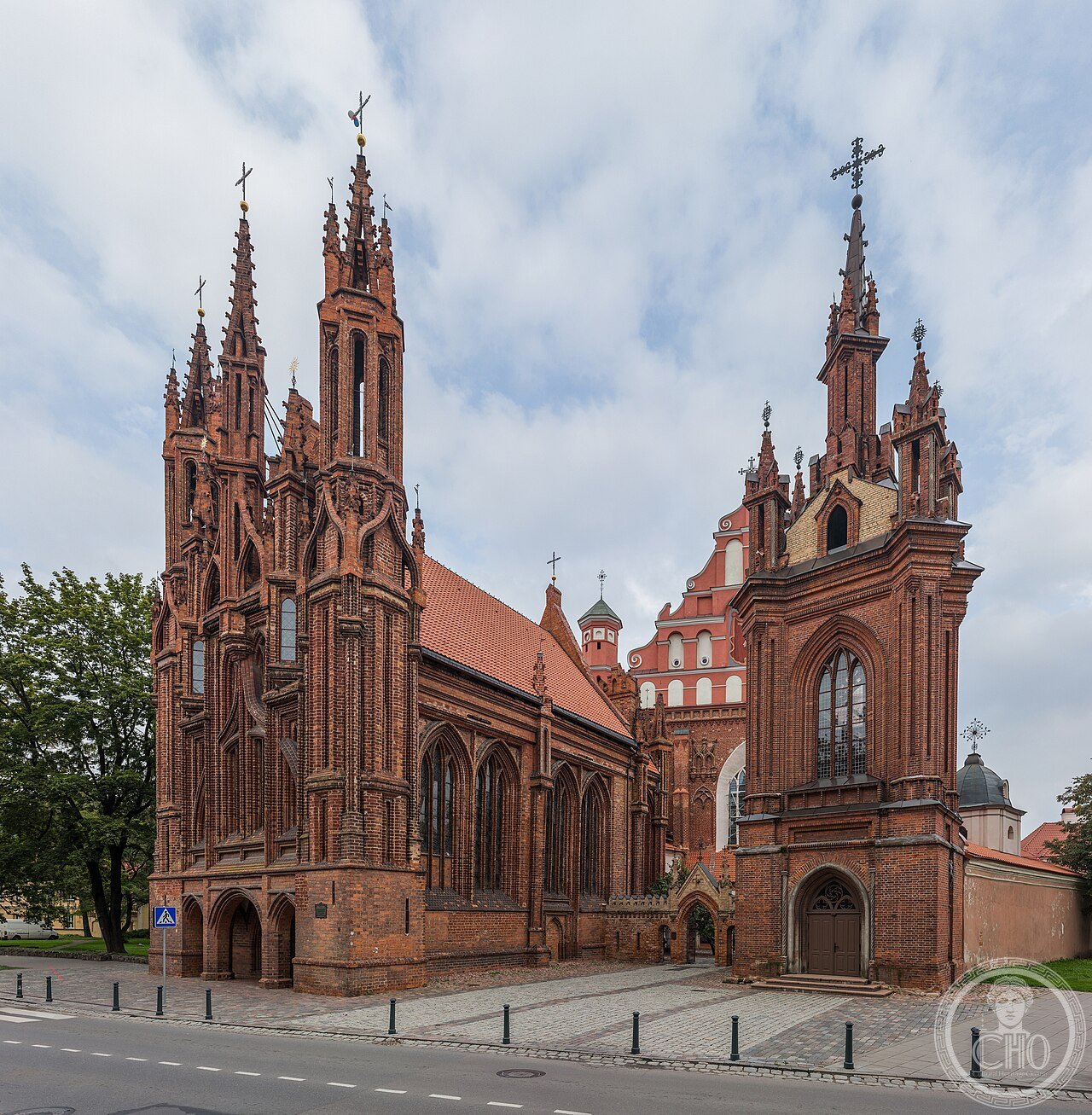
In Vilnius, Lithuania, a first wooden church stood on this site at the wish of Grand Duke Vytautas the Great, in honour of his wife Anna. It is documented from 1394 and was destroyed by fire, according to Wikipedia, in 1419. The brick church seen today was commissioned by Grand Duke Alexander I Jagiellon and built roughly between 1495 and 1500. The identity of the architect remains genuinely uncertain, with speculative attributions to Michael Enkinger or Benedikt Rejt, neither of them supported by contemporary written sources, and must therefore be taken as unresolved. The building, Flamboyant Gothic and in brick, was made with 33 different types of brick, specially shaped and fired, and is often described, though this is a judgement recurring in travel literature more than an established ranking, as among the finest examples of Flamboyant Gothic brick architecture in northern Europe. A famous legend attaches to the church: that Napoleon Bonaparte, passing through Vilnius in 1812 during the campaign in Russia, was so struck by it that he wished he could carry it to Paris «in the palm of his hand». The quotation, however, first appears in print only in 1859, in the guide to Vilnius by Adam Honory Kirkor, decades after the events, and is therefore popular tradition rather than documented history. There is a less romantic footnote: the troops of Napoleon, according to the same sources, in fact used the church as a storehouse or a stable during the occupation. The church stands beside the larger Bernardine Church, dedicated to Saint Francis of Assisi, and its monastery, together forming the so-called Bernardine ensemble, one of the major architectural groups of Vilnius. Unlike many other churches of the city, Saint Anne stayed open through the Soviet period and was even restored between 1960 and 1970. Today it is an active Catholic church, set aside since June 2018 for the celebration of the Tridentine rite, and is commonly described as one of the most photographed buildings in Vilnius.
About St. Anne’s Church
In Vilnius, Lithuania, an earlier wooden church stood on this site on the initiative of Grand Duke Vytautas the Great in honor of his wife Anna, documented from 1394 and destroyed by fire, according to Wikipedia, in 1419. The brick church seen today was commissioned by Grand Duke Alexander I Jagiellon and built roughly between 1495 and 1500; the architect’s identity remains genuinely uncertain, with speculative attributions to Michael Enkinger or Benedikt Rejt, neither supported by contemporary written sources, and should be treated as unresolved. The building, in Flamboyant Gothic brick style, was constructed using 33 different types of specially shaped and fired brick, and is often described, though this is a recurring assessment in travel literature more than an established ranking, as among the finest examples of Flamboyant Gothic brick architecture in Northern Europe. A famous legend attaches to the church: that Napoleon Bonaparte, passing through Vilnius in 1812 during his Russian campaign, was so struck by it that he wished he could carry it back to Paris “in the palm of his hand”; the quote, however, first appears in print only in 1859, in Adam Honory Kirkor’s guide to Vilnius, decades after the events, and should be treated as popular tradition rather than documented history — with a less romantic footnote: Napoleon’s troops, according to the same sources, actually used the church as a storehouse or stable during the occupation. The church stands beside the larger Bernardine Church, dedicated to St. Francis of Assisi, and its monastery, together forming the so-called Bernardine ensemble, one of Vilnius’s major architectural complexes. Unlike many other churches in the city, St. Anne’s remained open throughout the Soviet period and was even renovated between 1960 and 1970; today it is an active Catholic church, designated since June 2018 for the celebration of the Tridentine rite, and is commonly described as one of the most photographed buildings in Vilnius.
Key facts
- 1394-1419: an earlier wooden church, built for Grand Duke Vytautas’s wife Anna, later burns.
- c. 1495-1500: the present brick church built, its architect unrecorded.
- 33 types of specially shaped and fired brick used in construction.
- The Napoleon legend, first recorded in print only in 1859, decades after 1812.
- Part of the Bernardine ensemble, beside the larger Bernardine Church and monastery.
- Since 2018, designated for the Tridentine rite, still an active Catholic church.
History
St. Anne’s survival through the Soviet period, remaining open and even restored between 1960 and 1970 while many other Vilnius churches were closed or repurposed, sets it apart within the city’s broader religious architectural history. The romantic Napoleon legend attached to it, first printed nearly half a century after the events it describes, sits in genuine tension with the documented, far less flattering fact that French troops used the building as a stable during the actual 1812 occupation.
What you see
A small, densely ornamented brick facade rises in Flamboyant Gothic style, its 33 varieties of specially fired brick creating a texture and silhouette distinct from the larger stone Gothic cathedrals of Northern Europe. Beside it, the larger Bernardine Church and monastery complex frames the smaller building, together forming one of Vilnius’s most recognizable architectural ensembles.
Practical information
- Opening hours: generally open daily outside services; check current hours before visiting.
- Address: Maironio g. 8, Vilnius, Lithuania.
Getting there
St. Anne’s Church stands in Vilnius’s Old Town, easily reached on foot within the historic centre. GPS: 54°40′59″N, 25°17′36″E.
Nearby
- Bernardine Church and Monastery — the larger adjoining complex.
- Historic Centre of Vilnius — the surrounding UNESCO World Heritage old town.
Sources
- Wikipedia — “Church of St. Anne, Vilnius” (en.wikipedia.org).
- Go Vilnius — official Vilnius tourism site, “Church of St. Anne and Bernardine Complex”
- Lithuania Travel — official national tourism site.
Find it on the map
See this place and what’s around it →📷 Become a Cultural Heritage Online photographer
Share your photos of places: they stay published under your name as the author. The more they're seen, the more you get noticed — and soon a contest will reward the most appreciated photos.
Log in or sign up free to add a photo