

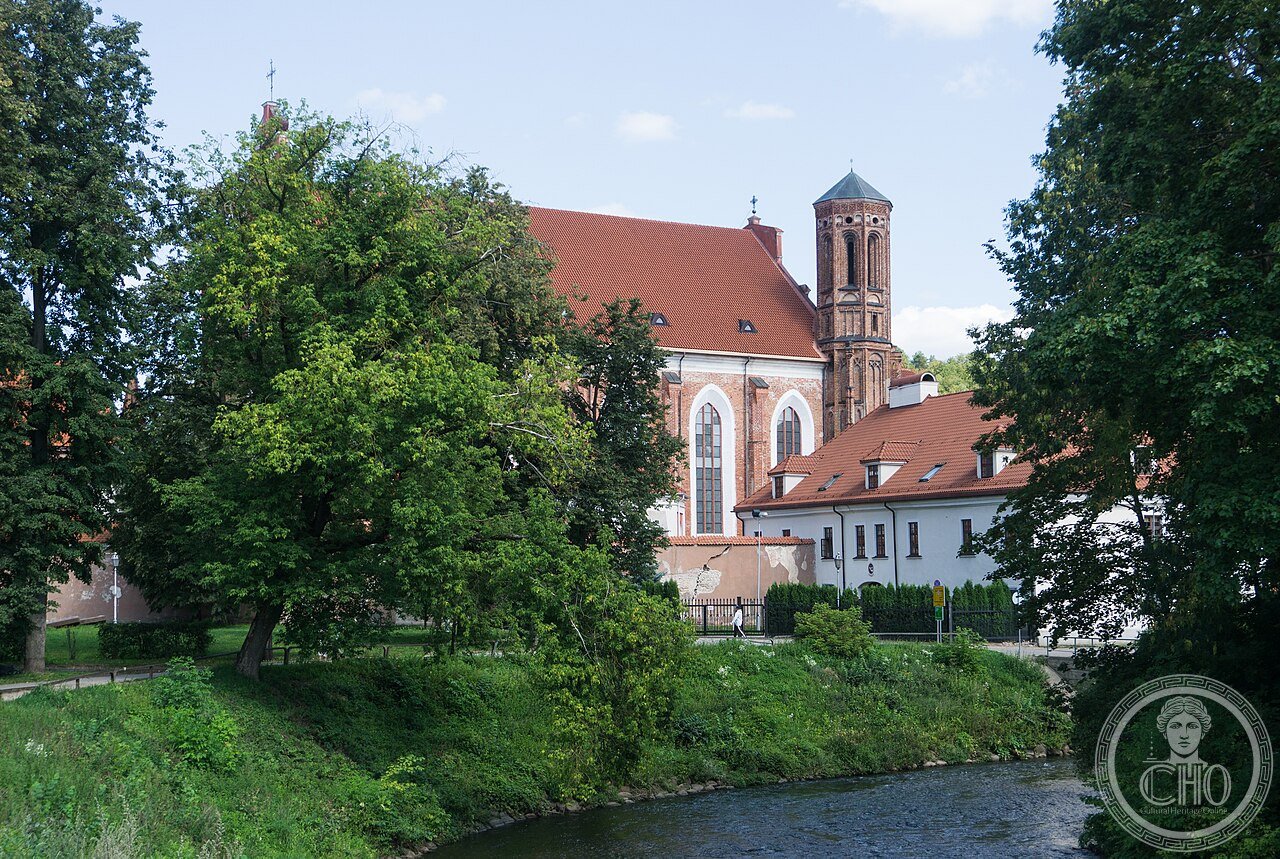
In Vilnius the Observant Franciscans, called Bernardines after Saint Bernardine of Siena to tell them from the Conventual Franciscans, settled in the middle of the 15th century. Work paid for by Grand Duke Casimir Jagiellon began in 1469, but the first wooden church burned down as early as 1475. A later attempt in stone was partly pulled down around 1500 for faults in the building, and only the chancel and the sacristy were saved. The Gothic church seen today was raised between 1506 and 1516, taking in the surviving parts of the earlier one, perhaps with the help of a master builder from Gdańsk, Michael Enkinger. Late Gothic and in brick, with pointed windows, buttresses and twin octagonal towers, it counts among the largest and oldest Gothic buildings in Vilnius. The interior is divided into three naves by eight pillars and keeps wall paintings of the 16th century, brought back to light during the restoration of 1981, fourteen Rococo altars added later, and a wooden crucifix of the 15th century, held to be the oldest sculpture of its kind known in Lithuania. The monastery housed a novitiate, a seminary, a scriptorium and a library. It suffered documented damage during the war with Moscow of 1655-1661, when Cossack forces killed friars and townspeople who had taken shelter inside, and was closed by the tsarist authorities in 1864, after the 19th-century risings, and turned into barracks. Between 1919 and 1923 the monastery building housed the Faculty of Fine Arts of Vilnius University, later reorganised as the Vilnius Academy of Arts: a link with art teaching that belongs to the twentieth century, not to the early history of the university. Under Soviet rule the church was closed and handed to the Art Institute, which used it as a warehouse, according to some sources from the fifties onward. The Bernardine friars came back in 1994, alongside the post-Soviet religious revival of Lithuania and the inscription of the historic centre of Vilnius on the UNESCO World Heritage List, and began a large restoration that is still under way. The church works today as an active Catholic parish; no shared museum use with art institutions is documented now, that tie belonging only to the Soviet period and to the first decades of the twentieth century.
About the Bernardine Church
In Vilnius, Lithuania, the Franciscan Observant friars, called Bernardines after St. Bernardine of Siena to distinguish them from the Conventual Franciscans, settled in the mid-15th century; work, funded by Grand Duke Casimir Jagiellon, began in 1469, but the first wooden church burned down already in 1475, and a subsequent stone attempt was partly demolished around 1500 for construction faults, saving only the chancel and sacristy. The Gothic church seen today was built between 1506 and 1516, incorporating the surviving parts of the earlier structure, with the possible involvement of a master builder from Gdańsk, Michael Enkinger. The building, in Late Gothic brick style, with pointed-arch windows, buttresses and twin octagonal towers, is considered one of the largest and oldest Gothic buildings in Vilnius; the interior, divided into three naves by eight pillars, preserves 16th-century wall paintings, uncovered during restoration in 1981, fourteen Rococo altars added later, and a 15th-century wooden crucifix said to be the oldest known sculpture of its kind in Lithuania. The monastery housed a novitiate, seminary, scriptorium and library; it suffered documented damage during the war with Moscow of 1655-1661, when Cossack forces killed friars and citizens sheltering inside, and was closed by tsarist authorities in 1864 following 19th-century uprisings, converted into barracks. Between 1919 and 1923 the monastery building housed the Faculty of Fine Arts of Vilnius University, later reorganized into the Vilnius Academy of Arts, a 20th-century link to artistic education, not to the university’s early history. During the Soviet period the church was closed and assigned to the Art Institute, which used it as a warehouse, according to some sources from the 1950s onward. Bernardine friars returned to the church in 1994, coinciding with Lithuania’s post-Soviet religious revival and the inscription of Vilnius’s historic centre on the UNESCO World Heritage List, launching a major restoration project still ongoing. The church functions today as an active Catholic parish; no current shared museum function with art institutions is documented, that association remaining tied only to the Soviet period and the early 20th century.
Key facts
- 1469-1500: initial construction attempts, both lost to fire and structural failure.
- 1506-1516: the present Gothic church built, incorporating surviving earlier elements.
- 15th-century wooden crucifix, possibly the oldest sculpture of its kind in Lithuania.
- 1864: the monastery closed by tsarist authorities and converted to barracks.
- Soviet era: the church used as a warehouse by the Art Institute.
- 1994: Bernardine friars return, launching an ongoing major restoration.
History
The Bernardine Church’s repeated early setbacks, an initial wooden church lost to fire and a stone replacement abandoned for structural faults, gave way to a standing Gothic building that has since survived war, tsarist closure, and Soviet-era repurposing as an art institute warehouse. Its 1994 return to active Franciscan use, timed with Lithuania’s post-Soviet religious revival and Vilnius Old Town’s UNESCO inscription, marked the reclaiming of one of the city’s largest Gothic monuments after more than a century of interrupted religious life.
What you see
Twin octagonal Gothic towers and a buttressed brick facade rise beside the smaller St. Anne’s Church, forming Vilnius’s Bernardine ensemble. Inside, three naves divided by eight pillars hold 16th-century wall paintings uncovered in 1981, fourteen later Rococo altars, and a 15th-century wooden crucifix among the oldest surviving sculptures of its kind in Lithuania.
Practical information
- Opening hours: generally open daily outside services; restoration work may affect access in some areas; check current hours before visiting.
- Address: Maironio g. 10, Vilnius, Lithuania.
Getting there
The Bernardine Church stands directly beside St. Anne’s Church in Vilnius’s Old Town, easily reached on foot. GPS: 54°40′55″N, 25°17′35″E.
Nearby
- St. Anne’s Church — the smaller, famous red-brick church directly adjoining.
- Historic Centre of Vilnius — the surrounding UNESCO World Heritage old town.
Sources
- Wikipedia — “Church of St. Francis and St. Bernardino, Vilnius” (en.wikipedia.org).
- Go Vilnius — official Vilnius tourism site, “Church of St. Anne and Bernardine Complex”
- Orbis Lituaniae (ldkistorija.lt) — “Bernardine Convent in Vilnius as a Classical Piece of Gothic Architecture”
Find it on the map
See this place and what’s around it →📷 Become a Cultural Heritage Online photographer
Share your photos of places: they stay published under your name as the author. The more they're seen, the more you get noticed — and soon a contest will reward the most appreciated photos.
Log in or sign up free to add a photo