

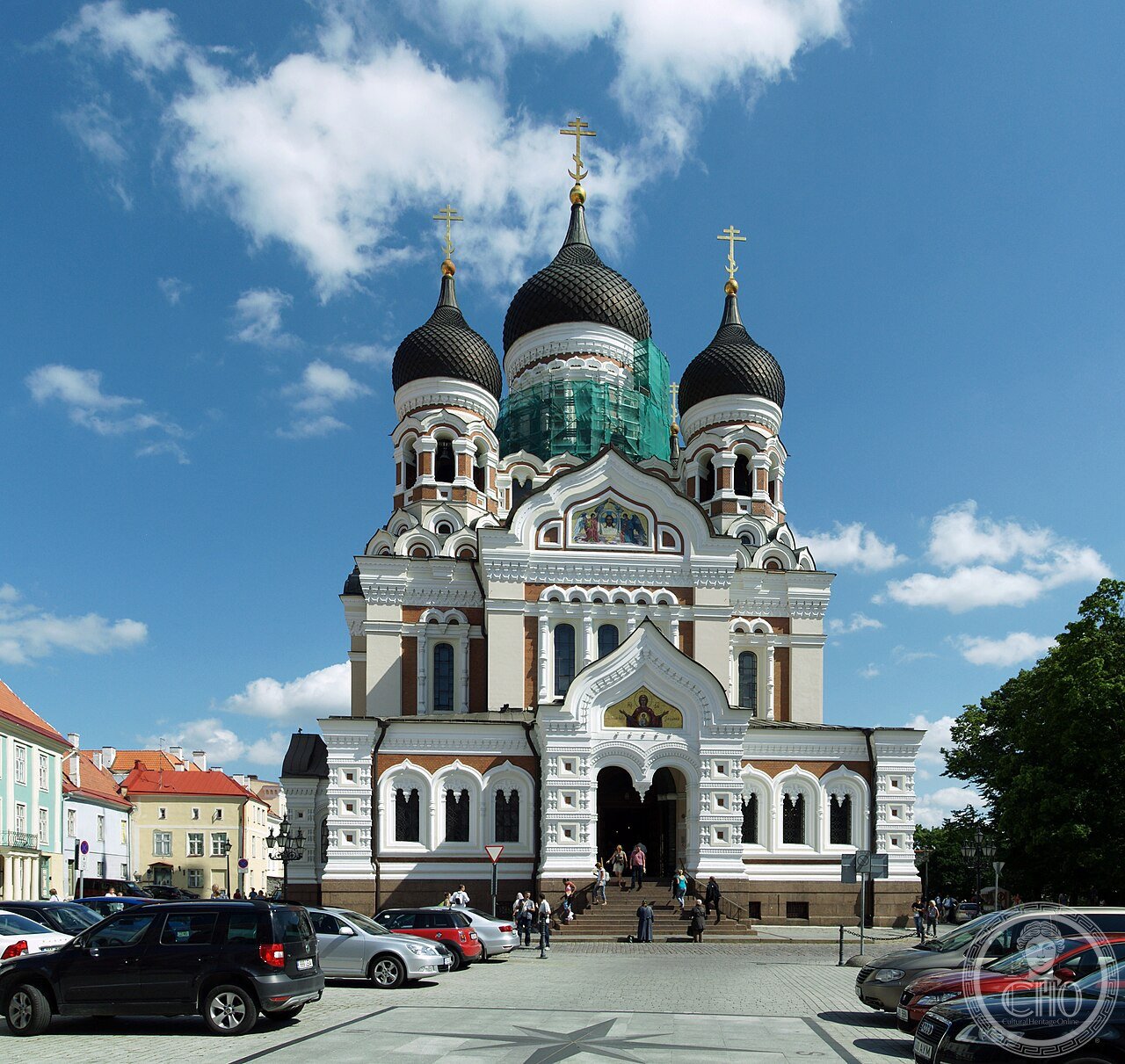
On Toompea Hill in Tallinn, Alexander Nevsky Cathedral was built between 1894 and 1900, consecrated that same year, to a design by the architect Mikhail Preobrazhensky, during the period of Russification of Estonia under Russian imperial administration, spanning the reigns of Alexander III and Nicholas II. It stands directly facing Toompea Castle, seat of the Estonian parliament, a placement sources consistently interpret as a deliberate gesture to visually assert Russian imperial and Orthodox dominance over the historic seat of Estonian and Baltic-German governance. The cathedral has long been a target of nationalist resentment in Estonia. In 1924 the architect Karl Burman proposed demolishing it, or converting it into a “Pantheon of Estonian Independence”. In October 1928 the Estonian parliament actually passed a law providing for its demolition by 1 May 1929. The demolition was not carried out, however, due to a documented combination of factors: lack of funds, the sheer scale and cost of demolishing such a massive masonry structure, and protests from Estonia’s Orthodox community, after which the authorities allowed it to continue functioning. Political sensitivity around the cathedral resurfaced after Russia’s 2022 invasion of Ukraine, when an Estonian member of parliament publicly proposed removing or relocating it and turning the site into a park. This remains an ongoing political discussion, not a decided policy, and is reported here as current context without taking a side. In Russian Revival style, the cathedral has five gilded onion domes on a Finnish granite base, and eleven bells cast in Saint Petersburg, the largest reportedly weighing around 16 tons. The interior has three gilded, carved wooden iconostases, icons painted in Saint Petersburg, and stained glass. Some tourism sources also describe mosaics on the facade, a detail less firmly documented than the other architectural elements. The cathedral remains today the main seat of the Estonian Orthodox Church of the Moscow Patriarchate, serving Tallinn’s Russian-speaking Orthodox community, and is simultaneously one of the city’s most visited landmarks, despite, and in part because of, its contested history.
About Alexander Nevsky Cathedral
On Toompea Hill in Tallinn, Alexander Nevsky Cathedral was built between 1894 and 1900, consecrated that same year, to a design by architect Mikhail Preobrazhensky, during the period of Russification of Estonia under Russian imperial administration, spanning the reigns of Alexander III and Nicholas II. It stands directly facing Toompea Castle, seat of the Estonian parliament, a placement sources consistently interpret as a deliberate gesture to visually assert Russian imperial and Orthodox dominance over the historic seat of Estonian and Baltic-German governance. The cathedral has long been a target of nationalist resentment in Estonia: in 1924 architect Karl Burman proposed demolishing it or converting it into a “Pantheon of Estonian Independence,” and in October 1928 the Estonian parliament actually passed a law providing for its demolition by 1 May 1929; the demolition was not carried out, however, due to a documented combination of factors — lack of funds, the sheer scale and cost of demolishing such a massive masonry structure, and protests from Estonia’s Orthodox community — after which authorities allowed it to continue functioning. Political sensitivity around the cathedral resurfaced after Russia’s 2022 invasion of Ukraine, when an Estonian member of parliament publicly proposed removing or relocating it and turning the site into a park: this remains an ongoing political discussion, not a decided policy, and is reported here as current context without taking a side. In Russian Revival style, the cathedral has five gilded onion domes on a Finnish granite base, eleven bells cast in Saint Petersburg, the largest reportedly weighing around 16 tons, and an interior with three gilded, carved wooden iconostases, icons painted in Saint Petersburg, and stained glass; some tourism sources also describe mosaics on the facade, a detail less firmly documented than the other architectural elements. The cathedral remains today the main seat of the Estonian Orthodox Church of the Moscow Patriarchate, serving Tallinn’s Russian-speaking Orthodox community, and is simultaneously one of the city’s most visited landmarks, despite, and in part because of, its contested history.
Key facts
- 1894-1900: built during the Russification of Estonia, facing the Estonian parliament.
- 1928: the Estonian parliament passes a law providing for the cathedral’s demolition.
- 1929: the planned demolition does not proceed, for financial and community reasons.
- Five gilded onion domes in Russian Revival style, on a Finnish granite base.
- Eleven bells, cast in Saint Petersburg, the largest reportedly around 16 tons.
- 2022 onward: the cathedral’s future again a subject of political discussion in Estonia.
History
Few churches anywhere carry as explicit a political intent in their siting as Alexander Nevsky Cathedral, built to physically confront the seat of Estonian governance during a period of deliberate imperial Russification. That it survived a formal 1928 parliamentary demolition law, and remains a live subject of political debate a century later following Russia’s 2022 invasion of Ukraine, illustrates how a single building can remain contested across radically different historical periods.
What you see
Five gilded onion domes rise above a granite base in Russian Revival style, directly facing Toompea Castle across the square. Inside, three gilded carved-wood iconostases and St. Petersburg-painted icons furnish a cathedral still in active use by Tallinn’s Orthodox community, its eleven bells among the most audible landmarks of the Old Town.
Practical information
- Opening hours: generally open daily outside services; modest dress expected; check current hours before visiting.
- Address: Lossi plats 10, Tallinn, Estonia.
Getting there
Alexander Nevsky Cathedral stands on Toompea Hill in Tallinn’s Old Town, easily reached on foot from the historic centre. GPS: 59°26′09″N, 24°44′22″E.
Nearby
- Toompea Castle — the seat of the Estonian parliament, directly across the square.
- Historic Centre of Tallinn — the surrounding UNESCO World Heritage old town.
- St. Olaf’s Church — the medieval church elsewhere in Tallinn’s Old Town.
Sources
- Wikipedia — “Alexander Nevsky Cathedral, Tallinn” (en.wikipedia.org).
- SpottingHistory.com — Alexander Nevsky Cathedral, Tallinn, Estonia.
- GPSmyCity — Alexander Nevsky Cathedral, Tallinn.
Find it on the map
See this place and what’s around it →📷 Become a Cultural Heritage Online photographer
Share your photos of places: they stay published under your name as the author. The more they're seen, the more you get noticed — and soon a contest will reward the most appreciated photos.
Log in or sign up free to add a photo