
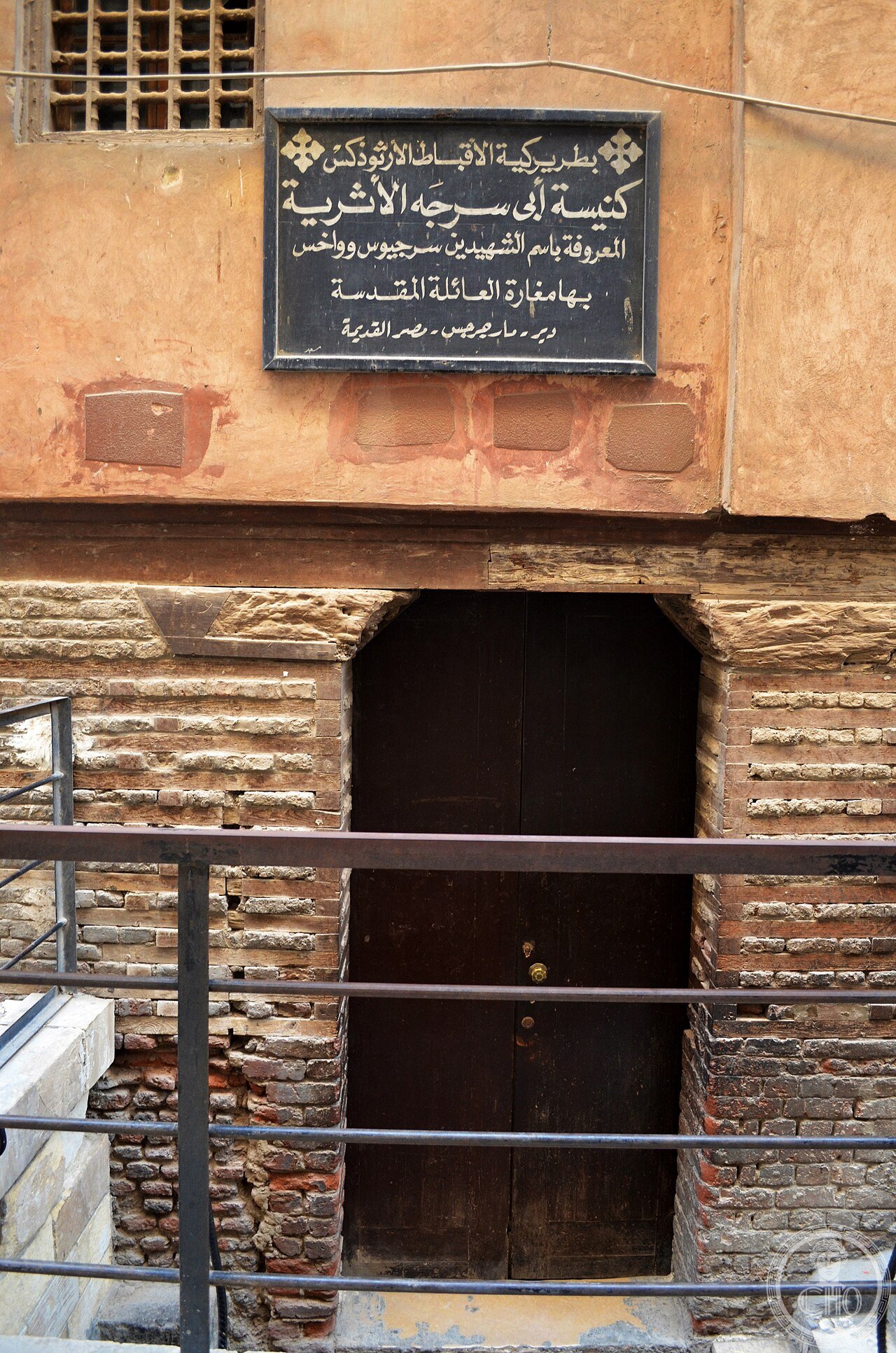
In Old Cairo, within the Roman fortress of Babylon, the Church of Saints Sergius and Bacchus, known as Abu Serga, is dated by some tourism sources to the 4th-5th century. The more solidly sourced academic account, drawn from Wikipedia, attributes the present structure to the late 7th century, the work of the scribe Athanasius under the Umayyad governor Abd al-Aziz ibn Marwan. The building burned in a fire in Fustat around 750, under the reign of Marwan II, and was rebuilt in the 8th century, with further work through the medieval period.
According to a long-standing Coptic tradition — not a historically verified fact, but a deeply held religious belief — the crypt beneath the high altar is where the Holy Family is said to have rested during the flight into Egypt to escape Herod. This crypt also gives the church its other name, the Church of the Cave. Some scholars, however, date the crypt’s actual architecture to the 12th-13th century, later than the tradition’s own setting.
The crypt, roughly ten metres below the altar, has historically suffered flooding from rising Nile groundwater. Direct descent was closed and replaced with a glass viewing panel. It is unclear from the most recent sources whether modern engineering has permanently resolved the problem, so accessibility should be checked at the time of the visit.
For centuries, from Patriarch Isaac (681-692) to Patriarch Christodulus (1047-1077), the church was the traditional site for the enthronement of the Coptic Patriarchs of Alexandria.
In basilica style, with a central nave and two side aisles, the church has marble columns — according to some sources partly reused from earlier buildings, though without rigorous archaeological confirmation — a wooden iconostasis inlaid with ivory, and three altars dedicated respectively to Saints Sergius and Bacchus, Saint George, and the Virgin Mary. The dedication recalls the two Roman soldier-saints Sergius and Bacchus, originally from Syria, who were martyred for their Christian faith according to hagiographic tradition, commonly placed under the persecutions of Emperor Maximian.
The church remains active today under the Coptic Orthodox Diocese of Old Cairo, Manial and Fum al-Khalig. It is open daily with no entrance fee, and forms part of the Coptic Cairo complex alongside the Hanging Church and the Ben Ezra Synagogue.
About the Church of Abu Serga
In Old Cairo, within the Roman fortress of Babylon, the Church of St. Sergius and Bacchus, known as Abu Serga, is traced by some tourism sources to the 4th-5th century, while the more solidly sourced academic account, drawn from Wikipedia, attributes the present structure to the late 7th century, the work of the scribe Athanasius under Umayyad governor Abd al-Aziz ibn Marwan; the building burned in a fire in Fustat around 750, under the reign of Marwan II, and was rebuilt in the 8th century, with further work through the medieval period. According to a long-standing Coptic tradition, not historically verified fact but a deeply held religious belief, the crypt beneath the high altar, which also gives the church its name “the Church of the Cave,” is where the Holy Family is said to have rested during the Flight into Egypt to escape Herod; some scholars, however, date the crypt’s actual architecture to the 12th-13th century, later than the tradition’s own setting. The crypt, roughly ten metres below the altar, has historically suffered flooding from rising Nile groundwater, to the point that direct descent was closed and replaced with a glass viewing panel; it is unclear from the most recent sources whether modern engineering has permanently resolved the problem, so accessibility should be checked at the time of visiting. The church served for centuries, from Patriarch Isaac (681-692) until Patriarch Christodulus (1047-1077), as the traditional site for the enthronement of Coptic Patriarchs of Alexandria. In basilica style, with a central nave and two side aisles, the church has marble columns, according to some sources partly reused from earlier buildings, though without rigorous archaeological confirmation, a wooden iconostasis inlaid with ivory, and three altars dedicated respectively to Sts. Sergius and Bacchus, St. George, and the Virgin Mary. The dedication recalls the two Roman soldier-saints Sergius and Bacchus, originally from Syria, martyred for their Christian faith according to hagiographic tradition, commonly placed under Emperor Maximian’s persecutions. The church remains active today under the Coptic Orthodox Diocese of Old Cairo, Manial and Fum al-Khalig, open daily with no entrance fee, and forms part of the Coptic Cairo complex alongside the Hanging Church and the Ben Ezra Synagogue.
Key facts
- Late 7th-8th century: the present structure built and rebuilt after a fire around 750.
- The crypt is traditionally identified as a resting place of the Holy Family during the Flight into Egypt.
- 681-1077: traditional site of Coptic Patriarch enthronements.
- Basilica plan with marble columns and an ivory-inlaid wooden iconostasis.
- Dedicated to Roman soldier-saints Sergius and Bacchus, martyred under Maximian.
- Part of the Coptic Cairo complex, alongside the Hanging Church and Ben Ezra Synagogue.
History
Abu Serga’s centuries-long role as the traditional enthronement site for Coptic patriarchs placed it at the institutional heart of Egyptian Christianity for nearly four hundred years, a status distinct from, though reinforced by, its older devotional association with the Holy Family’s flight into Egypt. The gap scholars identify between the tradition’s ancient setting and the crypt’s later medieval architecture is a reminder that a site’s spiritual significance and its physical fabric often developed on different timelines.
What you see
A basilica-plan church with marble columns and an ivory-inlaid wooden iconostasis sits above the crypt at the centre of the Holy Family tradition, reached historically by a stairway now often replaced by a glass viewing panel due to groundwater flooding. The church stands within the walls of the Roman fortress of Babylon, part of the dense cluster of ancient religious sites making up Coptic Cairo.
Practical information
- Opening hours: generally open daily; crypt accessibility varies and should be checked locally; no entrance fee, donations welcome.
- Address: Old Cairo (Coptic Cairo), Cairo, Egypt.
Getting there
The church stands within the Babylon Fortress complex in Old Cairo, easily reached by metro (Mar Girgis station) or taxi. GPS: 30°00′21″N, 31°13′51″E.
Nearby
- The Hanging Church — the celebrated Coptic church nearby, suspended over a Roman gate.
- Ben Ezra Synagogue — the historic synagogue within the same complex.
- Coptic Cairo — the wider ancient religious district.
Sources
- Wikipedia — “Saints Sergius and Bacchus Church” (en.wikipedia.org).
- Egypt Ministry of Tourism and Antiquities — egymonuments.gov.eg.
- Egyptian Streets — feature article on the Church of Abu Serga.
Find it on the map
See this place and what’s around it →📷 Become a Cultural Heritage Online photographer
Share your photos of places: they stay published under your name as the author. The more they're seen, the more you get noticed — and soon a contest will reward the most appreciated photos.
Log in or sign up free to add a photo