
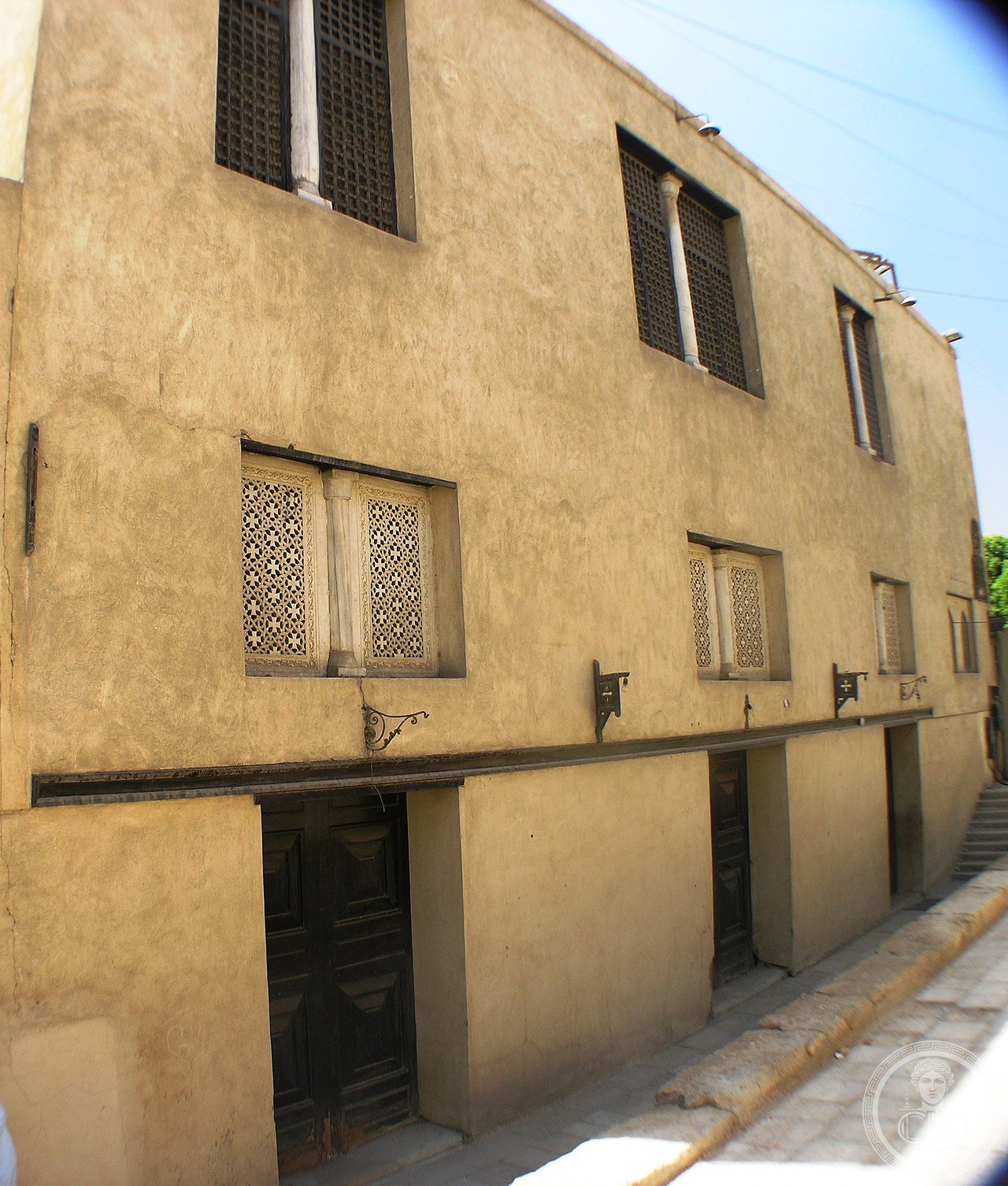
In Old Cairo, the church now known as St Barbara’s was originally dedicated to Saints Cyrus and John, two physician-martyrs, whose cult survives to this day in the northern chapels of the complex. When the relics of Saint Barbara were later brought here, a second sanctuary was built to receive them, so that the building today is in effect two churches side by side. The dating of the original structure remains uncertain: Wikipedia places it, as an estimate, between the 5th and the 6th century, while the better documented rebuilding dates from 1072-1073, under the Coptic patriarch Christodoulos (1047-1077), at the time when the patriarchate moved to Cairo. Further repairs followed a fire in the 12th century, and a major restoration was carried out between 1910 and 1922. According to Christian hagiography — not a historically established fact, but a religious tradition first attested in the 7th century — Saint Barbara was a young woman of the 3rd century, held prisoner by her pagan father Dioscorus, who killed her himself after discovering her secret conversion to Christianity, and who was then struck by lightning, so the legend goes. The Catholic Church removed her feast from the General Roman Calendar in 1969 for want of historical evidence, though the cult remains alive in the Coptic tradition, which keeps her relics in this church. The building follows a basilica plan, with an entrance, a narthex, a single long nave, two side aisles and three sanctuaries. Five marble columns separate the nave from the side aisles, and a semicircular choir area has seven steps. A wooden ambo, of about 1300, was rebuilt in 1911. The icons inside show the Virgin Mary, the infant Jesus, the Crucifixion and the Baptism. Contrary to what is sometimes reported, it cannot be confirmed with certainty whether the church stands outside the walls of the ancient Roman fortress of Babylon, unlike the Hanging Church and Abu Serga: the sources agree rather in placing it on the eastern edge of the fortress complex. The church is today an active Coptic Orthodox parish, near the Coptic Museum, and is part of the Coptic Cairo tourist and pilgrimage circuit along with the Hanging Church and Abu Serga.
About the Church of St. Barbara
In Old Cairo, the church now known as St. Barbara’s was originally dedicated to Saints Cyrus and John, two physician-martyrs whose cult survives today in the complex’s northern chapels; when St. Barbara’s relics were later brought there, a second sanctuary was built to house them, so the building today effectively comprises two adjoining churches. The dating of the original structure remains uncertain: Wikipedia places it, as an estimate, between the 5th and 6th centuries, while the best-documented rebuilding dates to 1072-1073, under Coptic Patriarch Christodoulos (1047-1077), during the period when the patriarchate relocated to Cairo; further repairs followed a 12th-century fire, and a major renovation was carried out between 1910 and 1922. According to Christian hagiography, not historically verified fact but a religious tradition first attested in the 7th century, St. Barbara was a young 3rd-century woman held captive by her pagan father Dioscorus, who personally killed her after discovering her secret conversion to Christianity, and was struck by lightning afterward according to the legend; the Roman Catholic Church removed her feast from the General Roman Calendar in 1969 for lack of historical evidence, though her cult remains alive in Coptic tradition, which holds her relics in this church. The building follows a basilica plan, with an entrance, narthex, a single long nave, two side aisles and three sanctuaries; five marble columns separate the nave from the side aisles, and a semicircular choir area has seven steps; a wooden ambo, dating to roughly 1300, was rebuilt in 1911. Icons inside depict the Virgin Mary, the infant Jesus, the Crucifixion and the Baptism. Contrary to what is sometimes reported, it cannot be confirmed with certainty whether the church stands outside the walls of the ancient Roman fortress of Babylon, unlike the Hanging Church and Abu Serga: sources instead agree in placing it on the eastern edge of the fortress complex. The church remains an active Coptic Orthodox parish today, near the Coptic Museum, and forms part of the Coptic Cairo tourist and pilgrimage circuit alongside the Hanging Church and Abu Serga.
Key facts
- Originally dedicated to Saints Cyrus and John, physician-martyrs.
- 1072-1073: the best-documented rebuilding, under Patriarch Christodoulos.
- Holds relics traditionally attributed to St. Barbara, a 3rd-century martyr.
- Basilica plan with five marble columns, three sanctuaries and a wooden ambo from c. 1300.
- 1910-1922: a major renovation of the church.
- Part of the Coptic Cairo circuit, near the Coptic Museum.
History
The church’s shift from honoring two physician-martyrs to becoming the enshrinement site of St. Barbara’s relics illustrates how Coptic devotional geography could be reshaped by the arrival of relics as much as by original foundation, layering one saint’s cult over another’s within the same walls. Its best-documented rebuilding in 1072-73 coincides precisely with the Coptic patriarchate’s relocation to Cairo, tying the church’s architectural history directly to a pivotal moment in the institutional life of the Coptic Church.
What you see
A basilica-plan interior, its nave separated from two side aisles by five marble columns, leads to three sanctuaries and a semicircular choir reached by seven steps. A carved wooden ambo dating to around 1300, rebuilt in 1911, stands among icons of the Virgin Mary, the infant Christ, and scenes of the Crucifixion and Baptism.
Practical information
- Opening hours: generally open daily; check current hours before visiting.
- Address: Old Cairo (Coptic Cairo), near the Coptic Museum, Cairo, Egypt.
Getting there
The church stands within the Coptic Cairo district, near the Coptic Museum, easily reached by metro (Mar Girgis station) or taxi. GPS: 30°00′21″N, 31°13′52″E.
Nearby
- Church of Abu Serga — the nearby church associated with the Holy Family’s flight into Egypt.
- The Hanging Church — the celebrated Coptic church suspended over a Roman gate.
- Coptic Museum — the museum of Coptic art and history nearby.
Sources
- Wikipedia — “Saint Barbara Church in Coptic Cairo” (en.wikipedia.org).
- Wikipedia — “Saint Barbara” (en.wikipedia.org).
- Wikipedia — “Coptic Cairo” (en.wikipedia.org).
Find it on the map
See this place and what’s around it →📷 Become a Cultural Heritage Online photographer
Share your photos of places: they stay published under your name as the author. The more they're seen, the more you get noticed — and soon a contest will reward the most appreciated photos.
Log in or sign up free to add a photo