
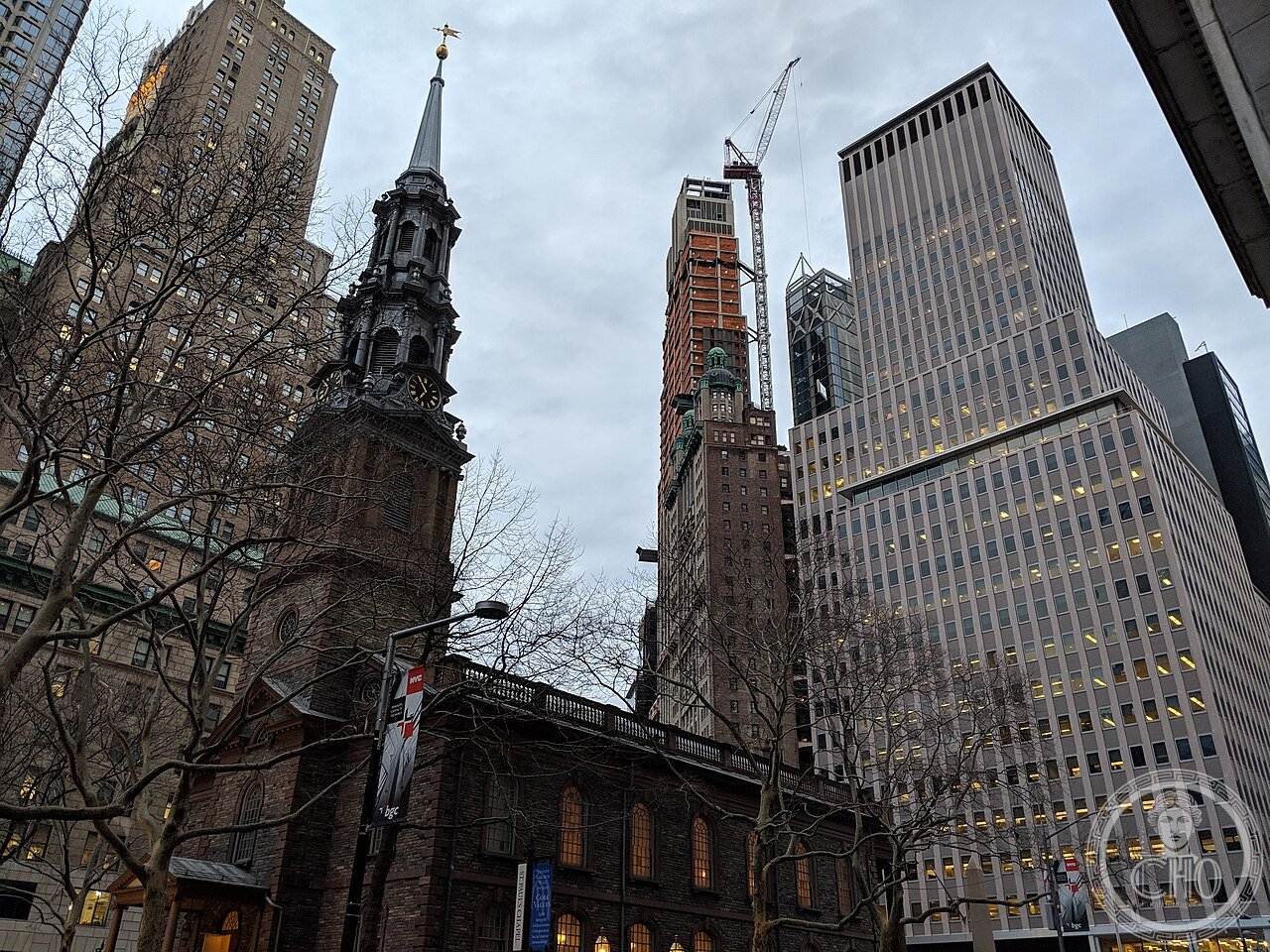
In Lower Manhattan, New York, St. Paul’s Chapel is the oldest church still standing on the island, built between 1764 and 1766, with its spire added later, between 1794 and 1796. The design is traditionally attributed to the architect Thomas McBean, although some historians have proposed the name of Peter Harrison instead. It is in Georgian style, inspired in part by the London church of St Martin-in-the-Fields, and built of Manhattan mica-schist with brownstone quoins. On 30 April 1789, the day of his inauguration as the first president of the United States, George Washington walked from Federal Hall to this chapel, together with Martha Washington and members of Congress, for a service led by the Episcopal bishop Samuel Provoost, and he went on attending until 1790, while New York remained the capital of the nation. A canopied pew on the north side was reserved for him, although the original furniture was removed during restoration work in the 2010s, and the place is marked today by an eighteenth-century oil painting of the Great Seal of the United States. The chapel, standing directly across from the World Trade Center site, suffered no structural damage, not even a broken pane, during the attacks of 11 September 2001, unlike Trinity Church itself, of which it is a satellite chapel, which did sustain some damage. For nine months it worked as a relief station open around the clock for the recovery workers in the area, offering meals, rest, counselling and the care of massage therapists, chiropractors, podiatrists and musicians. A large sycamore about a century old, at the north-west corner of the churchyard, fell and absorbed the debris of the blast, and is credited by reputable sources with having shielded the building from greater damage. The phrase «sheltering angel», sometimes used to describe it, appears only in secondary devotional sources and not in official ones, and should be taken as a popular nickname rather than a documented term. The roots of the tree were cast in bronze by the sculptor Steve Tobin and displayed at the chapel, which today also holds a permanent exhibition on 11 September and a communion chalice made from the steel of the Twin Towers. The revolutionary general Richard Montgomery is also buried in the churchyard. The chapel remains today an active part of the parish of Trinity Church Wall Street, a place of services and free concerts, and receives more than a million visitors a year.
About St. Paul’s Chapel
In Lower Manhattan, New York, St. Paul’s Chapel is the oldest surviving church building on the island, built between 1764 and 1766, with its spire added later, between 1794 and 1796; the design is traditionally attributed to architect Thomas McBean, though some historians have proposed Peter Harrison as an alternative, in Georgian style partly inspired by London’s St Martin-in-the-Fields church, built of Manhattan mica-schist with brownstone quoins. On 30 April 1789, the day of his inauguration as the first President of the United States, George Washington walked from Federal Hall to this chapel, together with Martha Washington and members of Congress, for a service led by Episcopal Bishop Samuel Provoost, and continued attending until 1790, while New York remained the nation’s capital; a canopied pew on the north side was reserved for him, though the original furniture was removed during 2010s renovation work, and the site is now marked by an 18th-century oil painting of the Great Seal of the United States. The chapel, standing directly across from the World Trade Center site, suffered no structural damage, not even a broken window, during the 11 September 2001 attacks, unlike Trinity Church itself, of which it is a satellite chapel, which did sustain some damage; for nine months it served as a round-the-clock relief station for recovery workers in the area, offering meals, rest, counseling, and support from massage therapists, chiropractors, podiatrists and musicians. A large, roughly century-old sycamore tree at the northwest corner of the churchyard fell, absorbing debris from the blast, and is credited by reputable sources with shielding the building from greater damage; the phrase “sheltering angel,” sometimes used to describe it, appears only in secondary devotional sources rather than official ones, and should be regarded as a popular nickname rather than a documented term. The tree’s roots were cast in bronze by sculptor Steve Tobin and displayed at the chapel, which today also holds a permanent 9/11 exhibit and a communion chalice made from World Trade Center steel. Revolutionary War General Richard Montgomery is also buried in the churchyard. The chapel remains an active part of the Trinity Church Wall Street parish today, hosting services and free concerts, and drawing more than a million visitors a year.
Key facts
- 1764-1766: built as the oldest surviving church building in Manhattan.
- 30 April 1789: George Washington worships here on his inauguration day.
- 11 September 2001: stands undamaged directly across from the World Trade Center site.
- Nine months as a 24-hour relief station for recovery workers after 9/11.
- A fallen sycamore tree, its roots cast in bronze by Steve Tobin, credited with shielding the chapel.
- Still active within the Trinity Church Wall Street parish, drawing over a million visitors a year.
History
As the oldest surviving church in Manhattan, St. Paul’s Chapel already carried two centuries of civic and presidential history — from Washington’s inauguration-day service to countless generations of city life — before its greatest test in 2001, when it emerged undamaged from an attack that devastated the neighborhood around it. Its nine-month transformation into a round-the-clock relief station gave the 18th-century building a new, defining chapter in American memory, one now permanently commemorated inside its own walls.
What you see
A Georgian portico and boxy classical proportions, echoing London church models of the 1720s, front a mica-schist building whose 1794-96 spire remains its most visible later addition. Inside, the site of Washington’s reserved pew, marked by an 18th-century painting of the Great Seal, sits alongside a permanent exhibit and artifacts documenting the chapel’s role after 11 September 2001.
Practical information
- Opening hours: generally open daily; check current hours before visiting.
- Address: 209 Broadway, New York, NY, United States.
Getting there
St. Paul’s Chapel stands on Broadway between Fulton and Vesey Streets in Lower Manhattan, near the National September 11 Memorial, easily reached by subway. GPS: 40°42′43″N, 74°00′35″W.
Nearby
- National September 11 Memorial & Museum — directly across the street.
- Trinity Church — the parish’s main church at the head of Wall Street.
Sources
- Wikipedia — “St. Paul’s Chapel” (en.wikipedia.org).
- Trinity Church Wall Street — official site (trinitychurchnyc.org).
- National September 11 Memorial & Museum — “Remembering ‘The Little Chapel That Stood'” (911memorial.org).
Find it on the map
See this place and what’s around it →📷 Become a Cultural Heritage Online photographer
Share your photos of places: they stay published under your name as the author. The more they're seen, the more you get noticed — and soon a contest will reward the most appreciated photos.
Log in or sign up free to add a photo