
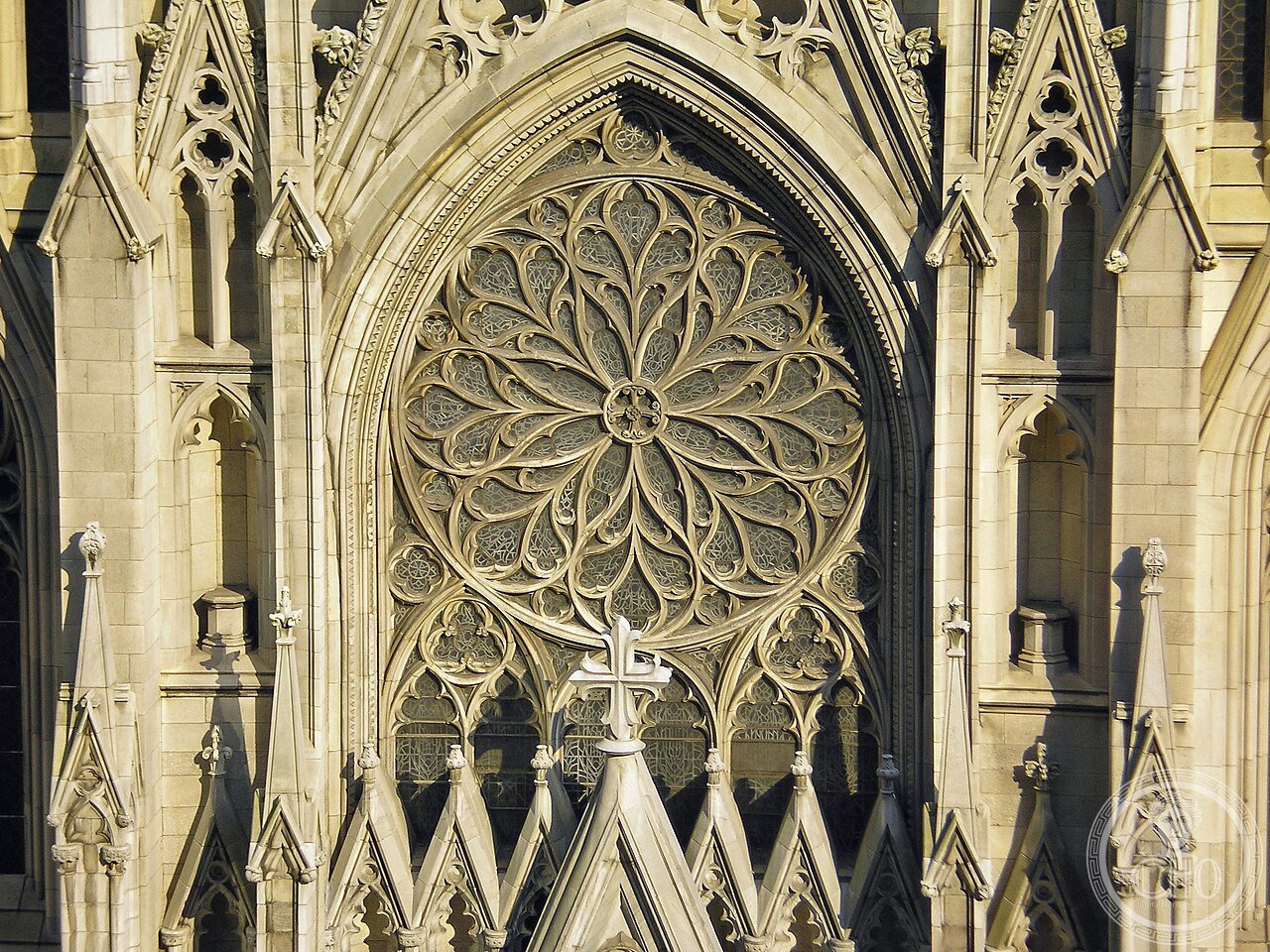
A New York, la Cattedrale di San Patrizio sorge su un terreno acquistato nel marzo 1810 da padre Anthony Kohlmann e da altri gesuiti per 11.000 dollari, tra la Fifth Avenue, Madison Avenue e le vie 50 e 51; i gesuiti vi costruirono un collegio con cappella, ceduto poi alla diocesi di New York nel 1813, con la scuola chiusa l’anno successivo e il terreno utilizzato anche per sepolture. La prima pietra della cattedrale attuale fu posata il 15 agosto 1858 dall’arcivescovo John Hughes, davanti a circa 100.000 persone, su progetto dell’architetto James Renwick Jr., che si ispirò in particolare alla Cattedrale di Colonia, allora ancora incompiuta; i lavori furono sospesi nell’agosto 1860 per mancanza di fondi e ulteriormente ritardati dalla Guerra Civile, riprendendo solo negli anni successivi. Nel 1858 il sito si trovava ai margini settentrionali della città allora sviluppata, in gran parte campagna, tanto che i critici deridevano il progetto come “la follia di Hughes”; solo con la crescita di New York verso nord l’area sarebbe diventata il cuore di Manhattan. L’edificio fu sostanzialmente completato nel 1878 e dedicato formalmente il 25 maggio 1879, mentre le due guglie gemelle furono terminate nell’ottobre 1888, diventando all’epoca le strutture più alte di New York City. In stile neogotico, costruita soprattutto in marmo bianco cavato tra New York e il Massachusetts, con fondamenta in granito gneiss blu, la cattedrale ha una capienza di circa 2.400 posti a sedere, fino a 3.000 contando i posti in piedi, e guglie alte circa 329,5 piedi, comunemente arrotondati a 330. Ha ospitato i funerali di numerosi americani celebri, tra cui quello di Babe Ruth il 19 agosto 1948, con circa 5.000 persone all’interno e decine di migliaia fuori, e quello di Robert F. Kennedy l’8 giugno 1968, diretto musicalmente da Leonard Bernstein, con Andy Williams tra i cantanti e l’elogio funebre pronunciato dal fratello Edward Kennedy; resta inoltre tradizionalmente legata alla benedizione della sfilata annuale del giorno di San Patrizio. Un importante restauro, condotto perlopiù tra il 2012 e il 2015 e annunciato dal cardinale Timothy Dolan nel marzo 2015, è costato secondo le fonti tra i 175 e i 200 milioni di dollari. La cattedrale resta sede dell’arcivescovo di New York e una delle chiese più visitate degli Stati Uniti, con una stima diffusa di circa cinque milioni di visitatori l’anno.
About St. Patrick’s Cathedral
In New York, St. Patrick’s Cathedral stands on land purchased in March 1810 by Father Anthony Kohlmann and fellow Jesuits for $11,000, bounded by Fifth Avenue, Madison Avenue and 50th and 51st Streets; the Jesuits built a college with a chapel there, later sold to the Diocese of New York in 1813, with the school closing the following year and the land also used for burials. The cornerstone of the present cathedral was laid on 15 August 1858 by Archbishop John Hughes, before a crowd of roughly 100,000, to a design by architect James Renwick Jr., who drew particular inspiration from Cologne Cathedral, then still unfinished; work was suspended in August 1860 for lack of funds and further delayed by the Civil War, resuming only in later years. In 1858 the site sat on the northern edge of the then-developed city, largely farmland, so much so that critics mocked the project as “Hughes’ Folly”; only as New York grew northward did the area become the heart of Manhattan. The building was substantially completed by 1878 and formally dedicated on 25 May 1879, while the twin spires were finished in October 1888, briefly making them the tallest structures in New York City. In Gothic Revival style, built mainly of white marble quarried in New York and Massachusetts, with a foundation of blue gneiss granite, the cathedral seats roughly 2,400, up to 3,000 counting standing room, with spires roughly 329.5 feet tall, commonly rounded to 330. It has hosted the funerals of numerous notable Americans, including Babe Ruth’s on 19 August 1948, with about 5,000 inside and tens of thousands outside, and Robert F. Kennedy’s on 8 June 1968, musically directed by Leonard Bernstein, with Andy Williams among the singers and the eulogy delivered by brother Edward Kennedy; it also remains traditionally tied to the blessing of the annual St. Patrick’s Day Parade. A major restoration, carried out mostly between 2012 and 2015 and announced by Cardinal Timothy Dolan in March 2015, cost, according to sources, between $175 and $200 million. The cathedral remains the seat of the Archbishop of New York and one of the most visited churches in the United States, with a widely cited estimate of around five million visitors a year.
Key facts
- 1858-1888: built and finished with twin spires, designed by James Renwick Jr.
- Once mocked as “Hughes’ Folly” for standing on then-rural land north of the developed city
- ~2,400 seated, spires roughly 330 feet tall, briefly the tallest structures in New York
- 1948 and 1968: site of the funerals of Babe Ruth and Robert F. Kennedy
- 2012-2015: major restoration costing an estimated $175-200 million
- Still the seat of the Archbishop of New York, among the most visited churches in the US
History
Ridiculed as “Hughes’ Folly” for its placement on what was then Manhattan’s rural fringe, St. Patrick’s Cathedral ended up at the exact centre of the city it was accused of standing too far from, as New York’s growth overtook the site within a few decades. Its role as the setting for major American funerals, from Babe Ruth to Robert F. Kennedy, has layered civic and cultural memory onto a building whose own construction was itself repeatedly delayed by war and financial hardship.
What you see
White marble Gothic Revival spires, inspired by Cologne Cathedral, rise roughly 330 feet above Fifth Avenue, framing an interior that seats around 2,400 worshippers. The 2012-2015 restoration returned the century-old stonework and stained glass to a condition close to their original state, ahead of the cathedral’s continued role hosting major state and civic occasions.
Practical information
- Opening hours: generally open daily outside major services; check current hours before visiting
- Address: 5th Avenue between 50th and 51st Streets, New York, NY, United States
Getting there
The cathedral stands on Fifth Avenue in Midtown Manhattan, directly across from Rockefeller Center, easily reached by subway. GPS: 40°45′29″N, 73°58′32″W.
Nearby
- Rockefeller Center — the landmark complex directly across Fifth Avenue
- Fifth Avenue — Manhattan’s famous shopping and landmark avenue
Sources
- Wikipedia — “St. Patrick’s Cathedral (New York City)” (en.wikipedia.org)
- Official cathedral site — History & Heritage page (saintpatrickscathedral.org)
- NYC Landmarks Preservation Commission — designation report
Gallery
St. Patrick's Cathedral, photographed by Luigi De Marchi.
Find it on the map
See this place and what’s around it →📷 Become a Cultural Heritage Online photographer
Share your photos of places: they stay published under your name as the author. The more they're seen, the more you get noticed — and soon a contest will reward the most appreciated photos.
Log in or sign up free to add a photo