
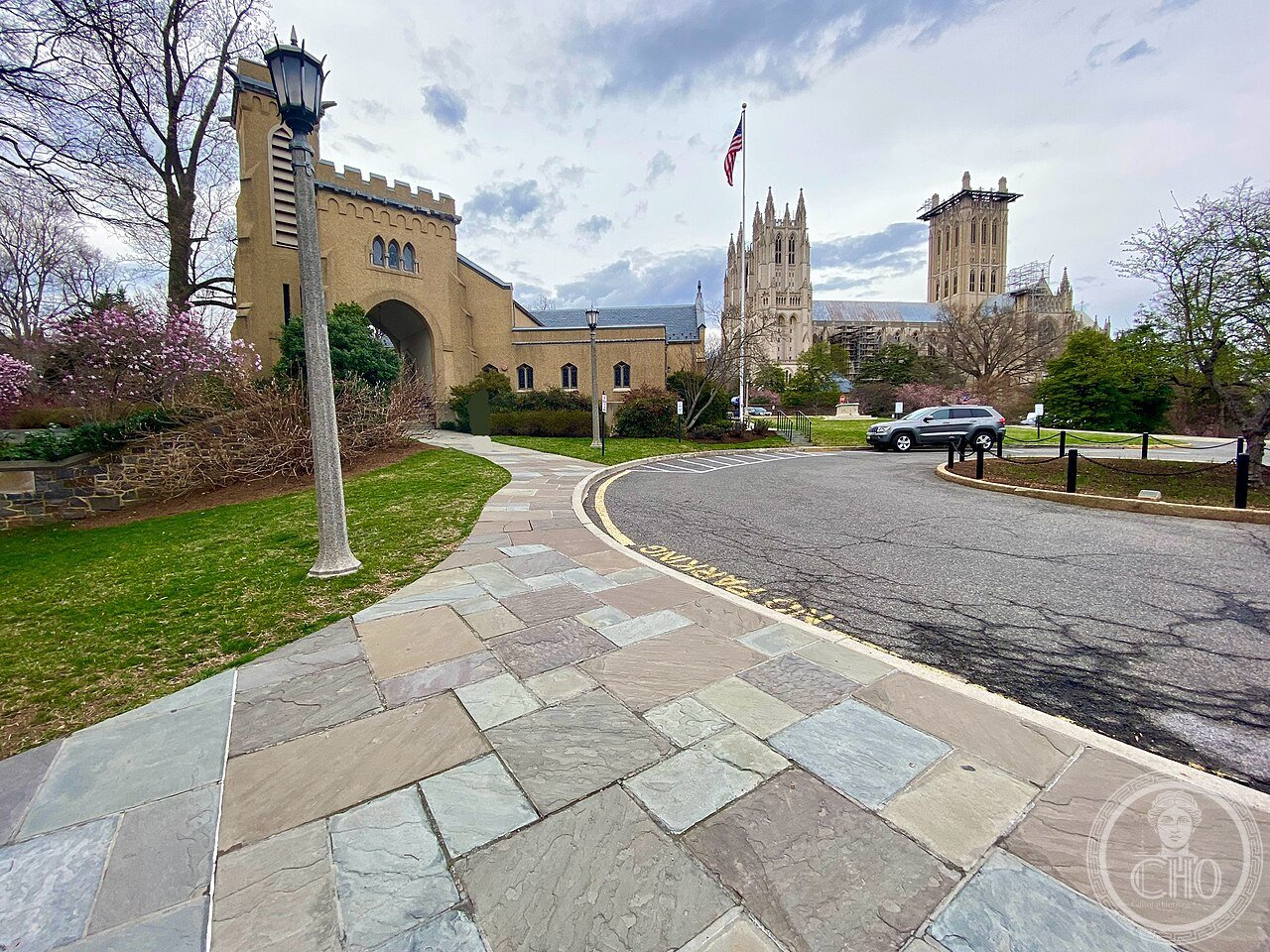
In Washington, D.C., the foundation stone of the national cathedral, dedicated to Saints Peter and Paul, was laid on 29 September 1907. President Theodore Roosevelt was there, with a crowd of more than 20,000. The work ended exactly eighty-three years later, on 29 September 1990, with the ceremony of the last finial, attended by President George H.W. Bush. The original design is owed to the English architect George Frederick Bodley, carried on after his death in 1907 by his partner Henry Vaughan until 1917, but most of the building was directed by Philip Hubert Frohman, chief architect for fifty years until his death in 1972. Built in pure English Gothic, the cathedral is entirely of masonry, with no structural steel, by medieval technique, stone upon stone. Among its many carved decorations stands the famous grotesque in the shape of Darth Vader, not the winner but the third-placed design in a design competition for children run in the eighties by National Geographic World, among some 1,400 entries from 16 countries, carved in 1986. Contrary to what is sometimes believed, the cathedral is not without a diocesan seat: it is the seat of the bishop of the Episcopal Diocese of Washington and, since 1941, the ceremonial seat of the presiding bishop of the whole Episcopal Church, a case unique in the world of a cathedral holding two bishops. It has hosted state funerals or memorial services for Presidents Dwight D. Eisenhower in 1969, Ronald Reagan in 2004, Gerald Ford in 2006-2007 and George H.W. Bush in 2018, besides the funeral of Helen Keller in 1968, whose ashes rest with those of her teacher Anne Sullivan Macy in the Chapel of Saint Joseph of Arimathea, and the tomb of President Woodrow Wilson, the only president buried in Washington. Among the stained glass is the so-called «Space Window», which encloses in an inert nitrogen chamber a fragment of lunar rock brought back to Earth by the Apollo 11 mission, given by the astronauts at the dedication of the window on 21 July 1974, on the fifth anniversary of the moon landing. The cathedral was established by act of Congress on 6 January 1893, which created its legal foundation without making it a federal institution or funding it with public money. The Virginia earthquake of 23 August 2011, of magnitude 5.8, caused damage estimated at about 38 million dollars, harming more than 75% of the pinnacles as well as carvings and flying buttresses. The cathedral, closed for about three months, reopened in November 2011, but the restoration work, carried out in phases, was still under way according to the most recent sources available, roughly halfway through.
About Washington National Cathedral
In Washington, D.C., the foundation stone of the national cathedral, dedicated to Saints Peter and Paul, was laid on 29 September 1907 in the presence of President Theodore Roosevelt and a crowd of more than 20,000; construction concluded exactly eighty-three years later, on 29 September 1990, with the final-finial ceremony attended by President George H.W. Bush. The original design is credited to English architect George Frederick Bodley, continued after his death in 1907 by his partner Henry Vaughan until 1917, but most of the construction was directed by Philip Hubert Frohman, chief architect for fifty years until his death in 1972. Built in pure English Gothic style, the cathedral is constructed entirely of masonry, with no structural steel support, using medieval techniques, stone upon stone; among its many carved decorations stands the famous Darth Vader grotesque, not the winning entry but the third-place design from a children’s design competition run in the 1980s by National Geographic World, drawing roughly 1,400 entries from 16 countries, carved in 1986. Contrary to what is sometimes believed, the cathedral is not without a diocesan seat: it is in fact the seat of the Bishop of the Episcopal Diocese of Washington and, since 1941, the ceremonial seat of the Presiding Bishop of the entire Episcopal Church, a unique case worldwide of a cathedral seating two bishops. It has hosted state funerals or memorial services for Presidents Dwight D. Eisenhower in 1969, Ronald Reagan in 2004, Gerald Ford in 2006-2007 and George H.W. Bush in 2018, as well as the funeral of Helen Keller in 1968, whose ashes rest alongside those of her teacher Anne Sullivan Macy in the Chapel of St. Joseph of Arimathea, and the tomb of President Woodrow Wilson, the only president buried in Washington. Among the stained glass windows is the so-called “Space Window,” which encloses in an inert nitrogen chamber a fragment of lunar rock brought back by Apollo 11, presented by the astronauts at the window’s dedication on 21 July 1974, the fifth anniversary of the moon landing. The cathedral was established by an act of Congress on 6 January 1893, which created its legal foundation without making it a federal institution or funding it with public money. The 23 August 2011 Virginia earthquake, magnitude 5.8, caused an estimated $38 million in damage, affecting more than 75 percent of the pinnacles along with carvings and flying buttresses; the cathedral, closed for roughly three months, reopened in November 2011, though restoration work, carried out in phases, remained ongoing according to the most recent available sources, roughly halfway complete.
Key facts
- 1907-1990: built over exactly eighty-three years, no structural steel used.
- Seat of two bishops, the Diocese of Washington and the Presiding Bishop of the Episcopal Church since 1941.
- State funerals for Presidents Eisenhower, Reagan, Ford and George H.W. Bush.
- The “Space Window” holds a fragment of Apollo 11 moon rock, dedicated 1974.
- Darth Vader grotesque, carved 1986, third place in a 1980s children’s design contest.
- 2011: a magnitude-5.8 earthquake causes roughly $38 million in damage, repairs still ongoing.
History
Built stone by stone without structural steel across eighty-three years, Washington National Cathedral finished construction only in 1990, making it one of the last great Gothic cathedrals raised anywhere in the world using largely traditional methods. Its dual role hosting both a diocesan bishop and the Presiding Bishop of the entire Episcopal Church, alongside its recurring use for state funerals, has made it a genuinely national religious space despite receiving no federal funding.
What you see
Pure English Gothic stonework rises without a single structural steel beam, its towers, flying buttresses and hundreds of carved grotesques and gargoyles the product of eight decades of continuous masonry work. Among the carvings, high on the building, sits the Darth Vader grotesque, a 1980s addition born from a children’s design contest rather than any medieval tradition.
Practical information
- Opening hours: generally open daily with seasonal variation; admission fee applies for some areas; check current hours before visiting.
- Address: 3101 Wisconsin Avenue NW, Washington, D.C., United States.
Getting there
The cathedral stands in northwest Washington, D.C., reachable by bus or car; the nearest metro stations require a short bus connection. GPS: 38°55′50″N, 77°04′15″W.
Nearby
- Cathedral of St. Matthew the Apostle — Washington’s Catholic cathedral, elsewhere in the city.
- Georgetown — the historic neighborhood a short distance away.
Sources
- Washington National Cathedral — official site, History and Fun Facts pages (cathedral.org).
- Wikipedia — “Washington National Cathedral” (en.wikipedia.org).
- Boundary Stones (WETA) — “How Darth Vader Came to the National Cathedral”
Find it on the map
See this place and what’s around it →📷 Become a Cultural Heritage Online photographer
Share your photos of places: they stay published under your name as the author. The more they're seen, the more you get noticed — and soon a contest will reward the most appreciated photos.
Log in or sign up free to add a photo