
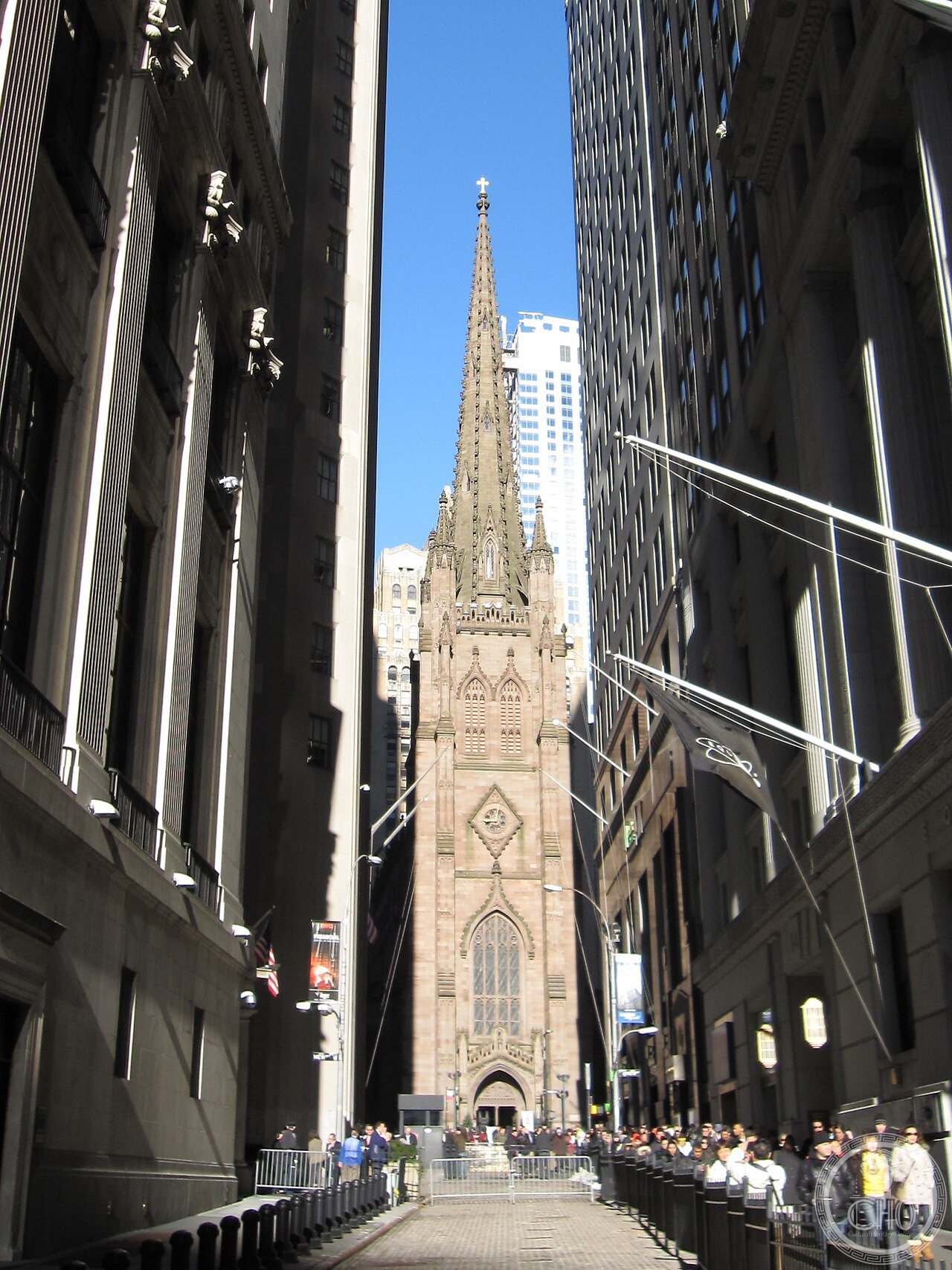
At the head of Wall Street, in Manhattan, the present Trinity Church is the third church built on the same site. The first, from 1698, was destroyed in the Great New York Fire of 1776. The second, built between 1788 and 1790, was demolished in 1839 after being weakened by the weight of snow in a particularly severe winter. The present building, constructed between 1839 and 1846 to a design by the architect Richard Upjohn, was consecrated on Ascension Day, 1 May 1846, by the Episcopal bishop of New York. In Gothic Revival style, considered a landmark of the American Gothic Revival, with a 281-foot spire topped by a gilded cross, the church was the tallest building in the United States from 1846 until 1869, when St. Michael’s Church in Chicago overtook it, and the tallest building in New York City until 1890. In the adjoining churchyard lie many figures from early American history. Among them is Alexander Hamilton, who died on 12 July 1804, the day after his duel with Aaron Burr, and his wife Elizabeth Schuyler Hamilton, who outlived him until 1854. Also buried here are Robert Fulton, inventor of the first commercially successful steamboat; the naval officer James Lawrence, author of the famous motto “Don’t give up the ship”; the Revolutionary spy Hercules Mulligan; and the statesman Albert Gallatin. Thanks to a grant of 215 acres along the west side of Manhattan made by Queen Anne in 1705, the parish became for centuries the largest landowner on the island, and used part of that wealth to help found King’s College, now Columbia University. According to recent sources, the parish’s overall assets today stand at around 6 billion dollars, concentrated in real estate in the Hudson Square neighbourhood. During the attacks of 11 September 2001, Trinity Church survived structurally but did not remain entirely unscathed. A large sycamore in the churchyard was destroyed by debris, later commemorated by Steve Tobin’s bronze sculpture “Trinity Root”, and the pipe organ was damaged by dust and smoke, restored only recently. The better-known role of relief centre for rescue workers belonged instead to St. Paul’s Chapel, a satellite chapel of the same parish closer to Ground Zero. The church remains an active Episcopal parish today and one of New York’s most visited tourist sites, with a marked rise in interest linked to the popularity of the musical “Hamilton” and to Hamilton’s own grave.
About Trinity Church
At the head of Wall Street in Manhattan, the present Trinity Church is the third church built on this site: the first, from 1698, was destroyed in the Great New York City Fire of 1776; the second, built between 1788 and 1790, was demolished in 1839 after being weakened by heavy snow loads during a particularly severe winter; the current building, constructed between 1839 and 1846 to a design by architect Richard Upjohn, was consecrated on Ascension Day, 1 May 1846, by the Episcopal Bishop of New York. In Gothic Revival style, widely considered a landmark of the American Gothic Revival movement, with a spire 281 feet tall topped by a gilded cross, the church was the tallest building in the United States from 1846 until 1869, when it was surpassed by St. Michael’s Church in Chicago, and the tallest building in New York City until 1890. In the adjoining churchyard lie numerous figures from early American history, including Alexander Hamilton, who died on 12 July 1804, the day after his duel with Aaron Burr, and his wife Elizabeth Schuyler Hamilton, who outlived him until 1854; also buried there are Robert Fulton, developer of the first commercially successful steamboat, naval officer James Lawrence, remembered for the phrase “Don’t give up the ship,” Revolutionary War spy Hercules Mulligan, and statesman Albert Gallatin. The parish became, thanks to a 215-acre land grant along Manhattan’s west side made by Queen Anne in 1705, the island’s largest landowner for centuries, using part of that wealth to help found King’s College, now Columbia University; according to recent sources, the parish’s overall assets today stand at around $6 billion, concentrated in real estate in the Hudson Square neighborhood. During the 11 September 2001 attacks, Trinity Church survived structurally but was not entirely unscathed: a large sycamore tree in the churchyard was destroyed by falling debris, later commemorated by the bronze sculpture “Trinity Root” by Steve Tobin, and the pipe organ was damaged by dust and smoke, only recently restored; the better-known role as a relief station for first responders belonged instead to St. Paul’s Chapel, a satellite chapel of the same parish located closer to Ground Zero. The church remains an active Episcopal parish today, among New York’s most visited tourist sites, with notably increased interest tied to the popularity of the musical “Hamilton” and Hamilton’s own grave.
Key facts
- 1839-1846: the third church on this site built, designed by architect Richard Upjohn.
- Tallest building in the US (1846-1869) and in New York City (until 1890).
- Alexander Hamilton’s grave, alongside Robert Fulton and other early American figures.
- 1705: Queen Anne’s 215-acre land grant makes Trinity Manhattan’s largest landowner for centuries.
- 2001: survives 9/11 structurally, though a churchyard tree and the organ suffer damage.
- Still an active Episcopal parish, boosted by “Hamilton” musical tourism.
History
Trinity’s third rebuilding on the same site, after fire destroyed the first church and snow load collapsed the second, reflects the sheer duration of continuous worship at the head of Wall Street since 1698. Its transformation from a parish into one of Manhattan’s largest private landowners, rooted in a single 1705 royal grant, gave it a financial trajectory unusual among American churches, one that continues to shape its role in Lower Manhattan real estate today.
What you see
A Gothic Revival spire, once the tallest structure in America, rises above the churchyard where Alexander Hamilton and other early American figures are buried, the bronze “Trinity Root” sculpture marking the site of a tree lost on 11 September 2001. The church’s brownstone facade closes the view up Wall Street, a landmark unchanged in silhouette since 1846 even as skyscrapers rose around it.
Practical information
- Opening hours: generally open daily outside services; check current hours before visiting.
- Address: 89 Broadway, New York, NY, United States.
Getting there
Trinity Church stands at the head of Wall Street in Lower Manhattan’s Financial District, easily reached by subway. GPS: 40°42′29″N, 74°00′44″W.
Nearby
- Wall Street — the historic financial thoroughfare beginning at the church.
- St. Paul’s Chapel — the affiliated colonial-era chapel a few blocks north.
- New York Stock Exchange — a short walk from the church.
Sources
- Wikipedia — “Trinity Church (Manhattan)” (en.wikipedia.org).
- Trinity Church Wall Street — official site, Visit & History pages (trinitychurchnyc.org).
- The Bowery Boys: New York City History — “Trinity Church: anchor of Wall Street, New York’s landlord”
Find it on the map
See this place and what’s around it →📷 Become a Cultural Heritage Online photographer
Share your photos of places: they stay published under your name as the author. The more they're seen, the more you get noticed — and soon a contest will reward the most appreciated photos.
Log in or sign up free to add a photo