
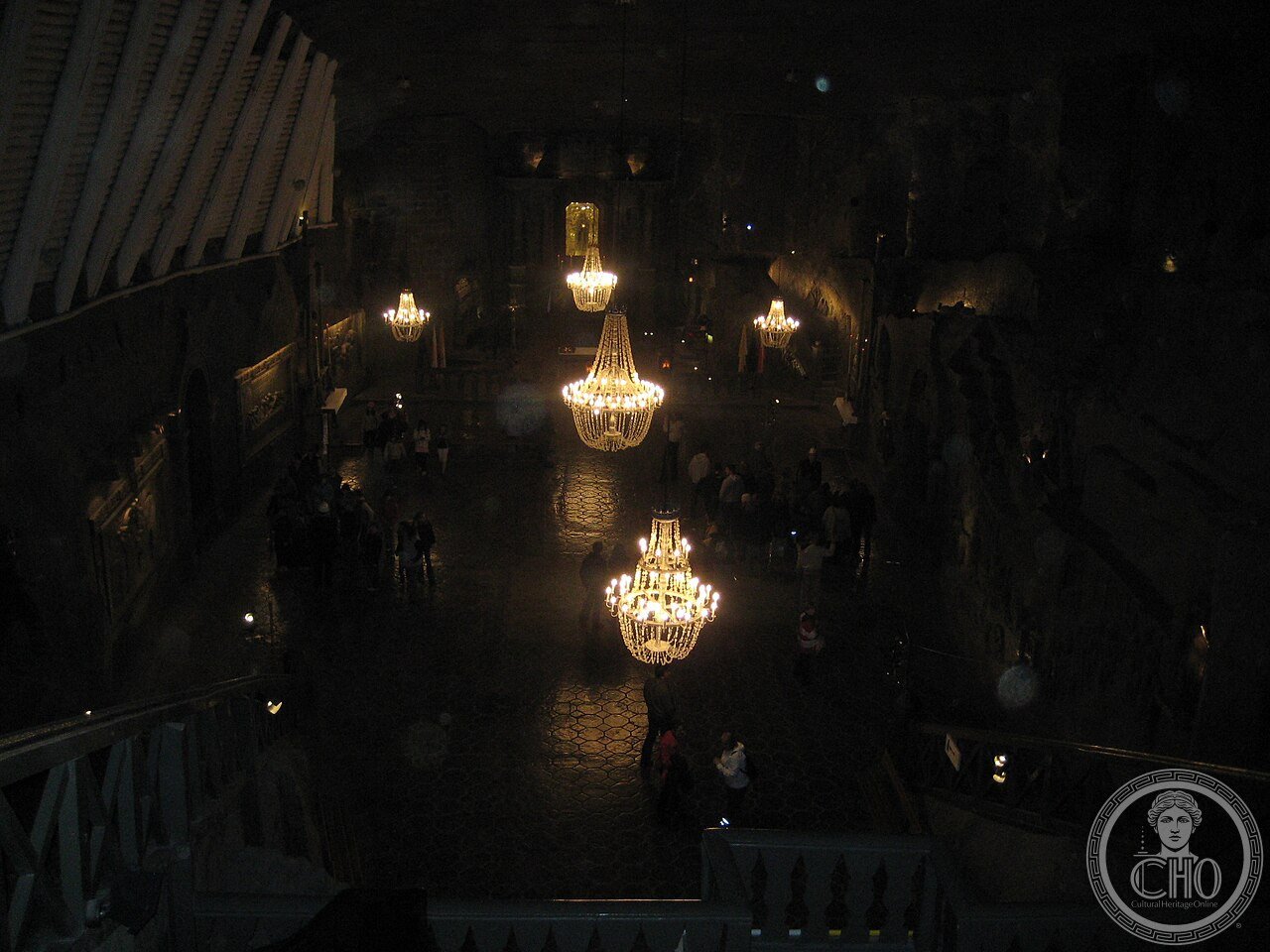
Nella miniera di sale di Wieliczka, vicino a Cracovia, la Cappella di Santa Kinga prende il nome dalla principessa ungherese Kinga, poi canonizzata, andata in sposa a Boleslao V di Polonia, secondo una leggenda tramandata dai minatori che vuole avesse gettato il proprio anello di fidanzamento in un pozzo salifero in Ungheria prima di partire per Cracovia, per poi ritrovarlo, una volta giunta a Wieliczka, incastonato in un blocco di sale estratto dai minatori locali — un racconto da considerare tradizione devozionale, non fatto storico, all’origine del culto di Santa Kinga come patrona dei minatori di sale polacchi. Una prima cappella più semplice esisteva sul sito dal 1722, ma quella che i visitatori vedono oggi fu scavata a partire dal 1896 in una grande cavità lasciata dall’estrazione di un blocco di sale “verde”, per opera soprattutto di due fratelli minatori-scultori, Józef e Tomasz Markowski — quest’ultimo autore in particolare dell’altare maggiore e dei rilievi laterali — insieme a un terzo scultore il cui cognome ricorre nelle fonti in grafie leggermente diverse; i lavori proseguirono in modo intermittente, nell’arco di più generazioni di minatori, fino al 1963. La cappella si trova a 101 metri di profondità e misura circa 54 metri di lunghezza, 18 di larghezza e 12 di altezza, ed è comunemente descritta, sebbene non esista una classifica ufficiale a confermarlo, come una delle più grandi ed elaborate cappelle sotterranee al mondo. Le pareti sono ricoperte di rilievi scolpiti nel salgemma raffiguranti scene bibliche, tra cui una versione dell’Ultima Cena ispirata, secondo quanto riportano le fonti, alla composizione di Leonardo da Vinci; i lampadari, a differenza delle pareti scolpite nel sale grigio, sono realizzati con sale disciolto e poi ricristallizzato in cristalli trasparenti simili al vetro. Il pavimento è interamente in sale, e la cappella, tuttora consacrata, viene utilizzata per funzioni religiose, compresi matrimoni, oltre a spettacoli sonori e luminosi che comprendono musiche di Chopin. Fa parte del sito UNESCO “Miniere reali di sale di Wieliczka e Bochnia”, iscritto nel 1978 tra i primi dodici siti mai inseriti nella Lista del Patrimonio Mondiale, ed estesa nel 2013 al Castello degli Żupy.
About the Chapel of St. Kinga
In the Wieliczka Salt Mine near Kraków, the Chapel of St. Kinga takes its name from the Hungarian princess Kinga, later canonized, who married Bolesław V of Poland, according to a legend passed down by miners that she threw her engagement ring into a salt shaft in Hungary before leaving for Kraków, only to find it, once she reached Wieliczka, embedded in a block of salt extracted by local miners — a story to be treated as devotional tradition, not historical fact, and the origin of St. Kinga’s veneration as patron saint of Polish salt miners. A simpler earlier chapel had existed on the site since 1722, but the one visitors see today was carved starting in 1896 in a large cavity left by the extraction of a “green” salt block, mainly by two miner-sculptor brothers, Józef and Tomasz Markowski — the latter responsible in particular for the high altar and side reliefs — together with a third sculptor whose surname appears in slightly different spellings across sources; work continued intermittently, across several generations of miners, until 1963. The chapel lies 101 metres underground and measures roughly 54 metres long, 18 metres wide and 12 metres high, and is commonly described, though no official ranking confirms it, as one of the largest and most elaborate underground chapels in the world. The walls are covered in relief carvings in rock salt depicting biblical scenes, including a version of the Last Supper reportedly inspired by Leonardo da Vinci’s composition; the chandeliers, unlike the grey carved-salt walls, are made from salt that was dissolved and then recrystallized into clear, glass-like crystals. The floor is entirely salt, and the chapel, still consecrated, is used for religious services, including weddings, alongside sound-and-light shows that include music by Chopin. It forms part of the UNESCO World Heritage Site “Wieliczka and Bochnia Royal Salt Mines,” inscribed in 1978 among the first twelve sites ever added to the World Heritage List, and extended in 2013 to include the Żupny Castle.
Key facts
- 1896-1963: the chapel carved intermittently by generations of miner-sculptors
- 101 metres underground, roughly 54 by 18 metres and 12 metres high
- Carved by brothers Józef and Tomasz Markowski, among others
- Chandeliers made from dissolved and recrystallized rock salt
- Still consecrated, used for services and weddings today
- 1978: part of one of the first 12 UNESCO World Heritage Sites ever inscribed
History
That miners spent nearly seven decades, across multiple generations, carving an entire consecrated church out of the material they extracted for a living speaks to a devotional culture deeply embedded in the mine’s working life, not a one-off commission by outside artists. Its survival as an active place of worship, rather than a purely decorative curiosity, distinguishes it from most underground tourist attractions built for spectacle alone.
What you see
Every surface of the chapel — altars, relief carvings, floor, statues — is worked directly from rock salt, its grey-toned walls contrasting with chandeliers made from clear recrystallized salt crystals hanging overhead. A salt-carved Last Supper and other biblical scenes line the walls of a space that functions, even 101 metres underground, as a genuine parish-scale church.
Practical information
- Opening hours: accessible only as part of the guided Wieliczka Salt Mine tourist route; check current hours and booking before visiting
- Address: Wieliczka Salt Mine, Wieliczka, near Kraków, Poland
Getting there
The Wieliczka Salt Mine lies a short drive southeast of Kraków, reachable by train, bus or organized tour. GPS: 49°58′45″N, 20°03′50″E.
Nearby
- Wieliczka Salt Mine — the wider underground complex surrounding the chapel
- Kraków — Poland’s historic former capital, a short drive away
Sources
- Wikipedia — “Wieliczka Salt Mine” (en.wikipedia.org)
- UNESCO World Heritage Centre — “Wieliczka and Bochnia Royal Salt Mines” (whc.unesco.org)
- Encyclopaedia Britannica — “Wieliczka salt mine” (britannica.com)
Find it on the map
See this place and what’s around it →📷 Become a Cultural Heritage Online photographer
Share your photos of places: they stay published under your name as the author. The more they're seen, the more you get noticed — and soon a contest will reward the most appreciated photos.
Log in or sign up free to add a photo