
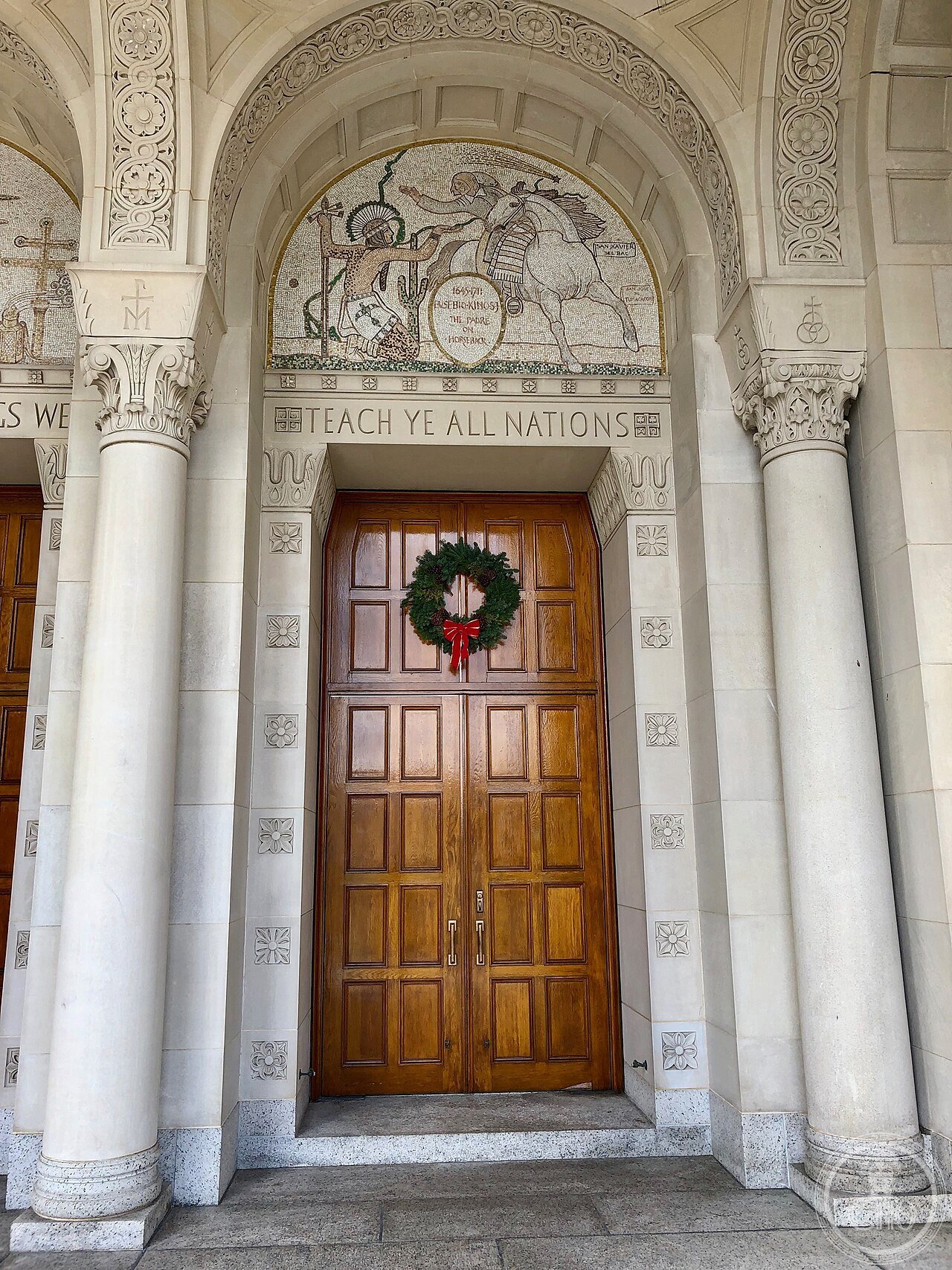
In Washington, D.C., the Basilica of the National Shrine of the Immaculate Conception grew out of an idea of Bishop Thomas J. Shahan, fourth rector of the Catholic University of America, who presented the project to Pope Pius X on 15 August 1913, obtaining his enthusiastic support and a personal donation of 400 dollars. The site was blessed on 16 May 1920 and the foundation stone on 23 September of the same year, on the campus of the same Catholic university. Construction proceeded in phases: the lower church was substantially complete by 1927, work stopped during the Great Depression and briefly during the Second World War, and the great upper church was built only between 1954 and 1959, an overall span of about thirty-nine years, commonly rounded to forty. Designed by the Boston firm Maginnis & Walsh, with the upper church phase directed by Eugene F. Kennedy Jr., the basilica adopts a mixed Neo-Byzantine and Neo-Romanesque style, deliberately chosen by Shahan instead of an initial Neo-Gothic proposal, dominated by the great central dome, the Trinity Dome, completed with a Venetian glass mosaic only in 2017. Sources cite a seating capacity of around 3,500, an overall capacity often given as 6,000 people, and a capacity prepared for up to about 10,000 for major events, figures that vary by source and by the configuration of the spaces. It is widely described as the largest Catholic church in North America and among the largest in the world, although no single official ranking confirms this precisely. The building houses 82 Marian chapels and oratories, each dedicated to a different national or cultural devotion to the Virgin, including the Chapel of Our Lady Mother of Africa, as well as a vast array of mosaics throughout the building. Known informally as “America’s Catholic Church”, a traditional name and not an official Vatican title, the basilica was raised to the rank of minor basilica by Pope John Paul II on 12 October 1990. It is not, however, a cathedral, since it is not the seat of any diocese, a role that in Washington belongs instead to the Cathedral of St. Matthew the Apostle.
About the National Shrine of the Immaculate Conception
In Washington, D.C., the Basilica of the National Shrine of the Immaculate Conception originated with an idea from Bishop Thomas J. Shahan, fourth rector of the Catholic University of America, who presented the project to Pope Pius X on 15 August 1913, receiving enthusiastic support and a personal donation of $400. The site was blessed on 16 May 1920, and the foundation stone laid on 23 September that year, on the campus of the same Catholic university. Construction proceeded in phases: the lower church was substantially complete by 1927, work paused during the Great Depression and briefly during the Second World War, and the great upper church was built only between 1954 and 1959 — an overall span of roughly thirty-nine years, commonly rounded to forty. Designed by the Boston firm Maginnis & Walsh, with the upper church phase directed by Eugene F. Kennedy Jr., the basilica adopts a mixed Neo-Byzantine and Romanesque Revival style, deliberately chosen by Shahan over an initial Neo-Gothic proposal, dominated by its large central dome, the Trinity Dome, completed with a Venetian glass mosaic only in 2017. Sources cite a seating capacity of around 3,500, an overall capacity often given as 6,000, and a capacity engineered for up to about 10,000 for major events — figures that vary by source and space configuration — and it is widely described as the largest Catholic church in North America and among the largest in the world, though no single authoritative ranking confirms this precisely. The building houses 82 Marian chapels and oratories, each dedicated to a different national or cultural devotion to the Virgin, including the Our Mother of Africa Chapel, alongside an extensive mosaic program throughout. Known informally as “America’s Catholic Church,” a traditional rather than official Vatican designation, the basilica was elevated to minor basilica status by Pope John Paul II on 12 October 1990; it is not, however, a cathedral, since it is not the seat of any diocese — a role in Washington held instead by the Cathedral of St. Matthew the Apostle.
Key facts
- 1920-1959: built in phases over roughly thirty-nine years, paused by the Depression and WWII.
- Neo-Byzantine and Romanesque Revival style, deliberately chosen over an initial Neo-Gothic proposal.
- Widely described as the largest Catholic church in North America.
- 82 Marian chapels and oratories, each reflecting a different national or cultural devotion.
- 2017: the Trinity Dome mosaic finally completed, in Venetian glass.
- 1990: elevated to minor basilica status; not a cathedral, as it is not a diocesan seat.
History
The basilica’s nearly forty-year construction, halted twice by national economic and military crisis, mirrors the scale of ambition behind a project conceived from the start as a national rather than diocesan monument — a status formalized only in 1990 when it became a minor basilica, still distinct from cathedral status. Its 82 national and cultural Marian chapels turn the building into something close to a devotional atlas of American Catholic communities, added and expanded gradually across the same decades-long construction.
What you see
A vast Neo-Byzantine and Romanesque Revival basilica rises around its central Trinity Dome, its Venetian glass mosaic completed only in 2017 despite the building’s mid-20th-century structural completion. Around the nave and crypt, 82 distinct chapels reflect Marian devotions from across the world, each decorated in a style reflecting its associated culture or nation.
Practical information
- Opening hours: generally open daily; check current hours before visiting, especially around major services.
- Address: 400 Michigan Avenue NE, Washington, D.C., United States.
Getting there
The basilica stands on the campus of the Catholic University of America in northeast Washington, D.C., reachable by metro or car. GPS: 38°56′00″N, 77°00′02″W.
Nearby
- Catholic University of America — the campus surrounding the basilica.
- Cathedral of St. Matthew the Apostle — the actual seat of the Archdiocese of Washington.
Sources
- Wikipedia — “Basilica of the National Shrine of the Immaculate Conception” (en.wikipedia.org).
- National Shrine official site — History pages (nationalshrine.org).
- Catholic World Report — “5 facts to know about the Basilica of the National Shrine of the Immaculate Conception” (2021).
Find it on the map
See this place and what’s around it →📷 Become a Cultural Heritage Online photographer
Share your photos of places: they stay published under your name as the author. The more they're seen, the more you get noticed — and soon a contest will reward the most appreciated photos.
Log in or sign up free to add a photo