
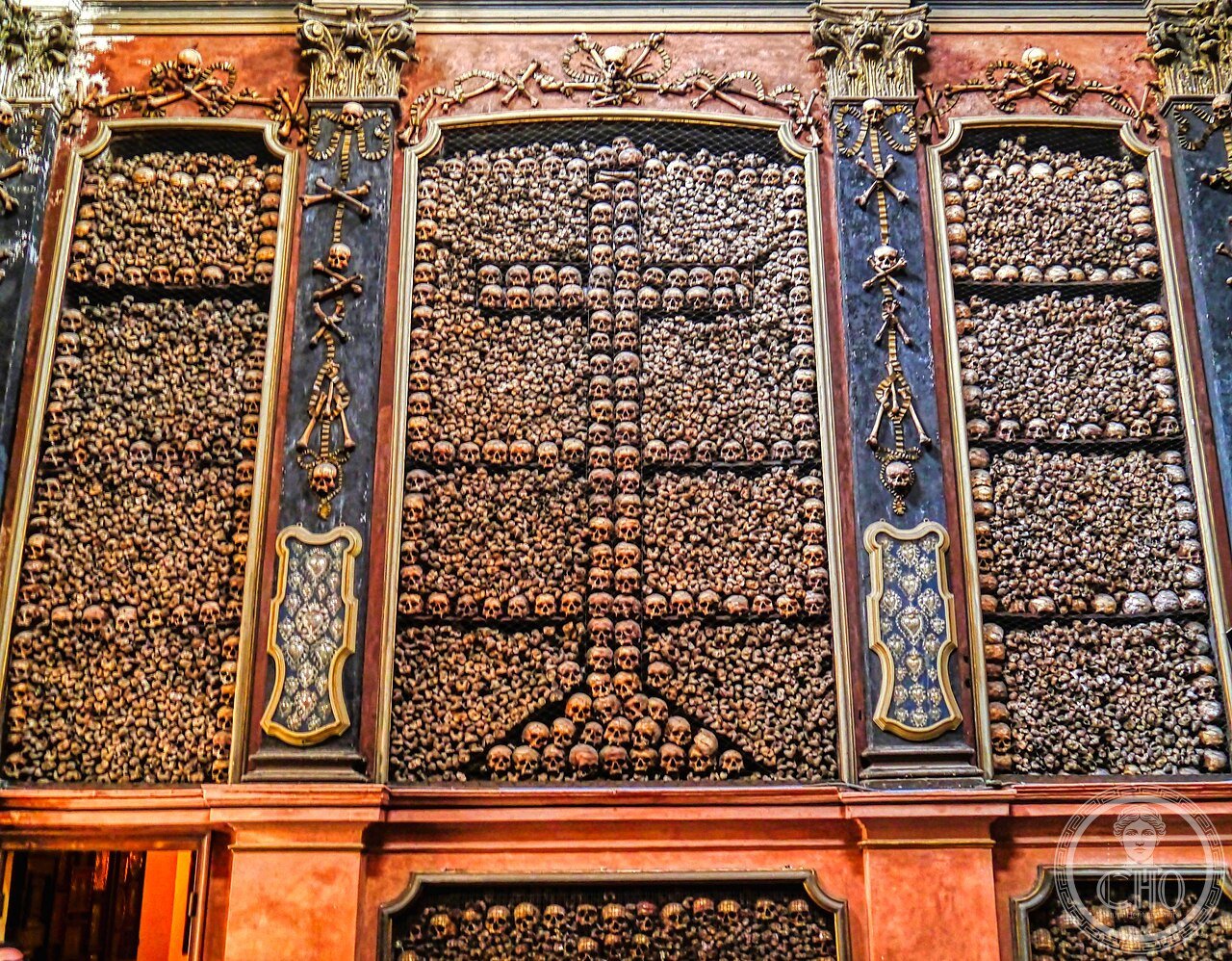
A Milano, un ospedale legato alla Basilica di Santo Stefano Maggiore esisteva in questa zona della città dal 1145; quando il cimitero annesso non ebbe più spazio, nel 1210 fu costruita una piccola camera per accogliere le ossa in eccedenza, dando origine all’ossario, a cui nel 1269 fu affiancata una chiesa. Vi confluirono nel tempo resti di pazienti dell’ospedale, di priori e confratelli dell’istituto, alcuni giustiziati per decapitazione, e, da circa il 1622, anche di prigionieri, quando pure il cimitero del carcere risultò insufficiente, oltre a resti di nobili milanesi provenienti dalle tombe di chiese vicine; le fonti più accurate non confermano invece, contrariamente a quanto talvolta riportato, che vi siano confluiti in modo specifico resti di vittime di epidemie di peste. La cappella ossario fu rinnovata nel 1679 sotto l’architetto Giovanni Andrea Biffi e sopravvisse a un incendio che nel 1712 distrusse la chiesa adiacente, poi ricostruita dall’architetto Carlo Giuseppe Merlo, con la struttura completata attorno al 1717 e la facciata definitiva risalente, secondo alcune fonti, al 1776. La volta della cappella fu affrescata nel 1695 da Sebastiano Ricci con il “Trionfo delle anime tra angeli in volo”, mentre i pennacchi raffigurano la Vergine Maria, sant’Ambrogio, san Sebastiano e san Bernardino da Siena: un contrasto netto tra le pareti macabre coperte di ossa e teschi disposti in motivi decorativi e la scena celeste dipinta sopra di esse. Nessuna fonte fornisce un conteggio attendibile del numero esatto di teschi e ossa presenti, cifra che varia ampiamente e in modo non verificabile tra i siti turistici. Secondo un racconto diffuso ma non documentato da una fonte primaria chiaramente identificata, fu proprio questa cappella a ispirare nel 1738 il re del Portogallo Giovanni V, che ne rimase colpito al punto da far costruire una cappella simile a Évora, l’odierna Capela dos Ossos. Il santuario di San Bernardino alle Ossa resta oggi una chiesa cattolica attiva, aperta ai visitatori, meno nota rispetto alle principali attrazioni di Milano ma tra le più suggestive del centro cittadino.
About San Bernardino alle Ossa
In Milan, a hospital linked to the Basilica of Santo Stefano Maggiore had existed in this part of the city since 1145; when its adjoining cemetery ran out of space, a small chamber was built in 1210 to hold the overflow bones, giving rise to the ossuary, joined in 1269 by an attached church. Over time it received the remains of hospital patients, of priors and brothers of the institution, some executed by beheading, and, from around 1622, of prisoners too, once the prison cemetery also proved insufficient, along with the remains of Milanese nobility from nearby church tombs; the more careful sources, contrary to what is sometimes reported, do not specifically confirm the inclusion of plague victims. The ossuary chapel was renovated in 1679 under architect Giovanni Andrea Biffi and survived a fire that destroyed the adjoining church in 1712, later rebuilt by architect Carlo Giuseppe Merlo, with the structure completed around 1717 and the final facade, according to some sources, dating to 1776. The chapel’s vault was frescoed in 1695 by Sebastiano Ricci with the “Triumph of Souls Amid Flying Angels,” while the pendentives depict the Virgin Mary, St. Ambrose, St. Sebastian and St. Bernardino of Siena: a stark contrast between the macabre walls, covered in skulls and bones arranged in decorative patterns, and the celestial scene painted above them. No source offers a reliable count of the exact number of skulls and bones present, a figure that varies widely and unverifiably across tourist sites. According to a widely repeated but not clearly primary-sourced account, it was this very chapel that in 1738 inspired Portugal’s King John V, who was so struck by it that he had a similar chapel built in Évora, today’s Capela dos Ossos. The Sanctuary of San Bernardino alle Ossa remains today an active Catholic church, open to visitors, less well known than Milan’s major attractions but among the most striking sites in the city centre.
Key facts
- 1210: the ossuary chamber built to hold overflow bones from the hospital cemetery
- 1269: a church is attached to the ossuary
- 1695: the ossuary vault frescoed by Sebastiano Ricci with the “Triumph of Souls”
- 1712: fire destroys the adjoining church, later rebuilt by Carlo Giuseppe Merlo
- 1738 (popular account): said to have inspired Portugal’s King John V to build Évora’s Chapel of Bones
- Still an active Catholic sanctuary, open to visitors in central Milan
History
San Bernardino alle Ossa’s ossuary predates the church that now surrounds it by nearly six decades, having grown out of pragmatic medieval cemetery overflow long before it acquired any decorative or devotional purpose. Its survival through the 1712 fire that destroyed the adjoining church, and its reported later influence on Évora’s own Chapel of Bones, place it within a wider European tradition of ossuary chapels that repeatedly reinterpreted human remains as both memento mori and, eventually, architectural spectacle.
What you see
Skulls and long bones cover the ossuary’s walls and niches in dense decorative arrangements, drawing the eye upward to Sebastiano Ricci’s 1695 ceiling fresco of souls ascending amid flying angels — a deliberate juxtaposition of earthly remains below and heavenly ascent above. The adjoining 18th-century church, rebuilt after the 1712 fire, frames this small but visually overwhelming chapel.
Practical information
- Opening hours: generally open daily outside Mass times; check current hours before visiting
- Address: Via Cesare Battisti, near Piazza Santo Stefano, Milan, Italy
Getting there
San Bernardino alle Ossa stands near Piazza Santo Stefano in central Milan, easily reached on foot from the Duomo. GPS: 45°27′45″N, 9°11′44″E.
Nearby
- Basilica di Santo Stefano Maggiore — the historic basilica linked to the original hospital
- Milan Cathedral (Duomo) — the city’s principal cathedral, a short walk away
Sources
- Wikipedia — “San Bernardino alle Ossa” (en.wikipedia.org)
- Liturgical Arts Journal — “The Ossuary Chapel of San Bernardino alle Ossa in Milan”
- Atlas Obscura — “San Bernardino alle Ossa in Milan”
Find it on the map
See this place and what’s around it →📷 Become a Cultural Heritage Online photographer
Share your photos of places: they stay published under your name as the author. The more they're seen, the more you get noticed — and soon a contest will reward the most appreciated photos.
Log in or sign up free to add a photo