
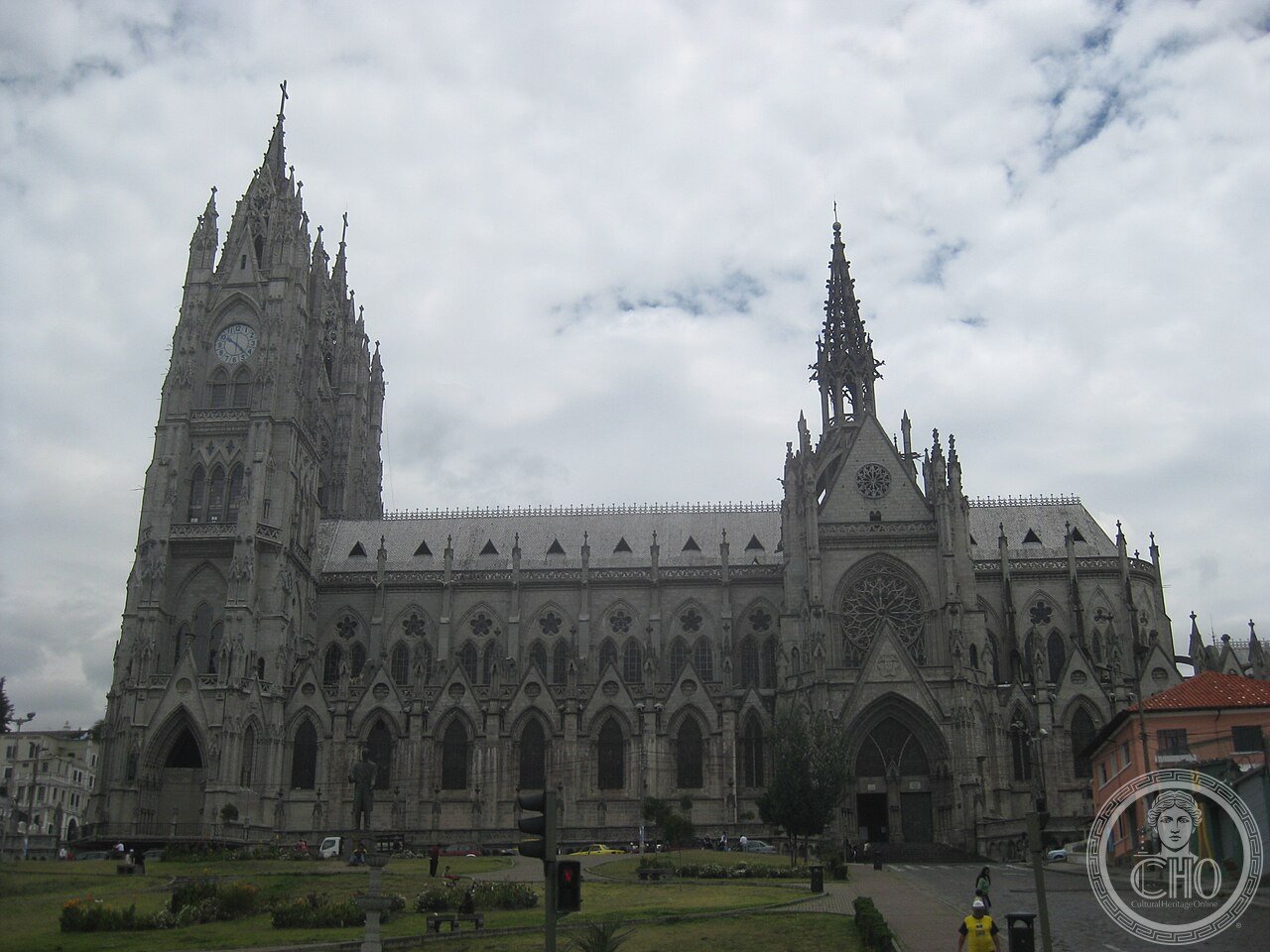
At Quito, in Ecuador, the Basilica of the National Vow commemorates the act of consecrating Ecuador to the Sacred Heart of Jesus, decided by Congress on 31 August 1873 and solemnly celebrated on 25 March 1874 in Quito Cathedral at the urging of President Gabriel García Moreno — who was, however, assassinated in 1875, well before the basilica was even proposed: it was the priest Julio Matovelle who put forward the idea in 1883, with a building decree signed by President Luis Cordero on 23 July 1883, while the foundation stone was laid, on the most commonly cited date, on 10 July 1892 (some sources place the actual start of work as early as 1887). The design, which cost 40,000 French francs, is by the French architect Emilio Tarlier, who drew on French Gothic architecture, though the sources do not agree on which specific cathedral — Notre-Dame in Paris or Bourges, in different versions. The basilica is famous above all for its gargoyles, carved not as the traditional European Gothic monsters but as animals native to Ecuador and the Galápagos: iguanas, giant tortoises, condors, armadillos, pumas and other species, according to the sources, which still work as rainwater spouts. Consecrated and inaugurated on 12 July 1988, the basilica is still officially unfinished more than a century after the work began, and a widespread local legend has it that the world, or Ecuador itself, will end when the work is finally completed. Some 140 metres long, 35 wide, and with a height the sources report inconsistently between 83 and more than 115 metres depending on whether the central body or the twin towers are counted, the basilica lets visitors climb to the towers and the clock tower by ladders and walkways, for a view over the city. It stands inside the historic centre of Quito, placed on the UNESCO World Heritage List in 1978, one of the first sites in the world to receive that recognition, though the basilica is not named individually in the inscription.
About the Basílica del Voto Nacional
In Quito, Ecuador, the Basilica of the National Vow commemorates Ecuador’s consecration to the Sacred Heart of Jesus, decreed by Congress on 31 August 1873 and solemnly celebrated on 25 March 1874 at Quito Cathedral under the drive of President Gabriel García Moreno — who was assassinated in 1875, well before the basilica itself was even proposed: the priest Julio Matovelle launched the idea in 1883, with a construction decree signed by President Luis Cordero on 23 July 1883, while the first stone was laid, according to the most commonly cited date, on 10 July 1892 (some sources place actual building work as early as 1887). The design, costing 40,000 French francs, is credited to French architect Emilio Tarlier, who drew on French Gothic architecture, though sources disagree on which specific cathedral inspired it — Notre-Dame de Paris or Bourges Cathedral, depending on the version. The basilica is best known for its gargoyles, carved not as traditional European Gothic monsters but as animals native to Ecuador and the Galápagos: iguanas, giant tortoises, condors, armadillos, pumas and other species depending on the source, which remain functional rainwater spouts. Consecrated and inaugurated on 12 July 1988, the basilica remains officially unfinished more than a century after construction began, and a widespread local legend holds that the world, or Ecuador itself, will end when the work is finally completed. At roughly 140 metres long and 35 metres wide, with a height sources report inconsistently as somewhere between 83 and over 115 metres depending on whether the central body or the twin towers are measured, the basilica lets visitors climb up into the towers and clock tower via ladders and walkways for views over the city. It stands within Quito’s historic centre, inscribed on the UNESCO World Heritage List in 1978, one of the first sites anywhere to receive that recognition, though the basilica is not individually named in the inscription.
Key facts
- 1873-74: Ecuador’s congressional decree and solemn ceremony consecrating the nation to the Sacred Heart
- 1892 (first stone): construction of the basilica begins, some sources say building started as early as 1887
- Gargoyles carved as native fauna — iguanas, Galápagos tortoises, condors, armadillos and pumas, not European monsters
- 1988: the basilica is consecrated and inaugurated
- Still officially unfinished, with a local legend that completion would mark the end of the world
- 1978: lies within Quito’s historic centre, one of the first UNESCO World Heritage Sites
History
The basilica’s origin traces to a national religious decree, not to the building itself, which followed a full generation later under different political leadership — a reminder that “founding” moments in civic memory and actual construction dates can diverge by decades. That the largest neo-Gothic basilica in the Americas remains technically incomplete after more than 130 years, and that Quiteños have folded this into a half-serious apocalyptic legend, says as much about the building’s place in local identity as any finished monument could.
What you see
Twin Gothic Revival towers rise over Quito’s historic centre, their exterior lined with gargoyles carved as Ecuadorian and Galápagos wildlife rather than the gargoyle-monsters of European cathedrals — a distinctly national reinterpretation of a French Gothic model. Visitors willing to climb narrow ladders and walkways can reach platforms high in the towers and the central clock tower, looking out over the Andean city below.
Practical information
- Opening hours: generally open daily with seasonal variation; a separate fee applies for climbing the towers; check current hours before visiting
- Address: Carchi and Venezuela, Historic Centre, Quito, Ecuador
Getting there
The Basílica del Voto Nacional stands in Quito’s historic centre, easily reached on foot from the main colonial-era plazas. GPS: 0°12′54″S, 78°30′27″W.
Nearby
- Iglesia de la Compañía de Jesús — the gold-leaf Jesuit church in Quito’s historic centre
- Church and Convent of San Francisco — South America’s largest colonial religious complex
- Historic Centre of Quito — the UNESCO World Heritage colonial old town
Sources
- Wikipedia — “Basílica del Voto Nacional” (en.wikipedia.org and es.wikipedia.org)
- UNESCO World Heritage Centre — “City of Quito” (whc.unesco.org)
- Ecuador.com — Basílica del Voto Nacional visitor information
Find it on the map
See this place and what’s around it →📷 Become a Cultural Heritage Online photographer
Share your photos of places: they stay published under your name as the author. The more they're seen, the more you get noticed — and soon a contest will reward the most appreciated photos.
Log in or sign up free to add a photo