

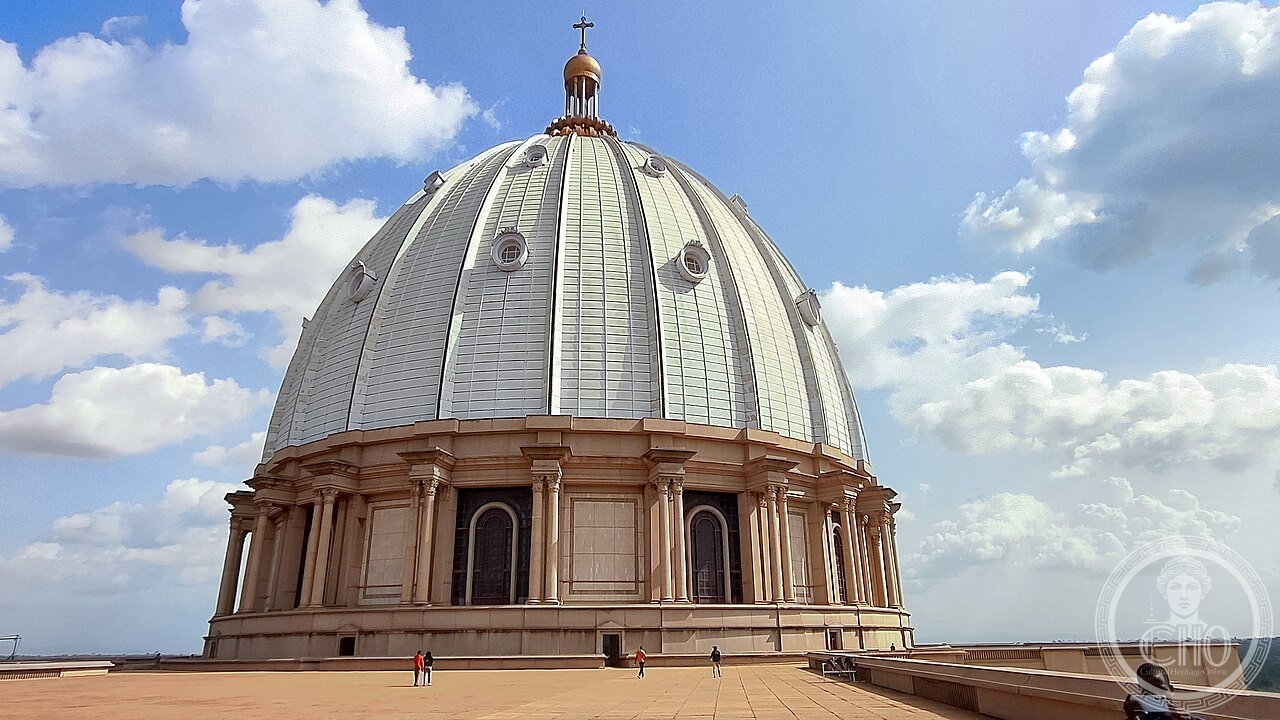
In Yamoussoukro, Ivory Coast, the Basilica of Our Lady of Peace was commissioned by President Félix Houphouët-Boigny for the home village he himself transformed into the national capital. Its cornerstone was laid on 10 August 1985, and it was consecrated by Pope John Paul II on 10 September 1990. Explicitly modeled on St. Peter’s Basilica in Rome, with a colonnade and Latin-cross plan topped by a dome, its dome measures 90 metres in diameter against St. Peter’s 41 metres, larger, unambiguously, on that measure, while the comparison of overall height remains unsettled, with sources disagreeing on which basilica is actually taller. The design is credited to the Ivorian-Lebanese architect Pierre Fakhoury, selected following a competition in February 1986. The cost, never officially disclosed, is estimated by sources across a wide and disputed range, from $175 million to $600 million, with $300 million often cited as a middle figure. Pope John Paul II agreed to consecrate the building on condition that a hospital also be built nearby, construction of which, slowed by Ivory Coast’s civil war, was not completed until 2014, and that the basilica be gifted to the Holy See rather than remain state property. It is now run by an autonomous foundation created by the Vatican. The building covers roughly 30,000 square metres, seating 7,000 worshippers in the nave with standing room for around 11,000 more, for a combined capacity estimated at about 18,000. Its stained glass, made in France, covers roughly 8,400 square metres across 18,500 panels, one of which depicts Houphouët-Boigny himself kneeling beside Jesus in the scene of the entry into Jerusalem. Built in what was then one of the world’s poorer nations, the basilica drew, and continues to draw, widespread criticism at home and abroad as a disproportionate example of prestige spending. Today, despite its monumental capacity, regular Sunday attendance is reported by sources at around 300 to 400 people, in part because Catholics make up only a minority, roughly 10 percent, of Ivory Coast’s population.
About the Basilica of Our Lady of Peace
In Yamoussoukro, Ivory Coast, the Basilica of Our Lady of Peace was commissioned by President Félix Houphouët-Boigny for the home village he himself transformed into the national capital: its cornerstone was laid on 10 August 1985, and it was consecrated by Pope John Paul II on 10 September 1990. Explicitly modeled on St. Peter’s Basilica in Rome, with a colonnade and Latin-cross plan topped by a dome, its dome measures 90 metres in diameter against St. Peter’s 41 metres — larger, unambiguously, on that measure — while the comparison of overall height remains unsettled, with sources disagreeing on which basilica is actually taller. The design is credited to Ivorian-Lebanese architect Pierre Fakhoury, selected following a competition in February 1986; the cost, never officially disclosed, is estimated by sources across a wide and disputed range, from $175 million to $600 million, with $300 million often cited as a middle figure. Pope John Paul II agreed to consecrate the building on condition that a hospital also be built nearby — construction of which, slowed by Ivory Coast’s civil war, was not completed until 2014 — and that the basilica be gifted to the Holy See rather than remain state property; it is now run by an autonomous foundation created by the Vatican. The building covers roughly 30,000 square metres, seating 7,000 worshippers in the nave with standing room for around 11,000 more, for a combined capacity estimated at about 18,000; its stained glass, made in France, covers roughly 8,400 square metres across 18,500 panels, one of which depicts Houphouët-Boigny himself kneeling beside Jesus in the scene of the entry into Jerusalem. Built in what was then one of the world’s poorer nations, the basilica drew, and continues to draw, widespread criticism at home and abroad as a disproportionate example of prestige spending; today, despite its monumental capacity, regular Sunday attendance is reported by sources at around 300 to 400 people, in part because Catholics make up only a minority, roughly 10 percent, of Ivory Coast’s population.
Key facts
- 1985-1990: built and consecrated in roughly five years, commissioned by President Houphouët-Boigny.
- 90-metre dome diameter, wider than St. Peter’s Basilica in Rome (41 m).
- 10 September 1990: consecrated by Pope John Paul II, on condition a hospital also be built nearby.
- Roughly 18,000 total capacity, among the largest churches in the world by area.
- 18,500 stained-glass panels, made in France, one depicting Houphouët-Boigny himself among biblical figures.
- Sunday attendance today: reported at roughly 300-400 people, far below its capacity.
History
Few religious buildings anywhere illustrate the gap between monumental ambition and everyday use as starkly as this basilica: consecrated only after the Vatican secured a hospital commitment and ownership transfer to the Holy See, it now stands largely empty on ordinary Sundays in a country where Catholics are a small minority, its scale a permanent artifact of one president’s determination to remake his home village into a national and religious capital in a single decade.
What you see
A colonnaded piazza and Latin-cross basilica rise beneath a dome wider than St. Peter’s in Rome, its interior lit by some 8,400 square metres of French-made stained glass depicting biblical scenes — including, in one panel, Houphouët-Boigny himself. The scale, deliberately modeled on the Vatican original, dwarfs the modest Ivorian city around it, built specifically to house this single monument.
Practical information
- Opening hours: generally open daily for visits outside Mass times; guided tours available; check current hours before visiting.
- Address: Yamoussoukro, Ivory Coast (Côte d’Ivoire).
Getting there
The basilica stands on the edge of Yamoussoukro, Ivory Coast’s political capital, reachable by car or organized tour from the city centre. GPS: 6°48′40″N, 5°17′49″W.
Nearby
- Presidential Palace of Yamoussoukro — Houphouët-Boigny’s official residence, with its sacred crocodile lake.
- Yamoussoukro — Ivory Coast’s official political capital.
Sources
- Wikipedia — “Basilica of Our Lady of Peace” (en.wikipedia.org).
- Encyclopaedia Britannica — “Basilica of Our Lady of Peace of Yamoussoukro” (britannica.com).
- The Christian Century — “The fascinating story of the Ivory Coast’s mega-basilica”
Find it on the map
See this place and what’s around it →📷 Become a Cultural Heritage Online photographer
Share your photos of places: they stay published under your name as the author. The more they're seen, the more you get noticed — and soon a contest will reward the most appreciated photos.
Log in or sign up free to add a photo