
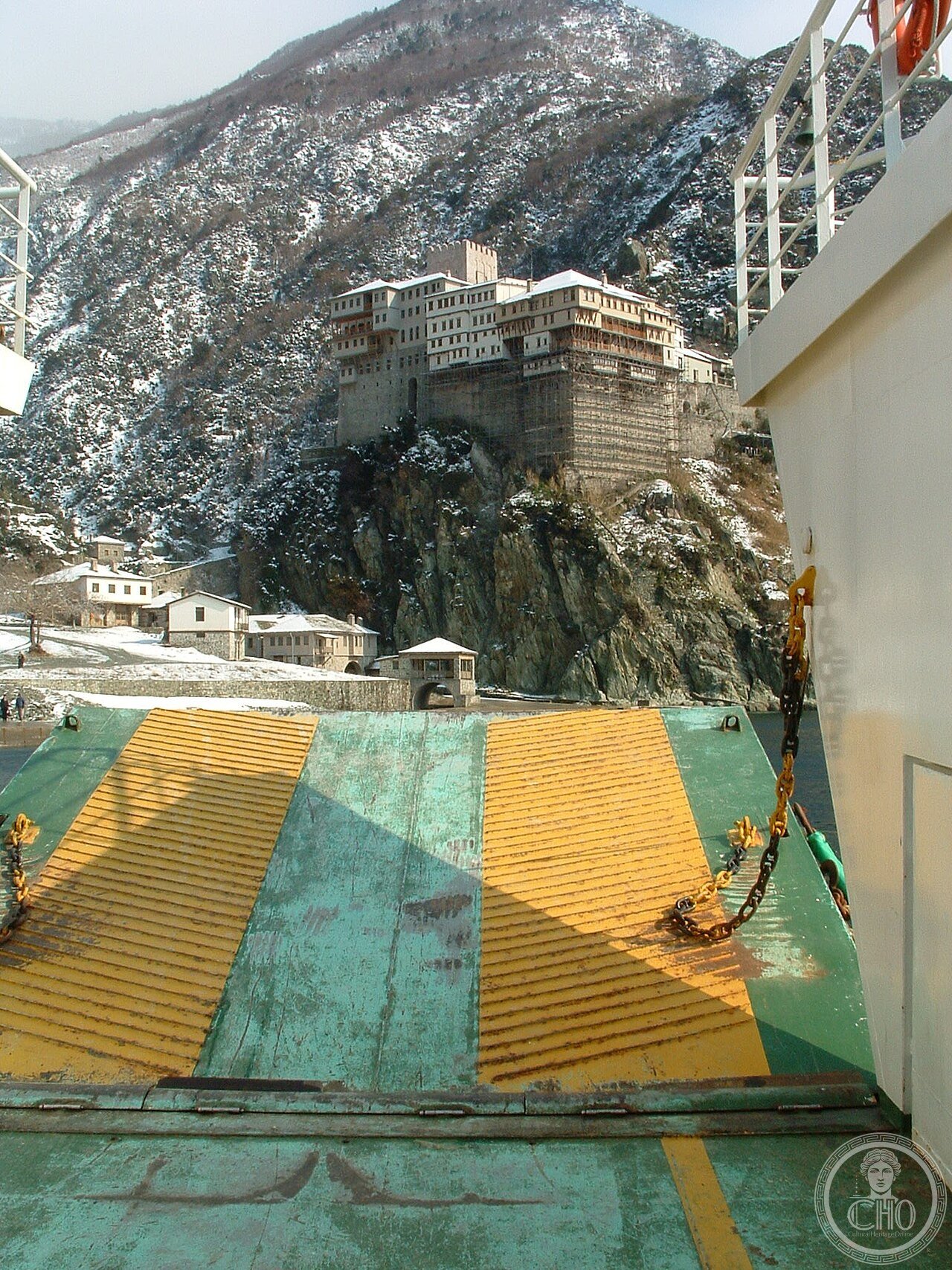
Sul versante sud-occidentale della penisola del Monte Athos, in Grecia, il monastero di Dionysiou fu fondato da san Dionisio di Korisos (Dionisio l’Athonita), che iniziò a costruirvi intorno al 1356-1366, completando la prima fase edilizia entro il 1370. Un crisobollo imperiale del settembre 1374, ancora conservato nell’archivio del monastero, ne attesta la fondazione: il principale benefattore fu l’imperatore Alessio III Comneno di Trebisonda, legato al fondatore tramite il fratello di quest’ultimo, metropolita della stessa Trebisonda. Il monastero occupa il quinto posto nella gerarchia dei venti monasteri sovrani del Monte Athos, arroccato su una roccia scoscesa a circa 80 metri sul mare, con l’aspetto di una fortezza. Un incendio del 1535 distrusse gran parte della struttura originaria; da allora, in modo insolito per gli standard athoniti, Dionysiou non ha subito altri incendi. Il katholikon (chiesa principale), ricostruito dopo l’incendio, fu affrescato dal pittore cretese Tzortzis. Tra i tesori custoditi, spicca l’icona della Vergine dell’Acatisto, tradizionalmente attribuita a san Luca e legata secondo la tradizione all’assedio di Costantinopoli del 626 d.C., donata al fondatore nel 1374 e recuperata due volte dopo furti (un’incursione piratesca nel 1592 e un altro furto nel 1767). La biblioteca conserva circa 800 codici e migliaia di libri a stampa antichi. Il monastero fa parte del Patrimonio Mondiale UNESCO del Monte Athos, iscritto nel 1988 come sito misto culturale e naturale.
About Dionysiou Monastery
Dionysiou Monastery, on the southwestern coast of the Mount Athos peninsula in Greece, was founded by Saint Dionysios of Korisos, known as Dionysios the Athonite, who began building on the site around 1356-1366, completing the first construction phase by 1370. A surviving imperial chrysobull dated September 1374, still preserved in the monastery’s archive, confirms its establishment; its principal benefactor was Emperor Alexios III Komnenos of Trebizond, connected to the founder through his brother, who served as Metropolitan of Trebizond. The monastery ranks fifth in the hierarchy of the twenty ruling monasteries of Mount Athos, built fortress-like on a steep rock roughly 80 metres above the sea. A fire in 1535 destroyed much of the original structure, and unusually for an Athonite community, Dionysiou has suffered no further fire damage since — the only monastery on the Holy Mountain able to make that claim. The rebuilt katholikon, or main church, was frescoed by the Cretan painter Tzortzis. Among the monastery’s treasures, the most celebrated is the icon of the Virgin of the Akathist, traditionally attributed to Saint Luke and associated in tradition with the 626 CE siege of Constantinople, gifted to the founder in 1374 and recovered twice after theft, once during a pirate raid in 1592 and again after a further theft in 1767. The monastery’s library holds roughly 800 manuscript codices and thousands of early printed books. As one of the twenty ruling monasteries, Dionysiou forms part of the UNESCO World Heritage Site “Mount Athos,” inscribed in 1988 as a mixed cultural and natural site, and remains an active monastic community of roughly fifty monks today, governed by the traditional Athonite rules including the exclusion of women.
Key facts
- c. 1356-1370: founding by Saint Dionysios of Korisos, with Trebizond imperial patronage
- September 1374: surviving imperial chrysobull confirms the monastery’s establishment
- 5th in the hierarchy of Mount Athos’s twenty ruling monasteries
- ~80 metres above the sea, built into a steep cliffside rock
- 1535: a major fire, after which the monastery has suffered no further fire damage
- Icon of the Virgin of the Akathist, traditionally attributed to Saint Luke
- 1988: part of the UNESCO World Heritage Site “Mount Athos”
History
Dionysiou Monastery’s founding through the patronage of the Trebizond imperial court, rather than Constantinople itself, reflects the fragmented but interconnected Byzantine world of the mid-14th century, in which regional successor states like Trebizond maintained their own networks of religious patronage on Mount Athos. Its unique record of surviving without fire damage since 1535 sets it apart among the Holy Mountain’s twenty ruling monasteries, most of which suffered repeated destructive fires across the following centuries, giving Dionysiou’s post-1535 architecture and frescoes an unusual degree of continuity.
What you see
The monastery’s fortress-like walls rise directly from a steep rock roughly 80 metres above the Aegean, their multi-storey wooden balconies overhanging the cliff edge in a design unique to Athonite monastic architecture. Inside, the katholikon’s frescoes by the Cretan painter Tzortzis and the monastery’s treasury, including the icon of the Virgin of the Akathist and an extensive manuscript library, preserve one of Mount Athos’s richest artistic and documentary collections.
Practical information
- Access: Mount Athos requires a special entry permit (diamonitirion); open only to men, following traditional Athonite restrictions; the Julian calendar is observed
- Address: Mount Athos peninsula, Chalkidiki, Greece
Getting there
Dionysiou Monastery lies on the southwestern coast of the Mount Athos peninsula, reachable by boat along the coastline from Daphni, the peninsula’s port. GPS: 40.1680° N, 24.2739° E.
Nearby
- Simonopetra Monastery — another dramatic cliffside monastery, along the same coastline
- Great Lavra — the oldest and highest-ranking monastery on Mount Athos, further along the peninsula
- Daphni — the port serving Mount Athos, reachable by boat
Sources
- Wikipedia — “Dionysiou Monastery” (en.wikipedia.org)
- UNESCO World Heritage Centre — “Mount Athos” (whc.unesco.org)
- Macedonian Heritage — “The Monastery of Dionysiou” (macedonian-heritage.gr)
Find it on the map
See this place and what’s around it →📷 Become a Cultural Heritage Online photographer
Share your photos of places: they stay published under your name as the author. The more they're seen, the more you get noticed — and soon a contest will reward the most appreciated photos.
Log in or sign up free to add a photo