

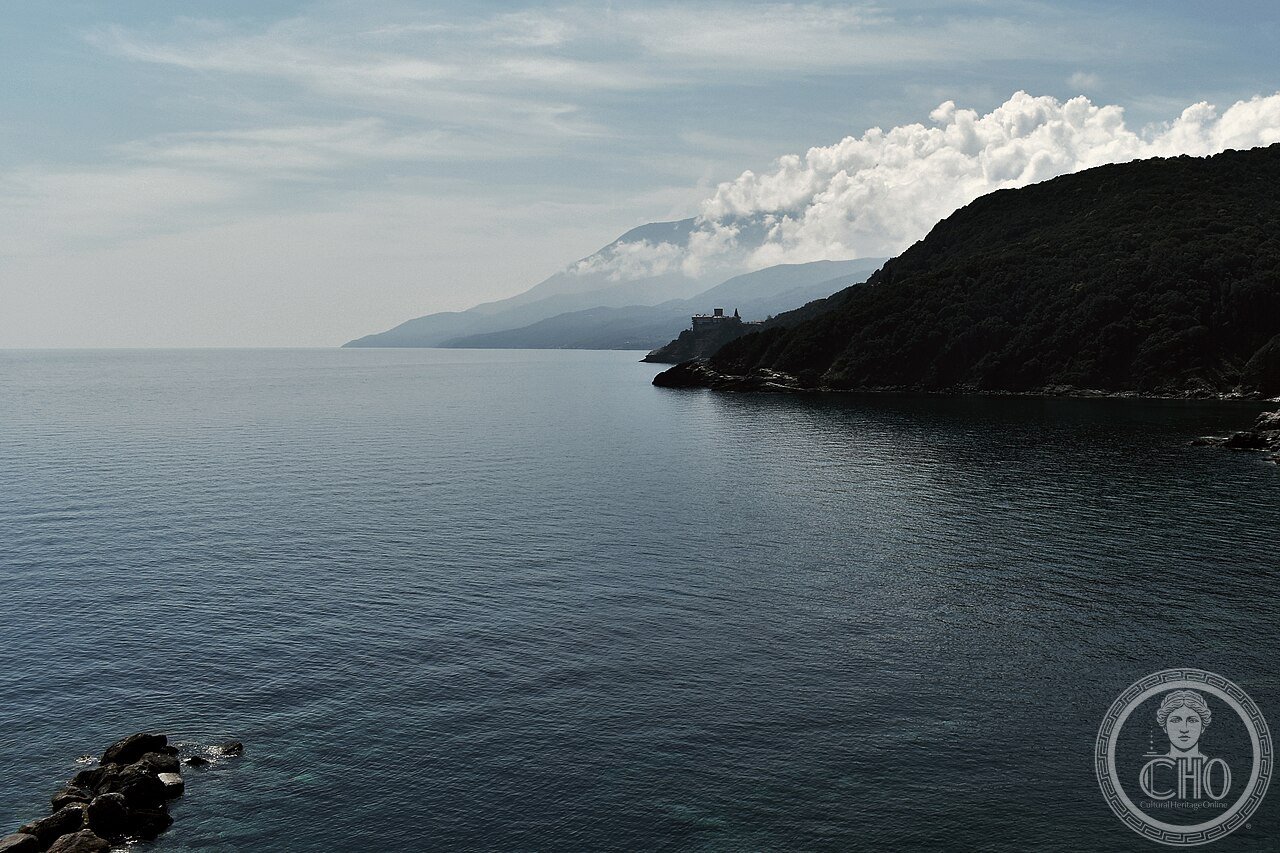
On Mount Athos, in Greece, a monastery called Stavronikita is documented in sources as early as 1012 and 1016. It was abandoned around the middle of the 13th century after pirate raids and the consequences of the Fourth Crusade. The abbot Gregorios Giromeriatis bought the ruined site in 1533 and began the rebuilding. On his death, in 1540, it was the ecumenical patriarch Jeremias I of Constantinople who completed the work, and in 1536 a patriarchal edict sanctioned the official restoration of the monastery, the last of the twenty ruling monasteries of Mount Athos to be formally recognised, though it holds the fifteenth place in their hierarchy and not the last, as is sometimes wrongly believed. Stavronikita is today the smallest of the twenty, built as a compact fortress directly on a rock spur above the sea, with a tower and an aqueduct added in 1770. The katholikon, dedicated to Saint Nicholas, was frescoed between 1545 and 1546 by the famous Cretan painter Theophanes, one of the most important painted cycles on the whole of Mount Athos. The monastery also keeps a famous mosaic icon of Saint Nicholas, known as «of the Oyster», tied to a tradition according to which it was recovered from the sea with a shell still attached to the forehead of the saint depicted, although the sources give different versions of the details and the dates of the story. Since 1988 the monastery has formed part of the UNESCO World Heritage Site of Mount Athos.
About Stavronikita Monastery
A monastery called Stavronikita on Mount Athos, Greece, is documented in sources as early as 1012 and 1016, but it was abandoned around the mid-13th century following pirate raids and the disruption caused by the Fourth Crusade. The abbot Gregorios Giromeriatis purchased the ruined site in 1533 and began its reconstruction; following his death in 1540, Ecumenical Patriarch Jeremias I of Constantinople completed the work, and in 1536 a patriarchal edict formally reinstated the monastery as the last of the twenty ruling monasteries of Mount Athos to receive official recognition — though it ranks fifteenth in their hierarchy, not last, a distinction sometimes confused with its status as the smallest of the twenty. Stavronikita today is the smallest of Mount Athos’s ruling monasteries, built as a compact fortress directly on a rock outcrop above the sea, with a defensive tower and an aqueduct added in 1770. The katholikon, dedicated to Saint Nicholas, was frescoed between 1545 and 1546 by the renowned Cretan painter Theophanes, producing one of the most important fresco cycles anywhere on Mount Athos. The monastery also preserves a celebrated mosaic icon of Saint Nicholas known as “of the Oyster,” tied to a tradition holding that it was recovered from the sea with a shell still attached to the saint’s forehead — though sources give differing accounts of exactly when and how this occurred, treating it as a documented monastic tradition rather than a single settled historical event. Since 1988, Stavronikita has formed part of the UNESCO World Heritage Site “Mount Athos.”
Key facts
- 1012/1016: earliest documented references to a Stavronikita monastery on the site.
- 1533-1536: reconstruction and formal reinstatement as one of the twenty ruling monasteries.
- 15th in the hierarchy of Mount Athos’s twenty ruling monasteries; the smallest by size.
- 1545-1546: katholikon frescoes by the Cretan painter Theophanes.
- Mosaic icon of Saint Nicholas “of the Oyster,” tied to a recovery-from-the-sea tradition.
- 1988: becomes part of the UNESCO World Heritage Site “Mount Athos”
History
Stavronikita’s history of abandonment, purchase from ruin, and eventual formal reinstatement as the last of Mount Athos’s twenty ruling monasteries to gain official recognition illustrates the precariousness that could afflict even long-established Athonite communities amid piracy and the broader upheavals of the medieval eastern Mediterranean. Its Theophanes fresco cycle, completed in the mid-16th century, places the small monastery among the most artistically significant sites on the Holy Mountain, disproportionate to its modest physical scale.
What you see
The monastery’s compact, fortress-like structure rises directly from a rocky outcrop above the sea, its defensive tower and 1770 aqueduct reflecting the practical concerns of a small, exposed community. Inside the katholikon, Theophanes the Cretan’s mid-16th-century frescoes cover the walls, while the monastery’s treasury displays the mosaic icon of Saint Nicholas “of the Oyster” alongside other relics and manuscripts.
Practical information
- Access: Mount Athos requires a special entry permit (diamonitirion); open only to men, following traditional Athonite restrictions; the Julian calendar is observed.
- Address: Mount Athos peninsula, Chalkidiki, Greece.
Getting there
Stavronikita Monastery lies on the northeastern coast of the Mount Athos peninsula, reachable by boat along the coastline from Daphni, the peninsula’s port. GPS: 40.2680° N, 24.2767° E.
Nearby
- Pantokratoros Monastery — another Athonite monastery along the same coast.
- Iviron Monastery — major monastery further along the peninsula.
- Karyes — the administrative capital of Mount Athos, inland.
Sources
- Wikipedia — “Stavronikita” and “Monastic community of Mount Athos” (en.wikipedia.org).
- UNESCO World Heritage Centre — “Mount Athos” (whc.unesco.org).
- OrthodoxWiki — “Stavronikita Monastery (Athos)” (orthodoxwiki.org).
Find it on the map
See this place and what’s around it →📷 Become a Cultural Heritage Online photographer
Share your photos of places: they stay published under your name as the author. The more they're seen, the more you get noticed — and soon a contest will reward the most appreciated photos.
Log in or sign up free to add a photo