
Verso il 612, il monaco irlandese Gallo, discepolo di san Colombano, si ritirò in un eremo tra i boschi svizzeri e vi rimase fino alla morte, nel 646. Un secolo dopo, quell’eremo divenne una delle grandi abbazie d’Europa. Oggi la sua biblioteca barocca, tra 160.000 volumi e 2.100 manoscritti medievali, custodisce anche un ospite inatteso: la mummia di Schepenese, sacerdotessa egizia vissuta 27 secoli fa, giunta a San Gallo nel 1821.
About St. Gallen Abbey
Around 612, the Irish monk Gallus, a disciple and companion of Saint Columbanus, established a hermitage on the site of present-day St. Gallen and lived there until his death in 646. Nearly a century later, in 719, the monk Otmar revived the Gallus settlement, founding the Abbey of Saint Gall, which grew into one of the most important spiritual and intellectual centres of early medieval Europe. The abbey’s library preserves the Plan of Saint Gall, drawn up around 819-826 at the nearby Reichenau Abbey and today held at St. Gallen — the only surviving major architectural drawing anywhere from the roughly 700-year span between the fall of the Western Roman Empire and the 13th century, depicting an idealised monastic complex never actually built. The Abbey library itself, one of the oldest continuously operating libraries in the world, holds nearly 160,000 volumes, including around 2,100 handwritten manuscripts, nearly half of them medieval and 400 more than a thousand years old, among them important 7th- and 8th-century Irish manuscripts and illuminated works of the St. Gall School. The present library hall, built between 1758 and 1767 to a design by the architect Peter Thumb, is realised in exuberant Rococo style, with carved and polished wood, stucco, and painted ceilings, and is widely regarded as one of the most beautiful historic library interiors in the world. Since 1847 the abbey’s church has served as the cathedral of the Diocese of St. Gallen, and the entire abbey precinct — church, library, and surrounding buildings — has been inscribed as a UNESCO World Heritage Site since 1983. Among the library’s more unusual holdings is the mummy of Schepenese, daughter of a high priest who lived in Thebes, Egypt, between around 700 and 650 BCE; her mummy and elaborately painted double coffin arrived in St. Gallen in 1821 and remain on display within the library today.
Key facts
- c. 612: Irish monk Gallus establishes a hermitage on the site
- 719: Otmar founds the Abbey of Saint Gall on the earlier hermitage
- c. 819-826: the Plan of Saint Gall drawn up, the oldest surviving major medieval architectural plan
- 1758-1767: Rococo library hall built to designs by Peter Thumb
- 1821: the Egyptian mummy of Schepenese arrives at the library
- 1847: the abbey church becomes the cathedral of the Diocese of St. Gallen
- 1983: the Abbey precinct inscribed as a UNESCO World Heritage Site
History
The transformation of Gallus’s solitary 7th-century hermitage into one of early medieval Europe’s leading intellectual centres, over the course of just over a century, situates St. Gallen within a wider pattern of Irish and Scottish missionary monasticism reshaping the religious and cultural landscape of the early medieval Continent. The Abbey library’s survival across more than a millennium of European upheaval — preserving both the singular Plan of Saint Gall and a continuous run of medieval manuscripts — makes it one of the very few European monastic libraries whose medieval collection has never been dispersed or lost.
The presence of Schepenese’s Egyptian mummy within a Rococo Christian library, arriving nearly three millennia after her death and two millennia after Gallus’s own hermitage, reflects the 19th-century European fashion for collecting Egyptian antiquities as objects of scholarly and popular fascination, here juxtaposed in an unusually direct way against one of the continent’s oldest surviving centres of Christian learning.
What you see
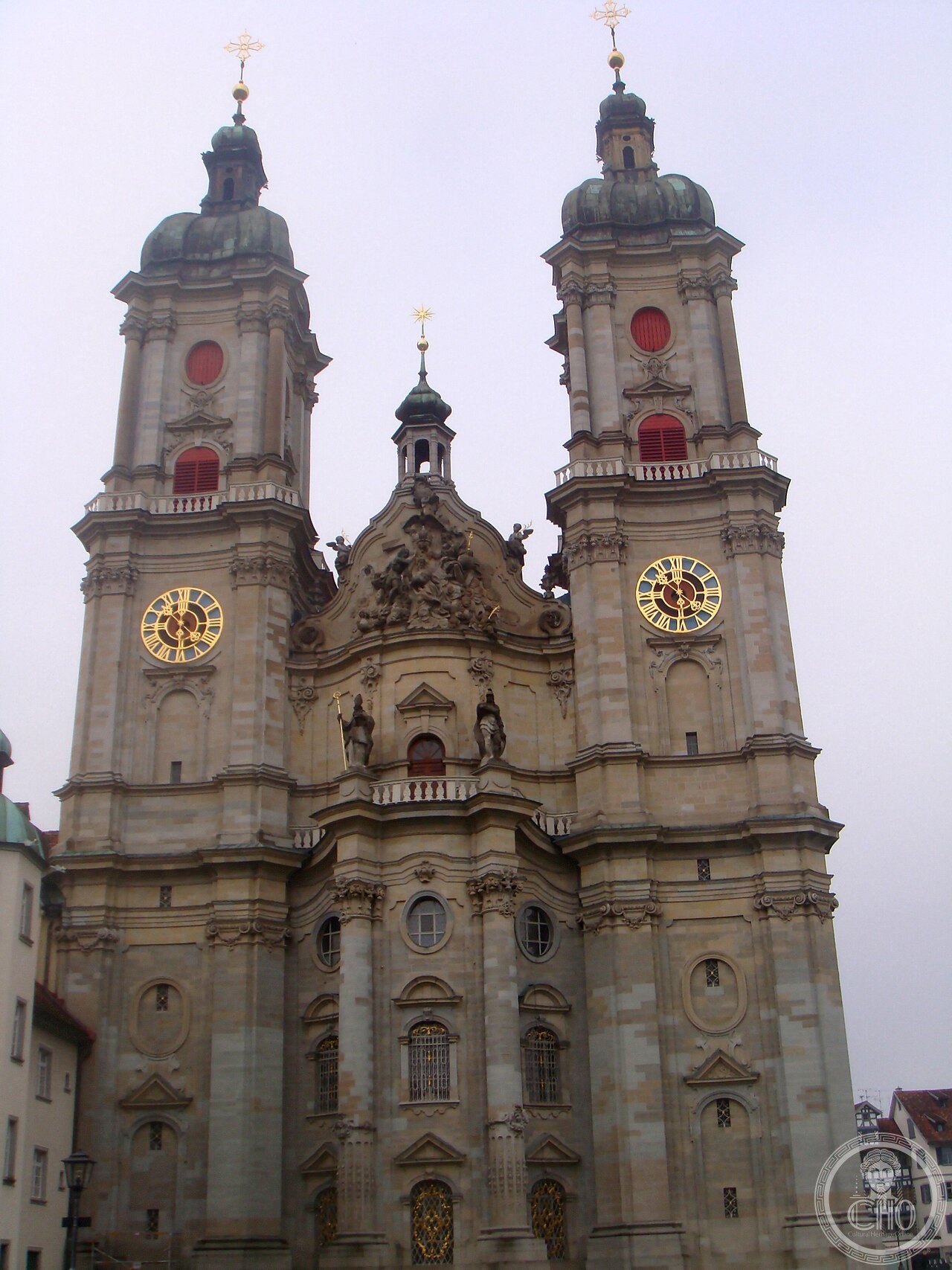
The abbey cathedral, rebuilt in the 18th century, is considered one of the last great sacred structures of the Baroque era in Central Europe, with twin towers and an ornate interior of frescoed ceilings and elaborate choir stalls. The adjoining library hall, built 1758-1767 to designs by Peter Thumb, presents a full Rococo ensemble of carved wood, stucco, and painted ceiling scenes, housing both the Plan of Saint Gall and the mummy of Schepenese alongside its medieval manuscript collection.
Practical information
- Opening hours: generally open daily with seasonal variation; check current hours before visiting; admission fee applies for the library
- Address: Klosterhof 6d, 9000 St. Gallen, Switzerland
Getting there
St. Gallen Abbey is located in the historic centre of St. Gallen, in northeastern Switzerland, easily reachable on foot from the city’s main train station. GPS: 47.4228° N, 9.3764° E.
Nearby
- St. Gallen Old Town — the surrounding historic city centre
- Textilmuseum St. Gallen — a museum dedicated to the city’s historic textile industry, nearby
- Lake Constance — a short distance to the north
Sources
- Wikipedia — “Abbey of Saint Gall,” “Abbey library of Saint Gall,” and “Plan of Saint Gall” (en.wikipedia.org)
- UNESCO World Heritage Centre — “Abbey of St Gall” (whc.unesco.org)
- Ancient Origins — “The Abbey Library of St. Gall: One of the Oldest Working Libraries in the World” (ancient-origins.net)
Find it on the map
See this place and what’s around it →📷 Become a Cultural Heritage Online photographer
Share your photos of places: they stay published under your name as the author. The more they're seen, the more you get noticed — and soon a contest will reward the most appreciated photos.
Log in or sign up free to add a photo