
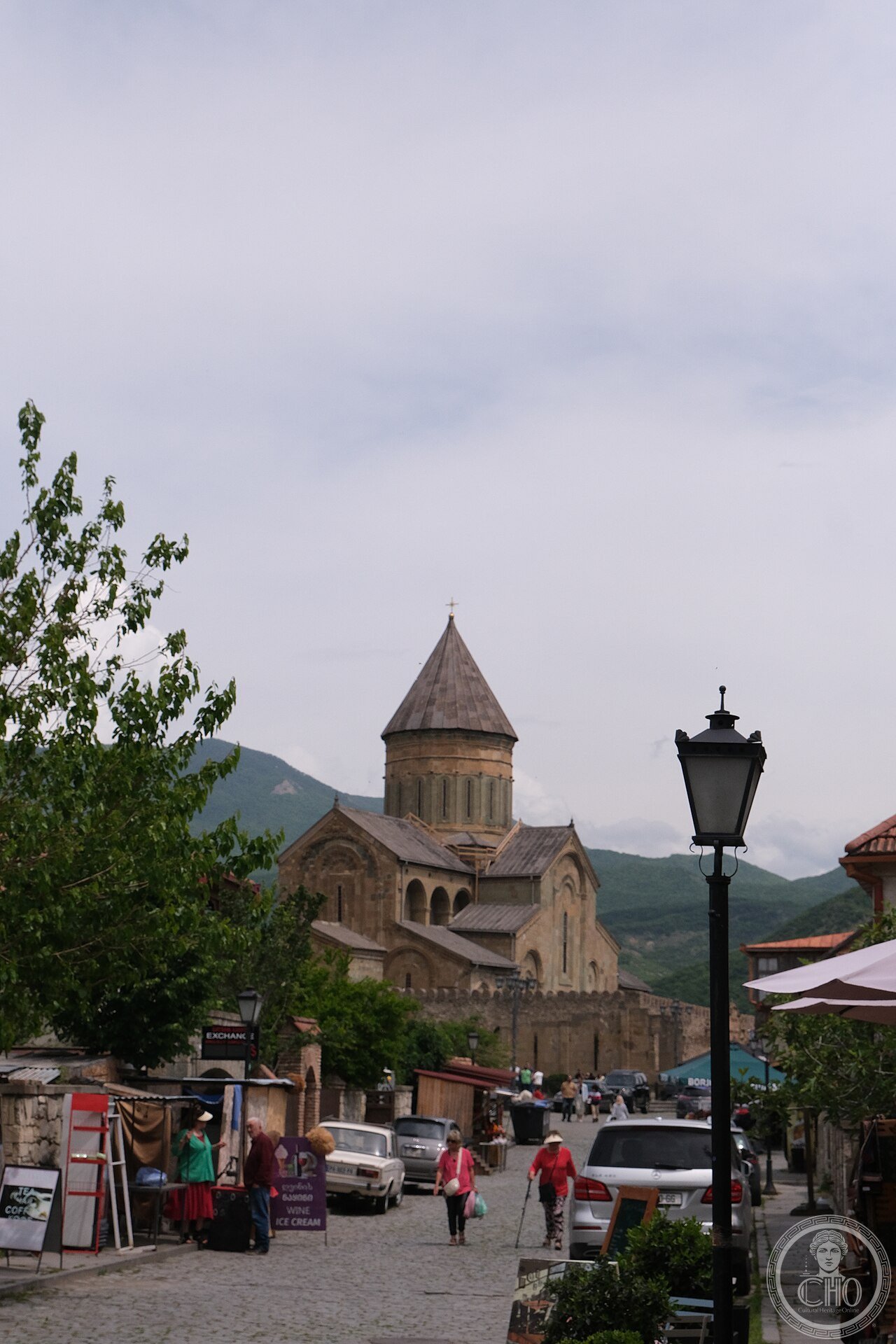
According to Georgian tradition, in the first century a Jew of Mtskheta named Elias bought Christ’s robe in Jerusalem from a Roman soldier and brought it home; his sister Sidonia, embracing it, died on the spot from emotion and was buried together with the relic. A miraculous cedar grew over her grave, and when it was cut down to build the first church, one pillar refused to be moved — until it moved by itself, at night, to the exact point of the burial, giving off holy oil. From that wonder, “Svetitskhoveli” means “life-giving pillar”.
About Svetitskhoveli Cathedral
The first church on the site of Svetitskhoveli was built in the 4th century AD during the reign of King Mirian III of Kartli (ancient Iberia), at the confluence of the Mtkvari and Aragvi rivers, on the initiative of Saint Nino, the woman traditionally credited with converting Georgia to Christianity. According to Georgian hagiography, in the 1st century a Jewish man from Mtskheta named Elias had travelled to Jerusalem and witnessed the crucifixion; he purchased Christ’s robe from a Roman soldier at Golgotha and brought it home to Georgia. His sister Sidonia, overcome with emotion upon touching the sacred garment, died on the spot, and was buried together with the robe still clasped in her arms. A great cedar tree grew from her grave, and when Saint Nino later ordered the tree felled to build the first church, one pillar carved from its wood refused to be set upright despite every effort — until, according to the legend, it moved into place by itself during the night and began to exude a miraculous holy oil, giving the site its name: “sveti” (pillar) and “tskhoveli” (life-giving). The cathedral seen today was constructed between 1010 and 1029 under the architect Arsukisdze, commissioned by Catholicos Melchizedek I of Georgia, replacing the earlier structures on the same sacred ground. Svetitskhoveli has long served as the traditional spiritual centre of the Georgian Orthodox Church and the site of the coronation and burial of numerous Georgian monarchs. The cathedral forms part of the Historical Monuments of Mtskheta, inscribed as a UNESCO World Heritage Site in recognition of the town’s exceptional concentration of medieval Georgian religious architecture.
Key facts
- 4th century AD: first church built under King Mirian III, at Saint Nino’s initiative
- Founding legend: Christ’s robe, brought by Elias, buried with his sister Sidonia
- The Living Pillar: a column said to have moved into place by itself, exuding holy oil
- 1010-1029: present cathedral built by architect Arsukisdze under Catholicos Melchizedek I
- Royal function: traditional site of coronation and burial for Georgian monarchs
- UNESCO World Heritage: part of the Historical Monuments of Mtskheta
History
The legend of Christ’s robe and the Living Pillar situates Svetitskhoveli as, according to Georgian tradition, one of the most sacred sites in the Christian world, its foundation narrative directly linking the cathedral to the Passion of Christ rather than to a later saint’s relics or a purely local miracle — a claim that has shaped Georgian religious identity for over a millennium. The cathedral’s role as the traditional coronation and burial site of Georgian monarchs situates it, alongside its religious function, as a central monument of Georgian national and dynastic history, comparable to the role played by major coronation cathedrals elsewhere in Europe.
The 11th-century rebuilding under Arsukisdze, replacing the site’s earlier 4th-century church, reflects the architectural ambitions of the Bagrationi dynasty during a golden age of medieval Georgian statehood, producing one of the largest and most sophisticated ecclesiastical structures built anywhere in the Caucasus region up to that time.
What you see
The cathedral’s cross-in-square plan and elaborate stone facade decoration reflect the mature medieval Georgian ecclesiastical architectural style developed during the 11th century. Within the church, a small chapel and inscribed pillar mark the traditional site of Sidonia’s grave and Christ’s robe, considered the cathedral’s most sacred point. The surviving carved reliefs on the exterior, including depictions attributed to the architect Arsukisdze himself, are among the finest examples of medieval Georgian stone carving.
Practical information
- Opening hours: generally open daily with seasonal variation; check current hours before visiting; free admission
- Address: Arsukidze Street, Mtskheta, Georgia
Getting there
Svetitskhoveli Cathedral is located in the historic town of Mtskheta, roughly 20 kilometres north of Tbilisi, easily reachable by road. GPS: 41.8423° N, 44.7210° E.
Nearby
- Jvari Monastery — a 6th-century monastery overlooking Mtskheta from a nearby hilltop
- Samtavro Monastery — another historic Mtskheta church, within walking distance
- Tbilisi — Georgia’s capital, roughly 20 kilometres away
Sources
- Wikipedia — “Svetitskhoveli Cathedral” (en.wikipedia.org)
- Georgia About — “About Sights – Svetitskhoveli (The Life Giving Pillar) Cathedral” (georgiaabout.com)
- UNESCO World Heritage Centre — “Historical Monuments of Mtskheta” (whc.unesco.org)
Find it on the map
See this place and what’s around it →📷 Become a Cultural Heritage Online photographer
Share your photos of places: they stay published under your name as the author. The more they're seen, the more you get noticed — and soon a contest will reward the most appreciated photos.
Log in or sign up free to add a photo