
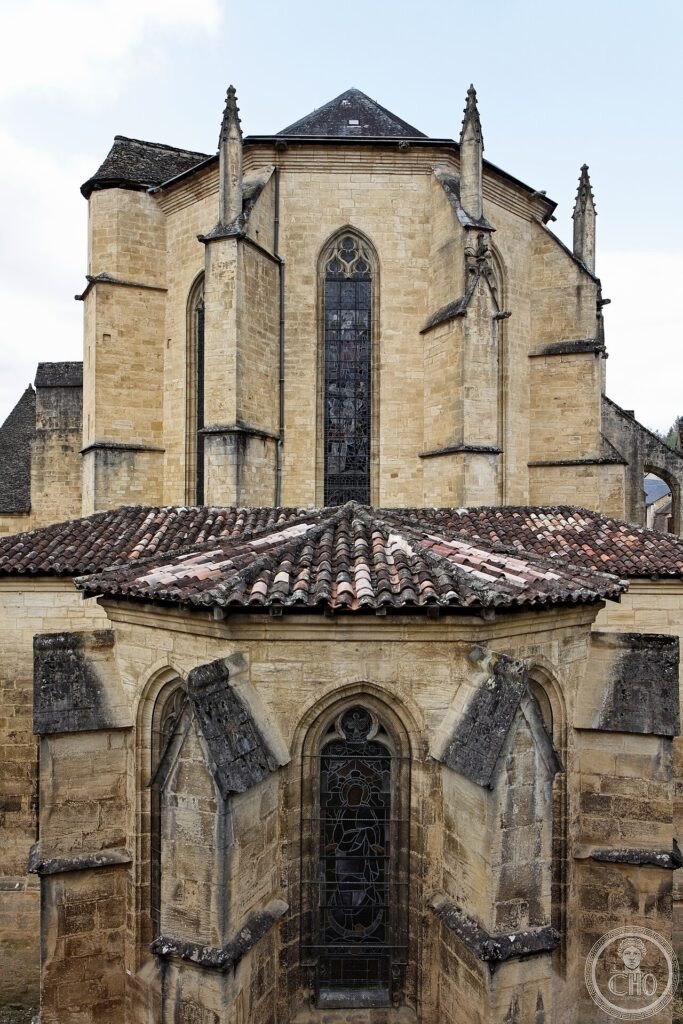
In the cemetery of Saint-Benoît, just behind the apse of the cathedral, the Lantern of the Dead has stood since about 1180: a conical tower whose real function remains a puzzle. For some it symbolically guided the souls of the dead with a perpetual light burning at its top; legend has it that it recalls Saint Bernard’s passage through the town in 1147.
At a glance
Sarlat Cathedral (Cathédrale Saint-Sacerdos) traces its history to a Benedictine monastery founded in the 9th century and dedicated to Saint Sacerdos, a bishop of Limoges, with the structure rebuilt between 1125 and 1160. In 1317, Pope John XXII elevated the monastery to a bishopric, and the church became a cathedral, its architecture illustrating the transition from Romanesque simplicity to Gothic elevation across its long building history. Directly behind the cathedral’s apse, in the former Saint-Benoît cemetery, stands one of Sarlat’s most genuinely enigmatic monuments: the Lanterne des Morts (Lantern of the Dead), probably built in the last third of the 12th century, around 1180. Also historically known as the Tower of the Moors, the structure’s exact original function remains a matter of ongoing scholarly debate — some historians interpret it as a religious monument meant to symbolically guide the souls of the dead through a perpetual light lit at its summit, giving the tower its name, while local legend recorded by the 17th-century chronicler Jean Tarde instead connects its construction to a visit by Saint Bernard of Clairvaux in 1147, who reportedly blessed bread with miraculous healing properties during his stay.
Key facts
- Monastic origins: Benedictine monastery founded 9th century, dedicated to Saint Sacerdos, a bishop of Limoges; rebuilt 1125-1160
- Cathedral status: conferred 1317 by Pope John XXII, elevating the monastery to a bishopric
- Architectural character: combines Romanesque simplicity with later Gothic elevation, reflecting its long building history from the medieval to the early modern period
- Lanterne des Morts: probably built c. 1180, in the former Saint-Benoît cemetery directly behind the cathedral apse; also known historically as the Tower of the Moors
- Uncertain function: variously interpreted as a symbolic beacon guiding souls of the dead via a perpetual summit light, or connected by local legend to a 1147 visit by Saint Bernard of Clairvaux, who reportedly blessed miraculously healing bread there
History
Sarlat’s 9th-century Benedictine foundation, dedicated to Saint Sacerdos of Limoges, situates the monastery within the broader Carolingian-era wave of monastic establishment across southwestern France, and its 1125-1160 rebuilding reflects the same period of renewed monastic construction and expansion visible at numerous comparable Benedictine houses across the region during the 12th century. The 1317 elevation to cathedral status, granted by the Avignon-based Pope John XXII as part of a wider reorganisation of French dioceses during this period of papal residence in Avignon rather than Rome, gave Sarlat formal episcopal standing that would last until the diocese’s eventual suppression, with the cathedral later continuing in reduced ecclesiastical status.
The Lanterne des Morts’s genuinely unresolved function makes it one of French medieval architecture’s more intriguing minor mysteries: unlike more straightforwardly documented funerary or devotional monuments, no surviving contemporary source definitively establishes the tower’s original intended purpose, leaving modern historians to work from later interpretive traditions — the “guiding light for souls” theory drawing on the tower’s cemetery location and its cone-shaped form suggestive of a lantern, and the Saint Bernard legend recorded by Jean Tarde in the 17th century representing a later, more narratively satisfying but historically less verifiable explanation typical of how medieval monuments whose original documentation was lost often acquired retrospective legendary explanations in subsequent centuries. Whichever interpretation is correct, the tower’s direct physical proximity to the cathedral apse and its shared documented dating to roughly the same broad period as the cathedral’s own 12th-century rebuilding give the two structures a meaningful spatial and chronological relationship regardless of the Lanterne’s precise original purpose.
What you see
The cathedral’s combination of Romanesque and Gothic elements, reflecting its long building history from the 12th-century rebuilding through later medieval and early modern additions, gives visitors a layered architectural record spanning several centuries within a single structure. The adjacent Lanterne des Morts, with its distinctive conical form standing in the former cemetery immediately behind the cathedral apse, rewards a short additional stop specifically to consider its unresolved function — one of the more genuinely open historical questions attached to any French medieval monument of comparable prominence. The recumbent effigy (gisant) of Saint Martin de Brive and other interior sculptural elements add further points of interest within the cathedral itself.
Practical information
- Opening hours: generally open daily, check current hours before visiting; free admission
- Address: Cour du Cloître, 24200 Sarlat-la-Canéda
Getting there
Sarlat-la-Canéda is reachable by train from Bordeaux (approximately 2.5 hours, typically with a change at Le Buisson) and by car via the D6089/D704 road network. The cathedral stands at the heart of Sarlat’s exceptionally well-preserved medieval old town. GPS: 44.8888° N, 1.2171° E.
Nearby
- Sarlat old town — surrounding the cathedral; one of the best-preserved medieval and Renaissance townscapes in France, extensively restored under the 1962 Malraux law
- Lascaux (replica caves) — approximately 20-25 minutes by car; the celebrated prehistoric painted cave, visited via its faithful modern reproduction (Lascaux IV)
- Château de Beynac — approximately 20 minutes by car; a dramatic clifftop medieval fortress overlooking the Dordogne river
Sources
- Sarlat Tourisme — official visitor portal, “La Cathédrale Saint-Sacerdos” and “La Lanterne des morts” (sarlat-tourisme.com)
- Terroir Périgord — visitor guide, “Cathédrale Saint-Sacerdos Sarlat” (terroir-perigord.com)
- Wikipedia — “Cathédrale Saint-Sacerdos de Sarlat” and “Lanterne des morts de Sarlat” (fr.wikipedia.org)
Find it on the map
See this place and what’s around it →📷 Become a Cultural Heritage Online photographer
Share your photos of places: they stay published under your name as the author. The more they're seen, the more you get noticed — and soon a contest will reward the most appreciated photos.
Log in or sign up free to add a photoIs this page about you?
This page is read by travellers and heritage enthusiasts who find it on Google. Tell us how you are connected to this place and we will take it from there.