
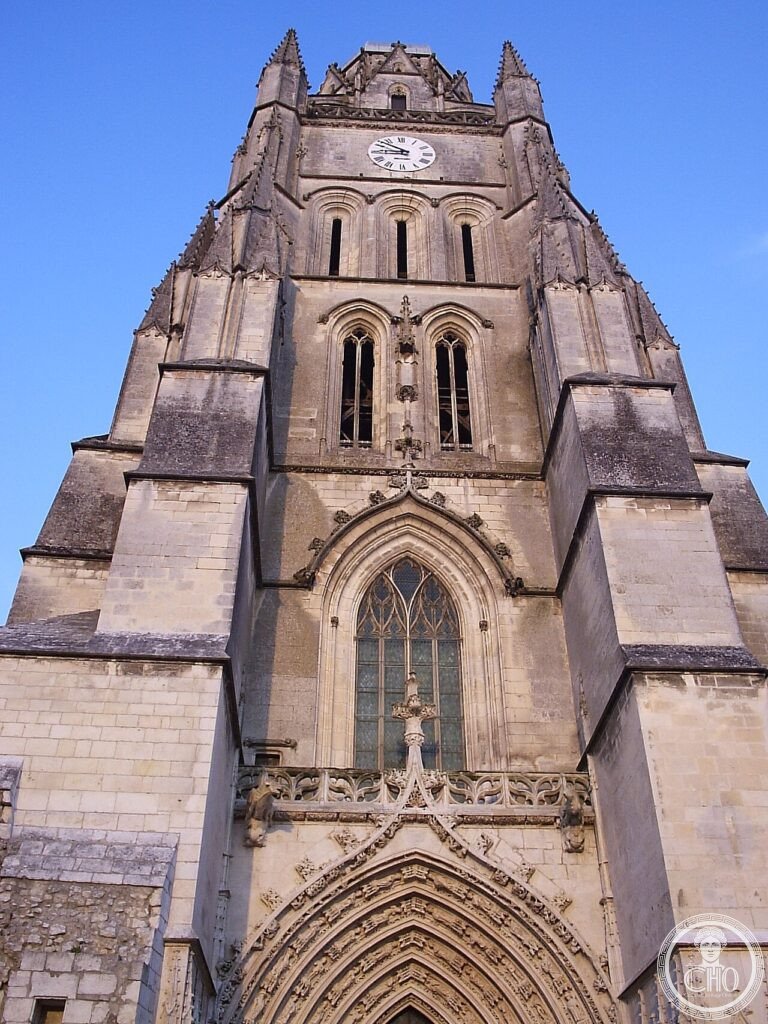
The bell tower was meant to carry a stone spire 96 metres high. In 1568 the Huguenot troops of François de Coligny d’Andelot sacked the cathedral, destroyed the statue of Charlemagne and deliberately undermined the piers of the nave, bringing it down. The spire was never completed: today the bell tower carries only a copper dome.
At a glance
Saintes Cathedral (Cathédrale Saint-Pierre) began as a Romanesque structure rebuilt in the 12th century, of which only the south transept arm, topped with a dome, survives today. From 1450, a major project launched an entirely new Flamboyant Gothic cathedral, still under construction when King Louis XI visited in 1472. The bell tower was originally designed to support a stone spire that would have reached 96 metres, but this ambitious plan was never realised, a direct casualty of the French Wars of Religion: in 1568, Huguenot troops under François de Coligny d’Andelot sacked the cathedral, defacing the portal and destroying a statue of Charlemagne, damaging or destroying part of the choir’s radiating chapels, pillaging furnishings, and — in a deliberate act of structural sabotage — undermining the nave’s pillars to cause its collapse. Reconstruction began only in 1585, with limited resources, and the nave never regained its original planned height, covered instead with a simple wooden roof frame rather than the vaulting the Gothic design had originally intended. The unfinished bell tower today carries a copper dome rather than the planned stone spire, giving the cathedral its distinctive, visibly incomplete silhouette.
Key facts
- Earlier Romanesque cathedral: rebuilt 12th century; only the domed south transept arm survives today
- Flamboyant Gothic rebuilding: begun 1450, still under construction during King Louis XI’s 1472 visit
- Planned spire: the bell tower was designed to carry a stone spire reaching 96 metres, never completed
- 1568 Huguenot sack: troops under François de Coligny d’Andelot defaced the portal, destroyed a statue of Charlemagne, damaged the choir’s radiating chapels, pillaged furnishings, and deliberately undermined the nave pillars to cause structural collapse
- 1585 reconstruction: undertaken with limited means; the nave never regained its originally planned height, covered instead by a simple wooden framework rather than stone vaulting
- Present appearance: the unfinished bell tower carries a copper dome in place of the planned stone spire, giving the building its distinctive atypical silhouette
History
Saintes Cathedral’s ambitious 1450 Flamboyant Gothic rebuilding, still visibly in progress during a royal visit by Louis XI in 1472, reflected the same wave of major late-medieval French cathedral construction visible at numerous other sites, driven by growing civic wealth and ecclesiastical ambition in the decades following the end of the Hundred Years’ War; the planned 96-metre spire would have placed Saintes among the tallest church towers in France had it been completed, giving a clear sense of the project’s original scale of ambition before the Wars of Religion intervened. The 1568 sack by Huguenot forces under François de Coligny d’Andelot — a member of the prominent Coligny family closely associated with French Protestant leadership during this period — went well beyond opportunistic pillaging to include the specifically deliberate structural sabotage of undermining the nave’s supporting pillars, a calculated act of architectural destruction intended to inflict maximum, effectively irreversible damage on the building rather than simply looting its movable contents.
The 1585 reconstruction’s clearly reduced ambition — rebuilding the nave with a simple wooden roof rather than restoring the original planned stone vaulting, and never resuming work on the abandoned 96-metre spire — reflects the genuinely diminished resources and confidence available to French Catholic ecclesiastical building projects in the decades of continued religious conflict following the 1568 destruction, well before the eventual 1598 Edict of Nantes brought a fuller measure of stability; the resulting building, with its copper-domed rather than spired bell tower, stands today as a directly legible physical record of interrupted ambition, comparable in kind to other French cathedrals whose surviving form reflects abandoned rather than fully realised original medieval designs.
What you see
The bell tower’s copper dome, replacing the planned but never-built 96-metre stone spire, is the cathedral’s most immediately distinctive visual feature, giving the building a silhouette visibly different from what its original Flamboyant Gothic designers intended. The nave’s simple wooden roof, a direct legacy of the reduced-resource 1585 reconstruction following the 1568 collapse, contrasts with the more elaborate vaulting typical of fully realised Flamboyant Gothic cathedral naves elsewhere in France. The surviving domed south transept arm, the sole remnant of the original 12th-century Romanesque cathedral, offers a direct physical link to the building’s pre-Gothic history.
Practical information
- Opening hours: generally open daily, check current hours before visiting; free admission
- Address: 1 Rue Saint-Pierre, 17100 Saintes
Getting there
Saintes has direct rail connections from Paris (via Poitiers or Bordeaux, approximately 3.5-4 hours total) and Bordeaux (approximately 1 hour). By car, Saintes sits at the junction of the A10 motorway. The cathedral stands in the historic centre on the Charente river. GPS: 45.7445° N, -0.6319° E.
Nearby
- Arc de Germanicus, Saintes — on the Charente riverbank near the cathedral; a well-preserved Roman triumphal arch, among the oldest surviving Roman monuments in Gaul
- Arènes de Saintes (Roman amphitheatre) — in the city; one of the oldest Roman amphitheatres in Gaul, still used for events
- Abbaye aux Dames, Saintes — in the historic centre; a significant Romanesque former Benedictine convent church
Sources
- Saintes Tourisme — official visitor portal, cathedral history (saintes-tourisme.fr)
- Bernezac.com — local heritage documentation, “Saintes – la Cathédrale Saint-Pierre” (bernezac.com)
- Ministère de la Culture — heritage listing, Base Mérimée PA00105252 (culture.gouv.fr)
- Wikipedia — “Cathédrale Saint-Pierre de Saintes” (fr.wikipedia.org)
Find it on the map
See this place and what’s around it →📷 Become a Cultural Heritage Online photographer
Share your photos of places: they stay published under your name as the author. The more they're seen, the more you get noticed — and soon a contest will reward the most appreciated photos.
Log in or sign up free to add a photoIs this page about you?
This page is read by travellers and heritage enthusiasts who find it on Google. Tell us how you are connected to this place and we will take it from there.