
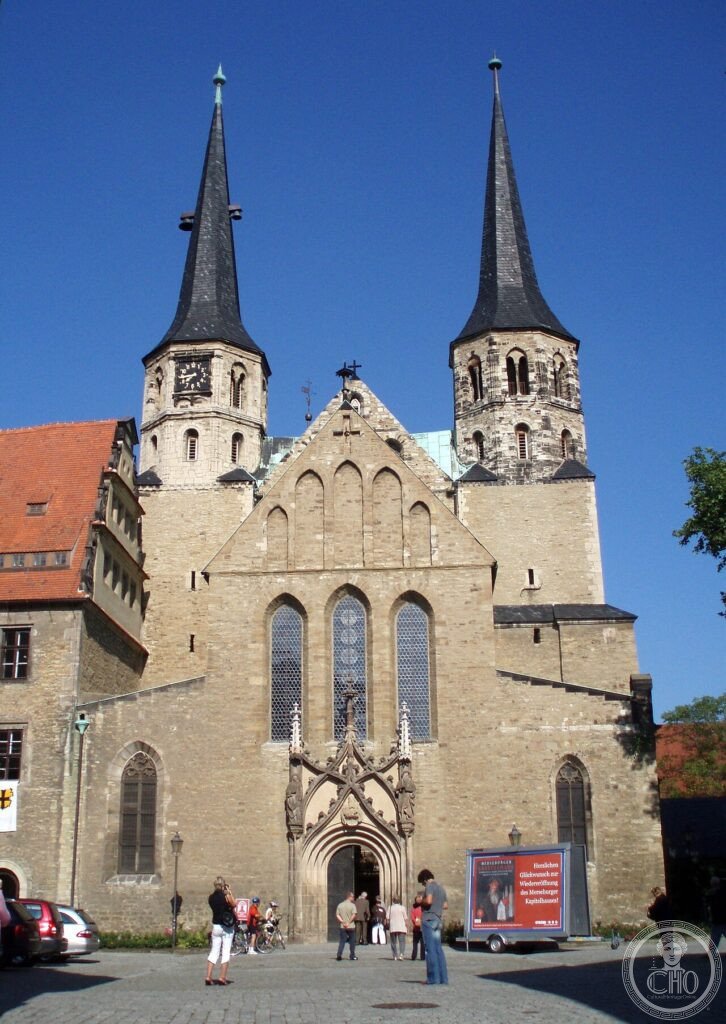
Consecrated in 1021 in the presence of the emperor Henry II, Merseburg Cathedral holds a unique treasure: two charms in Old High German, invoking pagan gods to heal an injured horse and to free a prisoner. Discovered only in 1841, they are the only written testimony of pre-Christian Germanic magic to have reached us.
At a glance
Merseburg Cathedral (Ss. John the Baptist and Lawrence’s Cathedral) was begun by Bishop Thietmar of Merseburg in 1015 and consecrated on 1 October 1021 in the presence of Emperor Henry II and his wife Cunigunde — the only canonised imperial couple in German history, for whom Merseburg was reportedly a favoured residence. The early Romanesque cathedral ranks among the most historically significant cathedral buildings in Germany, but its single most remarkable holding is textual rather than architectural: the Merseburg Incantations (Merseburger Zaubersprüche), the only pagan magic spells to survive in written form anywhere in Germany, recorded by an anonymous monk over a thousand years ago and preserved today in the cathedral’s dedicated “spell vault.” Written in Old High German — the oldest known Old High German text of its kind — the two short incantations invoke pre-Christian Germanic deities directly in specific practical emergencies (freeing a captive, and healing an injured horse’s leg), making them the only surviving spells anywhere involving explicitly non-Christian divine figures from the Germanic tradition. The manuscript containing them was rediscovered only in 1841 by the historian Georg Waitz in the library of the Merseburg Cathedral Chapter, who passed the text to the philologist and folklorist Jakob Grimm — of the Brothers Grimm — for scholarly editing and publication.
Key facts
- Construction: begun 1015 under Bishop Thietmar of Merseburg; consecrated 1 October 1021 in the presence of Emperor Henry II and Empress Cunigunde
- Imperial connection: a favoured residence of Henry II and Cunigunde, the only canonised imperial couple in German history
- Merseburg Incantations: two short Old High German spells, the only surviving pagan magic texts in written German — one invoking pre-Christian deities to free a captive, the other to heal an injured horse
- Rediscovery: found in 1841 by historian Georg Waitz in the Merseburg Cathedral Chapter library; edited and published by Jakob Grimm
- Display: presented in facsimile in the cathedral’s dedicated “Spell Vault” (Zaubersprüche-Gewölbe), with information on their origin, transmission, and translation
- Ladegast organ: housed in its original Baroque case (1693-1717) by Zacharias Thayßner
History
Bishop Thietmar of Merseburg’s early-11th-century cathedral project, consecrated in 1021 with Emperor Henry II himself present, reflects Merseburg’s genuine significance within the Ottonian and early Salian imperial world — a significance the cathedral’s continuing association with Henry II and Cunigunde, the only married couple in German imperial history both formally canonised as saints, only reinforces. The cathedral’s Old High German incantations, however, point to a very different and considerably older layer of the site’s cultural history: while the manuscript itself was physically copied down by a Christian monk, its content — direct invocation of named pre-Christian Germanic deities to resolve specific practical crises — preserves linguistic and religious material that must derive from an oral tradition substantially predating the cathedral, and indeed predating German Christianisation itself, making the incantations a genuinely rare written trace of pre-Christian Germanic religious practice surviving specifically because a medieval scribe, for reasons no longer recoverable, chose to record it rather than let it remain purely oral.
The nearly eight-century gap between the incantations’ original transcription and their 1841 rediscovery in the cathedral chapter library reflects how easily even genuinely unique manuscript material could go unrecognised for centuries within an institutional library before a specific researcher’s systematic examination brought it to modern scholarly attention; Georg Waitz’s decision to hand the material to Jakob Grimm, already established as Germany’s foremost philologist and folklorist through his work compiling German fairy tales and grammar, ensured the incantations received expert linguistic treatment and wide scholarly circulation immediately upon their reintroduction to public knowledge, cementing their status as one of the most important primary sources for understanding pre-Christian Germanic religious vocabulary and belief.
What you see
The cathedral’s early Romanesque architecture, dating substantially to the 1015-1021 building campaign, gives visitors a direct sense of early-11th-century German ecclesiastical building at imperial scale. The dedicated Spell Vault, displaying the Merseburg Incantations in facsimile alongside explanatory material on their origin, transmission, and translation, is the essential single destination for visitors specifically interested in the manuscript’s unique linguistic and religious significance. The Ladegast organ, housed within its original 1693-1717 Baroque case by Zacharias Thayßner, and further interior monuments including the grave slab of the antiking Rudolf of Rheinfelden, add further significant historical layers to the building.
Practical information
- Opening hours: March-October, Monday-Saturday 9:00-18:00, Sundays and religious holidays 11:00-18:00; November-February, Monday-Saturday 10:00-16:00, Sundays and religious holidays 12:00-16:00 (subject to closures for services, concerts, and weddings)
- Guided tours: April-October, Monday-Thursday 11:00 and 13:00, Friday-Saturday additionally 15:00, Sunday 13:00 and 15:00; November-March, reduced schedule
- Address: Domplatz 7, 06217 Merseburg
Getting there
Merseburg has direct rail connections from Leipzig (approximately 30 minutes) and Halle (Saale) (approximately 15 minutes). By car, Merseburg sits just off the A143/A38 motorway network. The cathedral and adjoining Merseburg Castle stand together on Domplatz in the historic centre. GPS: 51.3586° N, 12.0011° E.
Nearby
- Schloss Merseburg — directly adjoining the cathedral; a Renaissance-era castle, former residence of the bishops and later dukes of Merseburg
- Halle (Saale) — approximately 15 minutes by train; birthplace of composer Georg Frideric Handel, with its own significant historic centre
- Leipzig — approximately 30 minutes by train; a major cultural centre associated with Johann Sebastian Bach and Felix Mendelssohn
Sources
- Merseburger Dom — official visitor portal, “The Merseburg Incantations” (merseburger-dom.de/en)
- Transromanica — “Ss. John the Baptist and Lawrence’s Cathedral, Merseburg” (transromanica.com)
- Wikipedia — “Merseburg Cathedral” and “Merseburg Incantations” (en.wikipedia.org)
Find it on the map
See this place and what’s around it →📷 Become a Cultural Heritage Online photographer
Share your photos of places: they stay published under your name as the author. The more they're seen, the more you get noticed — and soon a contest will reward the most appreciated photos.
Log in or sign up free to add a photoIs this page about you?
This page is read by travellers and heritage enthusiasts who find it on Google. Tell us how you are connected to this place and we will take it from there.