
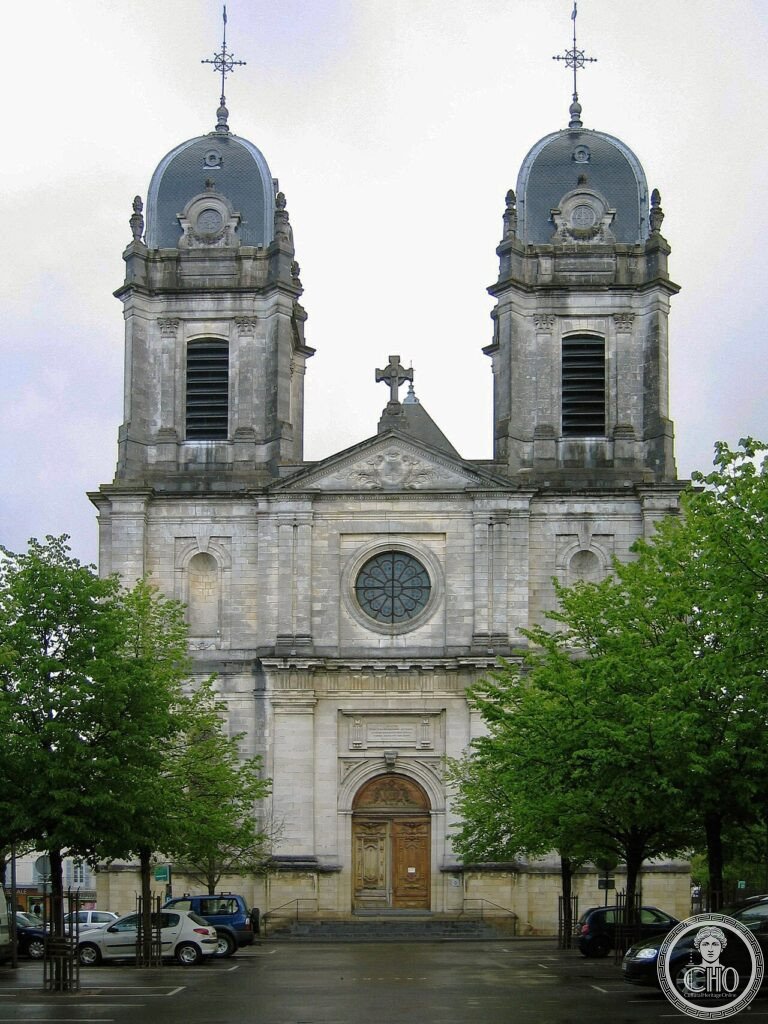
Of the Gothic cathedral built at the end of the thirteenth century, tall and ambitious, almost nothing remains: it collapsed in 1646, and the only thing saved was the splendid Portal of the Apostles, 12 metres high, in the north transept. The rebuilding, to plans perhaps by Vauban himself, took more than two centuries to be truly completed.
At a glance
Dax Cathedral (Cathédrale Notre-Dame) originated at the end of the 13th century, when the bishopric, benefiting from a period of civic prosperity, commissioned a new Gothic cathedral to replace an earlier Romanesque sanctuary that had become too small. That ambitious Gothic building, however, collapsed in 1646, and the only substantial element to survive this catastrophe is the celebrated Portail des Apôtres (Portal of the Apostles), in the north transept arm, listed as a historic monument in 1884: built in the early 14th century, 12 metres high and 8 metres wide, with a sculpted trumeau and a full programme of 14th-century Gothic sculpture of exceptional quality, genuinely rare for surviving work of this kind in southern France. Reconstruction of the cathedral proper extended from 1656 to 1719, following plans reportedly prepared by the military engineer Vauban, in a classical style reflecting the architectural taste of the period rather than any attempt to replicate the lost Gothic building — yet the project was not considered fully complete until 1894, well over two centuries after the medieval collapse that had made rebuilding necessary in the first place.
Key facts
- Gothic origins: late 13th century, replacing an earlier Romanesque sanctuary that had become too small during a period of civic prosperity
- 1646 collapse: the Gothic cathedral collapsed, leaving only the Portail des Apôtres standing from that period
- Portail des Apôtres: early 14th century, 12 metres high, 8 metres wide, with a sculpted trumeau; classified historic monument 1884 — an exceptional and rare survival of Gothic sculpture in southern France
- Reconstruction: 1656-1719, classical style, plans reportedly by the military engineer Vauban; the building was not considered fully complete until 1894
- Nearby Fontaine Chaude: in Dax’s historic centre, on the presumed site of former Roman baths, naturally hot spring water emerging at approximately 64°C
History
Dax’s late-13th-century decision to build an ambitious new Gothic cathedral reflected a period of genuine civic and ecclesiastical prosperity, and the resulting building’s eventual 1646 collapse — a dramatic structural failure rather than destruction by war or religious conflict — represents a less commonly documented category of French cathedral loss, closer to the kind of engineering failure recorded at a handful of other major medieval buildings whose ambitious vaulting or structural design eventually proved unsustainable across the centuries. That only the Portail des Apôtres survived this collapse, rather than the building’s main structural fabric, suggests the portal’s construction, sited in the north transept rather than forming part of the primary load-bearing structure that ultimately failed, was simply more structurally isolated from whatever specific weakness caused the main collapse — a pattern of partial survival documented at other collapsed medieval structures where secondary or peripheral elements sometimes outlast the primary structural failure that destroys a building’s main volume.
The attribution of the reconstruction plans to Vauban, France’s most celebrated military engineer of the Grand Siècle period, best known for his extensive network of fortifications across French frontier towns, would represent an unusual but not unprecedented application of his engineering expertise to ecclesiastical rather than military architecture. It is not clear whether the attribution reflects Vauban’s direct personal involvement or a more indirect influence transmitted through engineers trained in his broader methodological tradition. Either way, the reconstruction’s remarkably long completion timeline — from 1656 through to a full 1894 completion, spanning well over two centuries — illustrates how thoroughly major French ecclesiastical building projects could span multiple political regimes, from the reign of Louis XIV through the French Revolution and into the Third Republic, before reaching genuine final completion.
What you see
The Portail des Apôtres remains the cathedral’s single most significant surviving artwork, its 12-metre height and full programme of 14th-century Gothic sculpture — centred on a carved trumeau — offering visitors direct access to genuine medieval sculptural work otherwise lost when the main Gothic structure collapsed in 1646. The classical-style reconstruction, completed across the 17th to 19th centuries, presents a markedly different architectural character from the lost Gothic building, reflecting the specific tastes and engineering priorities of its much later builders. The nearby Fontaine Chaude, though not part of the cathedral itself, offers visitors a direct physical connection to Dax’s much older Roman-era thermal history, on the presumed site of the city’s ancient baths.
Practical information
- Opening hours: generally open daily, check current hours before visiting; free admission
- Address: Place Roger Ducos, 40100 Dax
Getting there
Dax has direct rail connections from Paris (via Bordeaux, approximately 4 hours total) and Bayonne (approximately 20-30 minutes). By car, Dax sits on the A63 motorway. The cathedral stands in the historic centre, near the Fontaine Chaude. GPS: 43.7084° N, -1.0530° E.
Nearby
- Fontaine Chaude, Dax — in the historic centre, a short walk from the cathedral; naturally hot spring water at approximately 64°C, on the presumed site of Roman-era baths
- Dax historic centre and thermal spa tradition — surrounding the cathedral; Dax remains one of France’s most significant thermal spa towns
- Bayonne — approximately 20-30 minutes by train; a historic Basque-influenced port city, itself home to Bayonne Cathedral
Sources
- Cœur Thermal — “L’histoire de Dax” (coeurthermal.com)
- Ministère de la Culture — heritage listing, Base Mérimée (culture.gouv.fr)
- Le Splendid Hôtel & Spa, Dax — visitor guide, “Un trésor architectural gothique” (splendid-hotel-spa.com)
- Wikipedia — “Cathédrale Notre-Dame de Dax” (fr.wikipedia.org)
Find it on the map
See this place and what’s around it →📷 Become a Cultural Heritage Online photographer
Share your photos of places: they stay published under your name as the author. The more they're seen, the more you get noticed — and soon a contest will reward the most appreciated photos.
Log in or sign up free to add a photoIs this page about you?
This page is read by travellers and heritage enthusiasts who find it on Google. Tell us how you are connected to this place and we will take it from there.